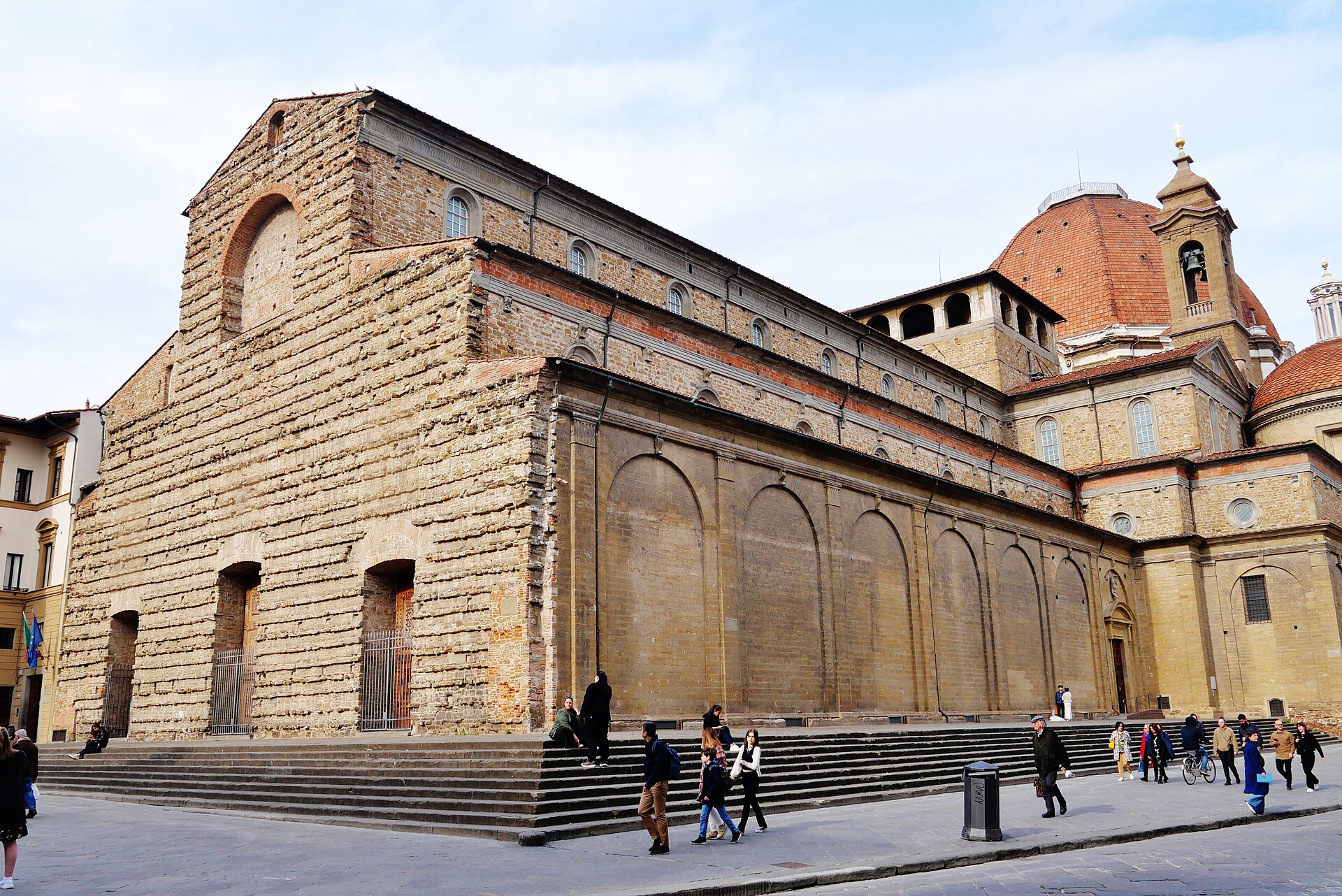
The Basilica di San Lorenzo is one of the oldest churches in Florence, Italy, situated at the center of the city's main market district. While the original church was consecrated in 393 CE, the current structure was largely rebuilt during the 15th century under the patronage of the Medici family, who utilized the basilica as their primary parish church and burial site.
The architecture represents a pivotal moment in the transition to Renaissance design, featuring the work of Filippo Brunelleschi, who designed the Old Sacristy and the nave. The complex includes the Laurentian Library, designed by Michelangelo, and the Medici Chapels, which serve as the final resting place for many members of the Medici dynasty.
Key Facts
- Materials
- Pietra serena, White marble, Brick
- Civilization
- Italian Renaissance
- Accessibility
- Wheelchair accessible via side entrance
- Date(s)
- 1419–1480s
- Condition
- Active church and museum
- Original Function
- Parish church
- Key Figures
- Filippo Brunelleschi, Michelangelo Buonarroti, Cosimo de' Medici, Donatello
Early Foundations
4th century CEThe original basilica was consecrated by Saint Ambrose of Milan in 393 CE. It served as the city's cathedral before the seat of the bishop was moved to Santa Reparata.
Renaissance Reconstruction
15th centuryGiovanni di Bicci de' Medici commissioned Filippo Brunelleschi to rebuild the church in 1419. The project became a family endeavor, with Cosimo de' Medici continuing the work after his father's death.
Michelangelo's Contributions
16th centuryIn the 1520s, Pope Clement VII commissioned Michelangelo to design the New Sacristy and the Laurentian Library, adding significant Mannerist elements to the complex.
Completion of the Medici Chapels
17th centuryThe Cappella dei Principi (Chapel of the Princes) was constructed to house the tombs of the Grand Dukes of Tuscany, featuring elaborate marble and semi-precious stone inlay.
Cultural Significance
The Basilica di San Lorenzo is inextricably linked to the rise of the Medici family, serving as a physical manifestation of their political and cultural dominance in Florence. It stands as a laboratory of Renaissance architectural theory, where the application of mathematical proportion and classical geometry redefined European church design.
Beyond its architectural importance, the site is a repository of artistic heritage, housing works by Donatello, Verrocchio, and Michelangelo. It remains a focal point for the study of the transition from medieval traditions to the humanistic ideals of the Renaissance.
Interpretive Notes
Scholarly debates and areas of uncertainty
There is ongoing academic discussion regarding the extent to which the current facade reflects Brunelleschi's original intentions, as the exterior remains unfinished despite Michelangelo's designs for a marble cladding. Additionally, the attribution of specific architectural details in the Laurentian Library continues to be a subject of analysis among Renaissance scholars.
Visiting Information
Entry Rules
Open to the public daily. Tickets are required for the museum areas, including the Medici Chapels and the Laurentian Library. Modest dress is required as it is a consecrated religious site.
Best Times to Visit
Early morning or late afternoon to avoid peak tourist crowds. Weekdays are generally quieter than weekends.
Photography
Photography is permitted for personal use without flash. Tripods and professional equipment require prior authorization.
Preservation Notes
The interior features delicate frescoes and stone carvings; visitors are requested to refrain from touching surfaces. Restoration work is periodic and may affect access to specific chapels.
Nearby POIs
11 shown- Palazzo Medici Riccardi0.1 km
- Battistero di San Giovanni0.2 km
- Duomo di Firenze0.3 km
- Museo dell'Opera del Duomo0.4 km
- Basilica di Santa Maria Novella0.4 km
- Galleria dell'Accademia di Firenze0.4 km
- Palazzo Strozzi0.4 km
- Museo Marino Marini0.5 km
- Museo Nazionale di San Marco0.6 km
- Museo Nazionale del Bargello0.6 km
- Palazzo Vecchio0.7 km
Sources & Further Reading
- [1]Brunelleschi's Basilica of San Lorenzo — Howard Saalman. University of California Press (1993)
- [2]The Medici Chapels — Edith Balas. Garland Publishing (1973)
Key Facts
- Materials
- Pietra serena, White marble, Brick
- Civilization
- Italian Renaissance
- Accessibility
- Wheelchair accessible via side entrance
- Date(s)
- 1419–1480s
- Condition
- Active church and museum
- Original Function
- Parish church
- Key Figures
- Filippo Brunelleschi, Michelangelo Buonarroti, Cosimo de' Medici, Donatello
Nearby POIs
11 shown- Palazzo Medici Riccardi0.1 km
- Battistero di San Giovanni0.2 km
- Duomo di Firenze0.3 km
- Museo dell'Opera del Duomo0.4 km
- Basilica di Santa Maria Novella0.4 km
- Galleria dell'Accademia di Firenze0.4 km
- Palazzo Strozzi0.4 km
- Museo Marino Marini0.5 km
- Museo Nazionale di San Marco0.6 km
- Museo Nazionale del Bargello0.6 km
- Palazzo Vecchio0.7 km