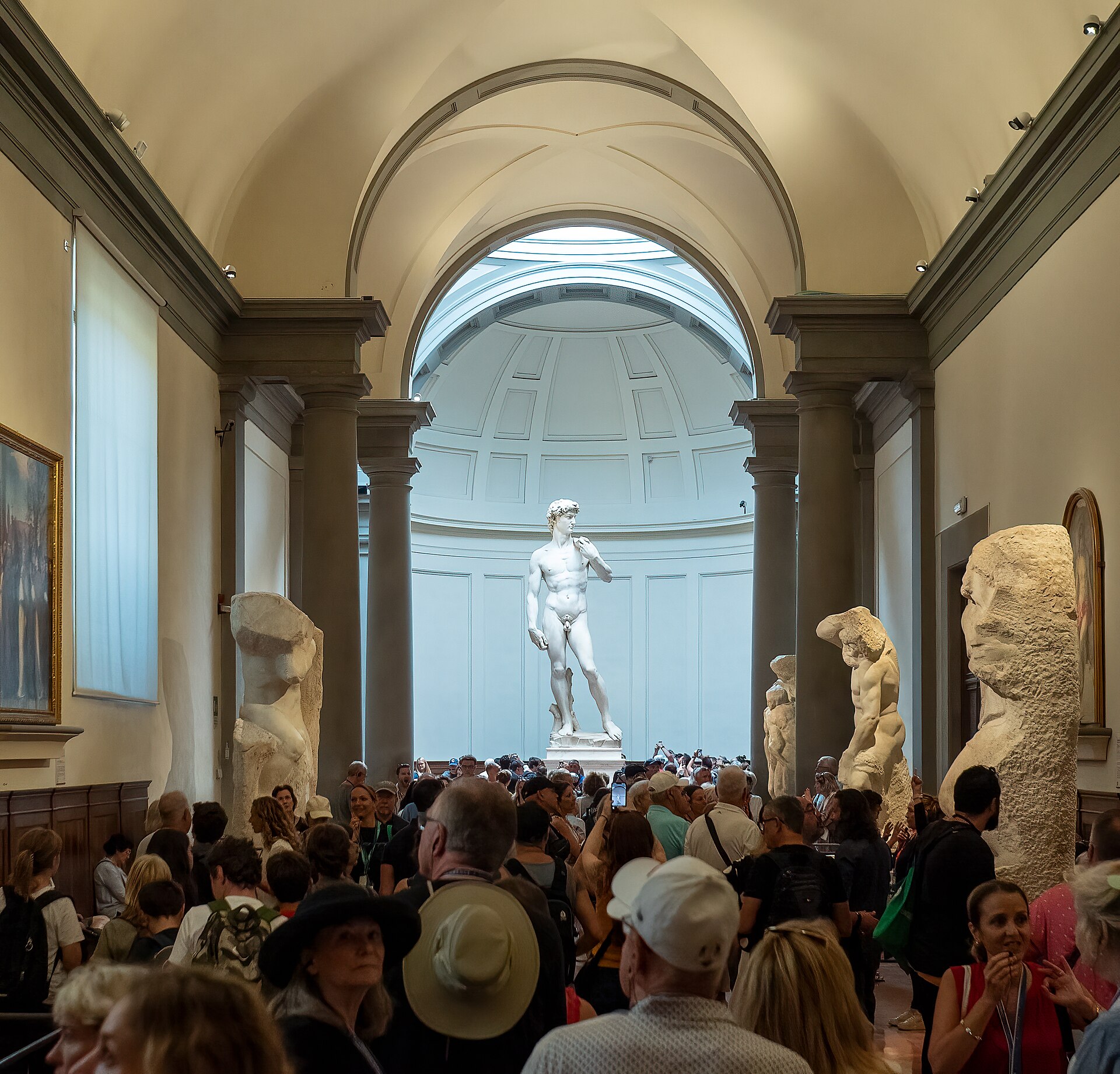
The Galleria dell'Accademia di Firenze is a world-renowned art museum located in the heart of Florence. Originally established in 1784 by Grand Duke Peter Leopold of Tuscany as a teaching collection for students of the Academy of Fine Arts, the museum was intended to provide pupils with access to masterworks for study and inspiration.
Today, the gallery is most famous for housing Michelangelo's David, which was moved to the purpose-built Tribune in 1873 to protect it from environmental damage. Beyond this iconic sculpture, the museum holds an extensive collection of Florentine paintings from the 13th to the 16th centuries, as well as Michelangelo's unfinished 'Prisoners' (Slaves) and a significant collection of historical musical instruments.
Key Facts
- Materials
- Stone, Brick, Marble
- Civilization
- Italian
- Accessibility
- Fully wheelchair accessible
- Date(s)
- 1784
- Condition
- Well-preserved, active museum
- Original Function
- Teaching collection for the Academy of Fine Arts
- Key Figures
- Michelangelo Buonarroti, Peter Leopold of Tuscany
Foundation as an Educational Institution
1784Grand Duke Peter Leopold reorganized the various art schools of Florence into the Accademia di Belle Arti. The gallery was created as a teaching collection, housing plaster casts and masterworks for students to study.
Arrival of the David
1873Michelangelo's David was moved from the Piazza della Signoria to the Accademia. Architect Emilio De Fabris designed the 'Tribune' specifically to house the statue, providing it with a skylight to illuminate the marble.
Expansion and Modernization
20th CenturyThe museum expanded its holdings significantly, incorporating the Gipsoteca Bartolini and a collection of musical instruments from the Cherubini Conservatory, solidifying its status as a major cultural institution.
Cultural Significance
The Galleria dell'Accademia serves as a primary site for the study of Florentine Renaissance art. Its role in preserving Michelangelo's works has made it a central pillar of Italian cultural heritage and a primary destination for art historians and tourists alike.
The museum's evolution from a private academic collection to a public institution reflects the broader history of art conservation and the democratization of culture in Italy. It remains a focal point for debates regarding the management of high-traffic heritage sites.
Interpretive Notes
Scholarly debates and areas of uncertainty
There is ongoing academic discussion regarding the long-term conservation of the David, particularly concerning the structural integrity of the marble ankles, which have shown signs of micro-fractures due to the statue's historical tilt and the vibrations of the city.
Visiting Information
Entry Rules
Timed entry tickets are highly recommended due to high demand. Visitors must pass through security screening. Large bags and backpacks are not permitted inside the galleries.
Best Times to Visit
Early morning or late afternoon on weekdays to avoid peak tourist crowds. The museum is closed on Mondays.
Photography
Personal photography is permitted without flash or tripods. Professional photography requires prior authorization.
Preservation Notes
Do not touch any sculptures or paintings. Maintain a respectful distance from the artworks to avoid triggering proximity sensors.
Nearby POIs
11 shown- Museo Nazionale di San Marco0.2 km
- Palazzo Medici Riccardi0.3 km
- Museo dell'Opera del Duomo0.4 km
- Basilica di San Lorenzo0.4 km
- Duomo di Firenze0.5 km
- Battistero di San Giovanni0.5 km
- Museo Nazionale del Bargello0.7 km
- Basilica di Santa Maria Novella0.8 km
- Palazzo Strozzi0.8 km
- Palazzo Vecchio0.9 km
- Museo Marino Marini0.9 km
Sources & Further Reading
- [1]
- [2]Michelangelo's David: A Masterpiece Restored — Francine Giese. Art History Journal (2015)
Key Facts
- Materials
- Stone, Brick, Marble
- Civilization
- Italian
- Accessibility
- Fully wheelchair accessible
- Date(s)
- 1784
- Condition
- Well-preserved, active museum
- Original Function
- Teaching collection for the Academy of Fine Arts
- Key Figures
- Michelangelo Buonarroti, Peter Leopold of Tuscany
Nearby POIs
11 shown- Museo Nazionale di San Marco0.2 km
- Palazzo Medici Riccardi0.3 km
- Museo dell'Opera del Duomo0.4 km
- Basilica di San Lorenzo0.4 km
- Duomo di Firenze0.5 km
- Battistero di San Giovanni0.5 km
- Museo Nazionale del Bargello0.7 km
- Basilica di Santa Maria Novella0.8 km
- Palazzo Strozzi0.8 km
- Palazzo Vecchio0.9 km
- Museo Marino Marini0.9 km