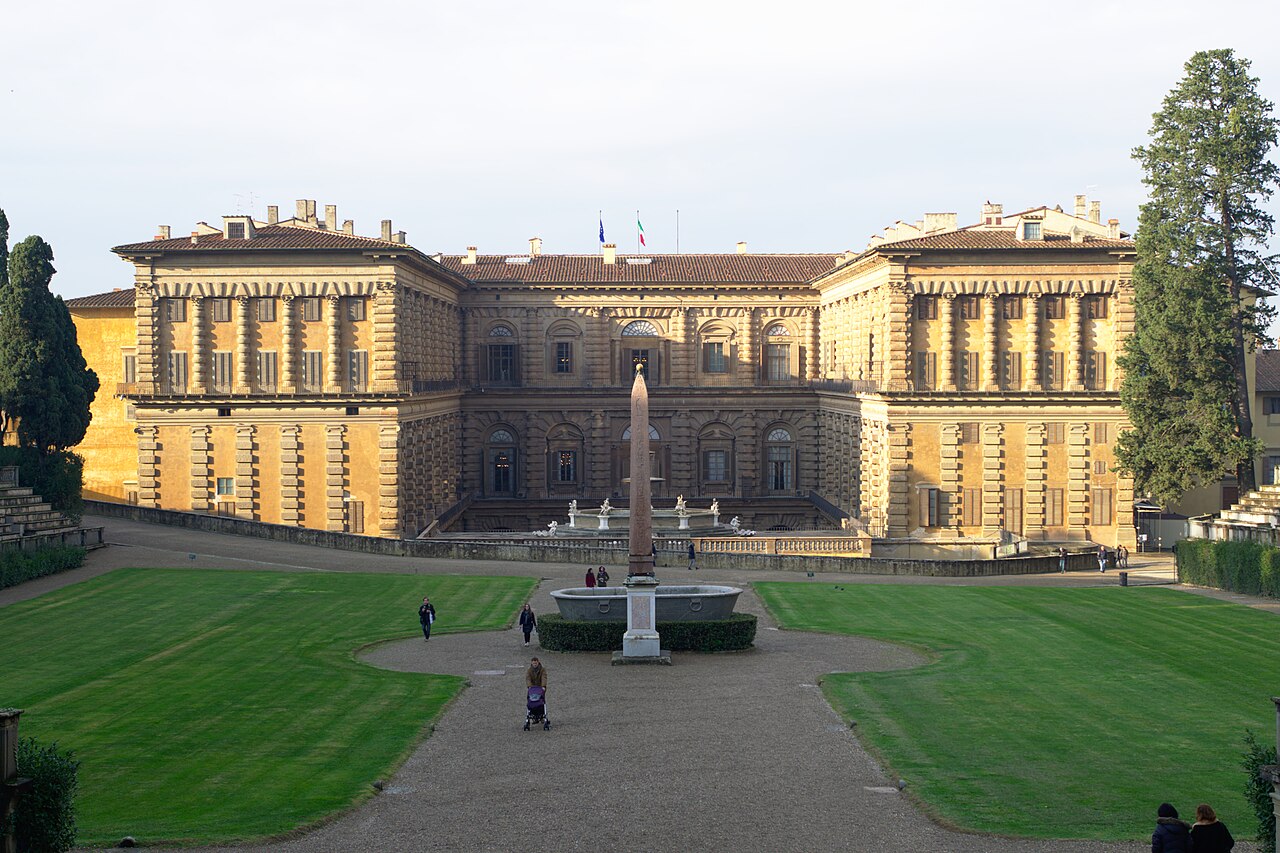
The Palazzo Pitti is a vast, semi-circular Renaissance palace situated on the south side of the River Arno in Florence. Originally commissioned in 1458 by the banker Luca Pitti, the structure was later purchased by the Medici family in 1549, who transformed it into their primary residence and the administrative center of the Grand Duchy of Tuscany.
The palace complex serves as the largest museum entity in Florence, housing several distinct galleries including the Palatine Gallery, the Royal Apartments, the Gallery of Modern Art, and the Treasury of the Grand Dukes. Its architecture, characterized by its imposing rusticated stone facade, reflects the transition from the austere early Renaissance style to the more expansive Mannerist and Baroque additions commissioned by successive generations of the Medici and later the House of Lorraine.
Key Facts
- Materials
- Pietra forte sandstone, Brick
- Civilization
- Italian
- Accessibility
- Partially accessible; elevator access to main galleries
- Date(s)
- 1458 - 17th century
- Condition
- Well-preserved, active museum complex
- Original Function
- Private residence
- Key Figures
- Luca Pitti, Cosimo I de' Medici, Eleonora di Toledo, Bartolomeo Ammannati
Origins and Medici Acquisition
1458-1549The palace was commissioned by Luca Pitti, a wealthy Florentine banker, reportedly to rival the Medici family's own residence. Following the decline of the Pitti family's fortunes, the unfinished building was purchased by Eleonora di Toledo, wife of Cosimo I de' Medici, who sought a more spacious residence for the ducal family.
Expansion and Mannerist Influence
1550-1600Under the direction of architect Bartolomeo Ammannati, the palace underwent significant expansion. The courtyard was added, and the structure was integrated into the Boboli Gardens, creating a unified landscape and architectural ensemble that defined the Medici court's power.
Baroque Additions and Royal Use
17th-18th centuryThe palace was further extended with the addition of the lateral wings, known as the 'rondò', which gave the facade its current expansive appearance. During the 18th century, the palace served as the residence for the House of Lorraine, who succeeded the Medici as rulers of Tuscany.
Modern Museum Complex
1919-presentIn 1919, King Victor Emmanuel III donated the palace to the Italian state. It was subsequently opened to the public as a museum complex, housing the extensive art collections previously held by the ruling dynasties of Florence.
Cultural Significance
The Palazzo Pitti stands as a testament to the political and cultural hegemony of the Medici family. It represents the evolution of the Italian palace from a fortified urban residence to a center of artistic patronage and administrative power. The integration of the palace with the Boboli Gardens established a model for royal landscape design that influenced European court architecture for centuries.
Today, the site is central to the cultural identity of Florence, preserving not only the artistic legacy of the Renaissance but also the material history of the Tuscan state. It remains a focal point for international art historical research and public engagement with the history of the Italian nobility.
Interpretive Notes
Scholarly debates and areas of uncertainty
The original design of the palace remains a subject of debate among architectural historians. While traditionally attributed to Filippo Brunelleschi, many scholars argue that the design was likely the work of his pupil, Luca Fancelli, noting that the building's proportions and rustication techniques deviate from Brunelleschi's known stylistic patterns.
Visiting Information
Entry Rules
Open Tuesday through Sunday. Tickets are required for entry to the various galleries and the Boboli Gardens. Visitors are subject to security screening. Large bags and backpacks must be left in the cloakroom.
Best Times to Visit
Early morning or late afternoon on weekdays to avoid peak tourist crowds. Spring and autumn are ideal for visiting the adjacent Boboli Gardens.
Photography
Personal photography is permitted without flash or tripods. Professional photography requires prior authorization from the museum administration.
Preservation Notes
The palace is subject to ongoing conservation efforts. Visitors are requested to refrain from touching the artworks or wall coverings. Some rooms may be closed periodically for maintenance or restoration.
Nearby POIs
11 shown- Forte di Belvedere0.4 km
- Galleria degli Uffizi0.6 km
- Palazzo Vecchio0.7 km
- Palazzo Strozzi0.7 km
- Museo Marino Marini0.7 km
- Museo Nazionale del Bargello0.9 km
- Battistero di San Giovanni1 km
- Duomo di Firenze1 km
- Basilica di Santa Maria Novella1.1 km
- Basilica di Santa Croce1.1 km
- Museo dell'Opera del Duomo1.1 km
Sources & Further Reading
- [1]The Palazzo Pitti: A History of the Medici Residence — Janet Cox-Rearick. Harry N. Abrams (1993)
- [2]Florence: The City and its Architecture — Richard Goldthwaite. Yale University Press (2011)
Key Facts
- Materials
- Pietra forte sandstone, Brick
- Civilization
- Italian
- Accessibility
- Partially accessible; elevator access to main galleries
- Date(s)
- 1458 - 17th century
- Condition
- Well-preserved, active museum complex
- Original Function
- Private residence
- Key Figures
- Luca Pitti, Cosimo I de' Medici, Eleonora di Toledo, Bartolomeo Ammannati
Nearby POIs
11 shown- Forte di Belvedere0.4 km
- Galleria degli Uffizi0.6 km
- Palazzo Vecchio0.7 km
- Palazzo Strozzi0.7 km
- Museo Marino Marini0.7 km
- Museo Nazionale del Bargello0.9 km
- Battistero di San Giovanni1 km
- Duomo di Firenze1 km
- Basilica di Santa Maria Novella1.1 km
- Basilica di Santa Croce1.1 km
- Museo dell'Opera del Duomo1.1 km