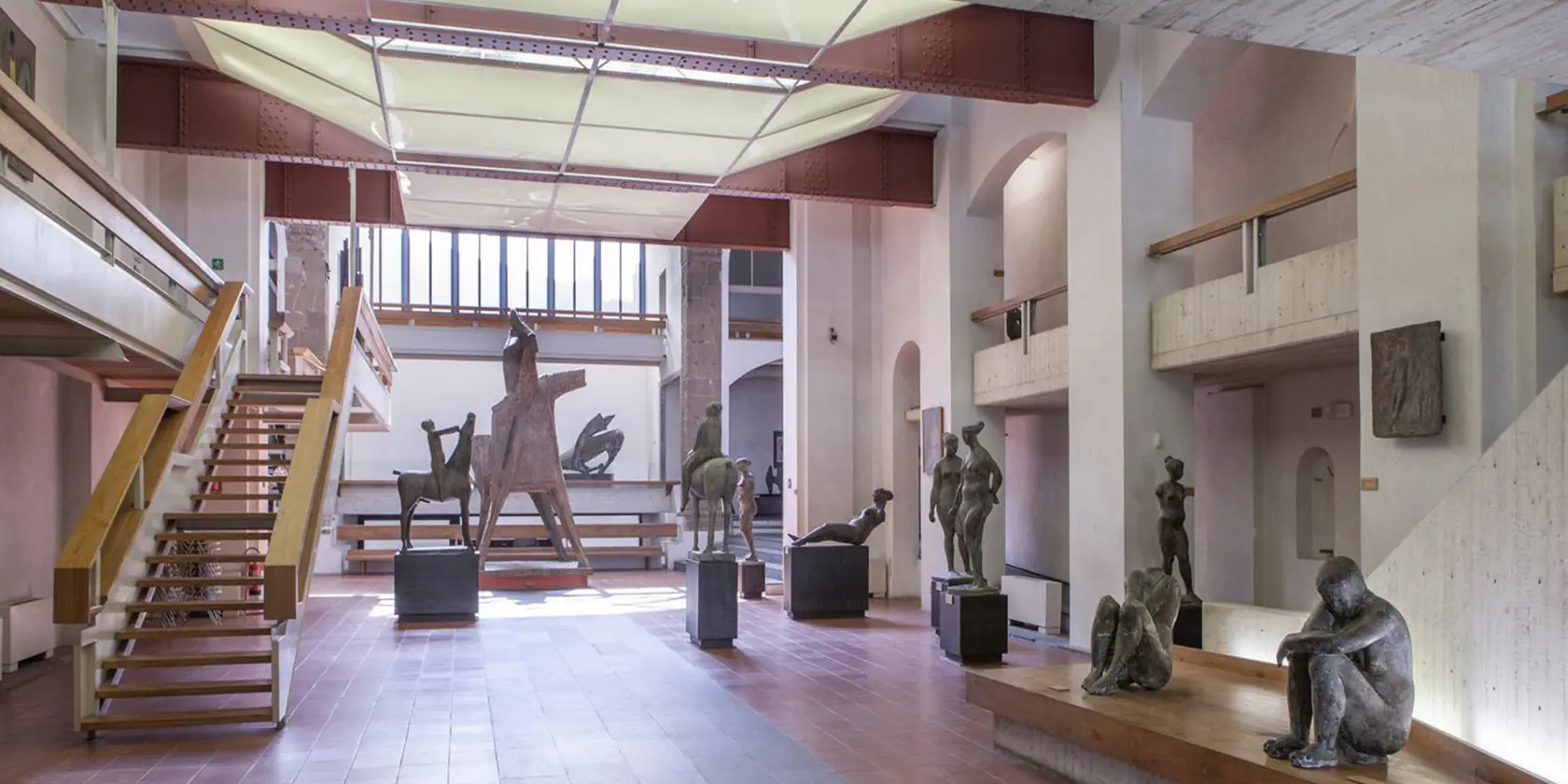
The Museo Marino Marini is located within the deconsecrated church of San Pancrazio in the heart of Florence. The museum houses a significant collection of works by the Italian sculptor Marino Marini, featuring over 180 pieces including sculptures, paintings, and drawings that span the artist's entire career.
The museum is notable for its architectural integration, where contemporary exhibition design by architects Lorenzo Papi and Bruno Sacchi interacts with the historic fabric of the 9th-century church. The space preserves the Rucellai Chapel, which contains Leon Battista Alberti's Tempietto del Santo Sepolcro, a masterpiece of Renaissance architecture.
Key Facts
- Materials
- Stone, Bronze, Wood, Plaster
- Civilization
- Italian
- Accessibility
- Wheelchair accessible
- Date(s)
- 9th century (Church), 1988 (Museum)
- Condition
- Restored and active as a museum
- Original Function
- Church of San Pancrazio
- Key Figures
- Marino Marini, Leon Battista Alberti, Giovanni Rucellai
Origins of San Pancrazio
9th centuryThe church of San Pancrazio was founded in the 9th century and served as a significant religious site in Florence. It underwent various modifications over the centuries, most notably in the 15th century when Leon Battista Alberti designed the Rucellai Chapel and the Tempietto del Santo Sepolcro for the Rucellai family.
Deconsecration and Abandonment
18th-20th centuryFollowing the Napoleonic suppressions in the early 19th century, the church was deconsecrated and repurposed for various secular uses, including a tobacco factory and a courthouse, leading to a period of architectural neglect.
Transformation into a Museum
1980sIn the 1980s, the city of Florence initiated a major restoration project to convert the structure into a museum dedicated to Marino Marini. The project successfully preserved the historic architectural elements while creating a modern environment for the display of Marini's sculptures.
Cultural Significance
The museum represents a unique dialogue between historical religious architecture and 20th-century figurative art. By housing Marini's work—often characterized by themes of horsemen and human fragility—within a space that contains Alberti's Renaissance geometry, the museum highlights the continuity and evolution of Italian artistic tradition.
It serves as a vital cultural hub in Florence, providing a counterpoint to the city's predominantly Renaissance-focused tourism by showcasing modern sculptural mastery in a historic setting.
Interpretive Notes
Scholarly debates and areas of uncertainty
There is ongoing academic discussion regarding the appropriateness of housing modern, secular sculpture within a space that retains significant religious architectural features, specifically the Tempietto del Santo Sepolcro. Critics and scholars debate whether the museum design successfully balances the preservation of the sacred space with the requirements of a contemporary art gallery.
Visiting Information
Entry Rules
Open Wednesday to Monday. Tickets can be purchased at the entrance. Visitors are requested to refrain from touching the sculptures.
Best Times to Visit
Weekday mornings are generally quieter, allowing for a more contemplative experience of the space.
Photography
Personal photography is permitted for non-commercial use without the use of flash or tripods.
Preservation Notes
The museum maintains strict climate control to protect the bronze and plaster works. Visitors are asked to remain on designated paths to protect the historic flooring.
Nearby POIs
11 shown- Palazzo Strozzi0.2 km
- Basilica di Santa Maria Novella0.3 km
- Battistero di San Giovanni0.4 km
- Basilica di San Lorenzo0.5 km
- Duomo di Firenze0.5 km
- Palazzo Vecchio0.6 km
- Palazzo Medici Riccardi0.6 km
- Galleria degli Uffizi0.6 km
- Museo dell'Opera del Duomo0.7 km
- Museo Nazionale del Bargello0.7 km
- Palazzo Pitti0.7 km
Sources & Further Reading
- [1]Museo Marino Marini: The Collection — Fondazione Marino Marini. Museo Marino Marini Official Press (2020)View
- [2]Leon Battista Alberti and the Rucellai Chapel — Franco Borsi. Electa (1990)
Key Facts
- Materials
- Stone, Bronze, Wood, Plaster
- Civilization
- Italian
- Accessibility
- Wheelchair accessible
- Date(s)
- 9th century (Church), 1988 (Museum)
- Condition
- Restored and active as a museum
- Original Function
- Church of San Pancrazio
- Key Figures
- Marino Marini, Leon Battista Alberti, Giovanni Rucellai
Nearby POIs
11 shown- Palazzo Strozzi0.2 km
- Basilica di Santa Maria Novella0.3 km
- Battistero di San Giovanni0.4 km
- Basilica di San Lorenzo0.5 km
- Duomo di Firenze0.5 km
- Palazzo Vecchio0.6 km
- Palazzo Medici Riccardi0.6 km
- Galleria degli Uffizi0.6 km
- Museo dell'Opera del Duomo0.7 km
- Museo Nazionale del Bargello0.7 km
- Palazzo Pitti0.7 km