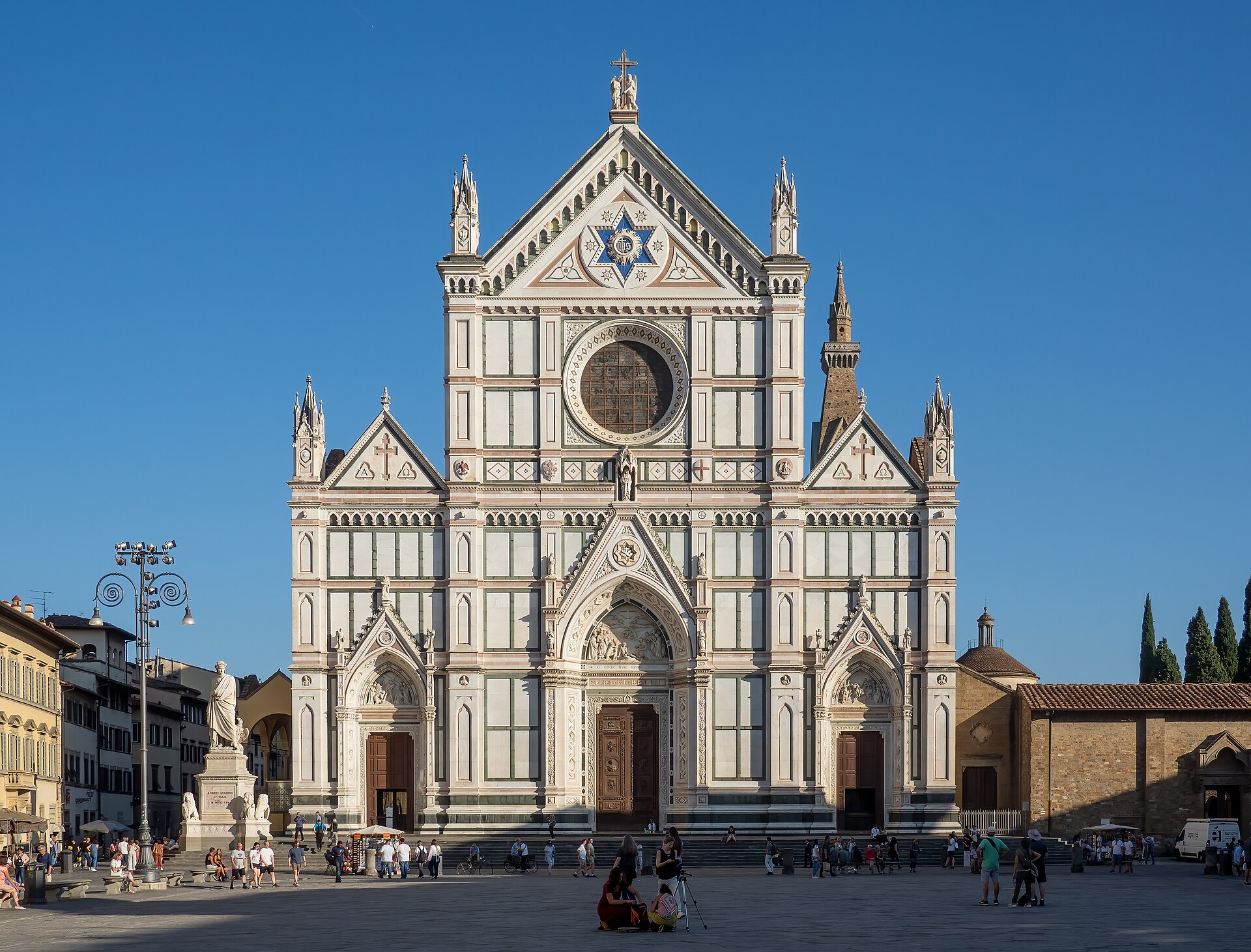
The Basilica di Santa Croce is the principal Franciscan church in Florence, Italy, and a monumental example of Italian Gothic architecture. Situated on the Piazza di Santa Croce, it serves as the final resting place for some of the most illustrious figures in Italian history, including Michelangelo, Galileo Galilei, Niccolò Machiavelli, and Gioachino Rossini, earning it the moniker 'Temple of the Italian Glories.'
The interior is renowned for its sixteen chapels, many of which contain significant frescoes by Giotto and his pupils, depicting scenes from the life of Saint Francis. The basilica's architectural layout, characterized by its vast nave and wooden truss roof, reflects the Franciscan emphasis on simplicity and preaching, while its facade, completed in the 19th century in a neo-Gothic style, provides a striking visual anchor to the city's historic center.
Key Facts
- Materials
- Brick, Marble, Pietra serena
- Civilization
- Italian
- Accessibility
- Wheelchair accessible via side entrance
- Date(s)
- 1294–1385
- Condition
- Active basilica and museum
- Original Function
- Franciscan Church
- Key Figures
- Giotto, Michelangelo, Galileo Galilei, Niccolò Machiavelli, Donatello
Founding and Construction
1294–1385Construction of the current basilica began in 1294, likely designed by Arnolfo di Cambio, on the site of an earlier 13th-century church. It was built to accommodate the growing Franciscan community in Florence and was consecrated in 1443 by Pope Eugenius IV.
Artistic Flourishing
14th–15th centuryDuring the 14th century, the church became a major center for art, with wealthy Florentine families commissioning chapels decorated by masters such as Giotto, Taddeo Gaddi, and Agnolo Gaddi. Donatello also contributed significant works, including the gilded bronze relief of the Annunciation.
The Temple of Italian Glories
16th–19th centuryOver the centuries, the basilica became the preferred burial site for the Florentine elite and national heroes. The addition of monumental tombs for figures like Michelangelo and Galileo solidified its status as a national pantheon, a role formally recognized during the Risorgimento.
Modern Restoration
1966–presentThe basilica suffered catastrophic damage during the 1966 Arno River flood, which destroyed numerous artworks, including Cimabue's Crucifix. Extensive restoration efforts have since been undertaken to preserve the frescoes and structural integrity of the complex.
Cultural Significance
Santa Croce is deeply embedded in the cultural identity of Italy, representing the intersection of religious devotion and secular intellectual achievement. It serves as a physical archive of the Italian Renaissance, housing works that defined the trajectory of Western art history. The presence of the tombs of Italy's greatest thinkers and artists transforms the space from a place of worship into a site of national pilgrimage and reflection on the Italian contribution to global culture.
Interpretive Notes
Scholarly debates and areas of uncertainty
There is ongoing academic discussion regarding the original design of the facade, which remained unfinished for centuries. Scholars debate the extent to which the 19th-century neo-Gothic facade by Niccolò Matas accurately reflects the original medieval intentions or if it represents a romanticized interpretation of the Gothic style.
Visiting Information
Entry Rules
Open daily for visitors. Tickets are required for entry to the basilica and the museum complex. Modest dress is required (shoulders and knees must be covered).
Best Times to Visit
Early morning or late afternoon to avoid peak tourist crowds. Weekdays are generally quieter than weekends.
Photography
Personal photography is permitted without flash or tripods. Professional photography requires prior authorization.
Preservation Notes
The site is highly sensitive to humidity and light. Visitors are requested to remain on marked paths and refrain from touching any artwork or tomb surfaces.
Nearby POIs
11 shown- Museo Nazionale del Bargello0.5 km
- Palazzo Vecchio0.6 km
- Galleria degli Uffizi0.6 km
- Museo dell'Opera del Duomo0.7 km
- Duomo di Firenze0.7 km
- Battistero di San Giovanni0.8 km
- Forte di Belvedere1 km
- Palazzo Medici Riccardi1 km
- Palazzo Strozzi1 km
- Galleria dell'Accademia di Firenze1 km
- Basilica di San Lorenzo1 km
Sources & Further Reading
- [1]Santa Croce in Florence: A Guide to the Basilica and the Cloisters — Pietro Ruschi. Opera di Santa Croce (2015)View
- [2]Giotto and the St. Francis Chapels — Andrew Ladis. Cambridge University Press (2008)
Key Facts
- Materials
- Brick, Marble, Pietra serena
- Civilization
- Italian
- Accessibility
- Wheelchair accessible via side entrance
- Date(s)
- 1294–1385
- Condition
- Active basilica and museum
- Original Function
- Franciscan Church
- Key Figures
- Giotto, Michelangelo, Galileo Galilei, Niccolò Machiavelli, Donatello
Nearby POIs
11 shown- Museo Nazionale del Bargello0.5 km
- Palazzo Vecchio0.6 km
- Galleria degli Uffizi0.6 km
- Museo dell'Opera del Duomo0.7 km
- Duomo di Firenze0.7 km
- Battistero di San Giovanni0.8 km
- Forte di Belvedere1 km
- Palazzo Medici Riccardi1 km
- Palazzo Strozzi1 km
- Galleria dell'Accademia di Firenze1 km
- Basilica di San Lorenzo1 km