New York City,United States of America
Statue of Liberty
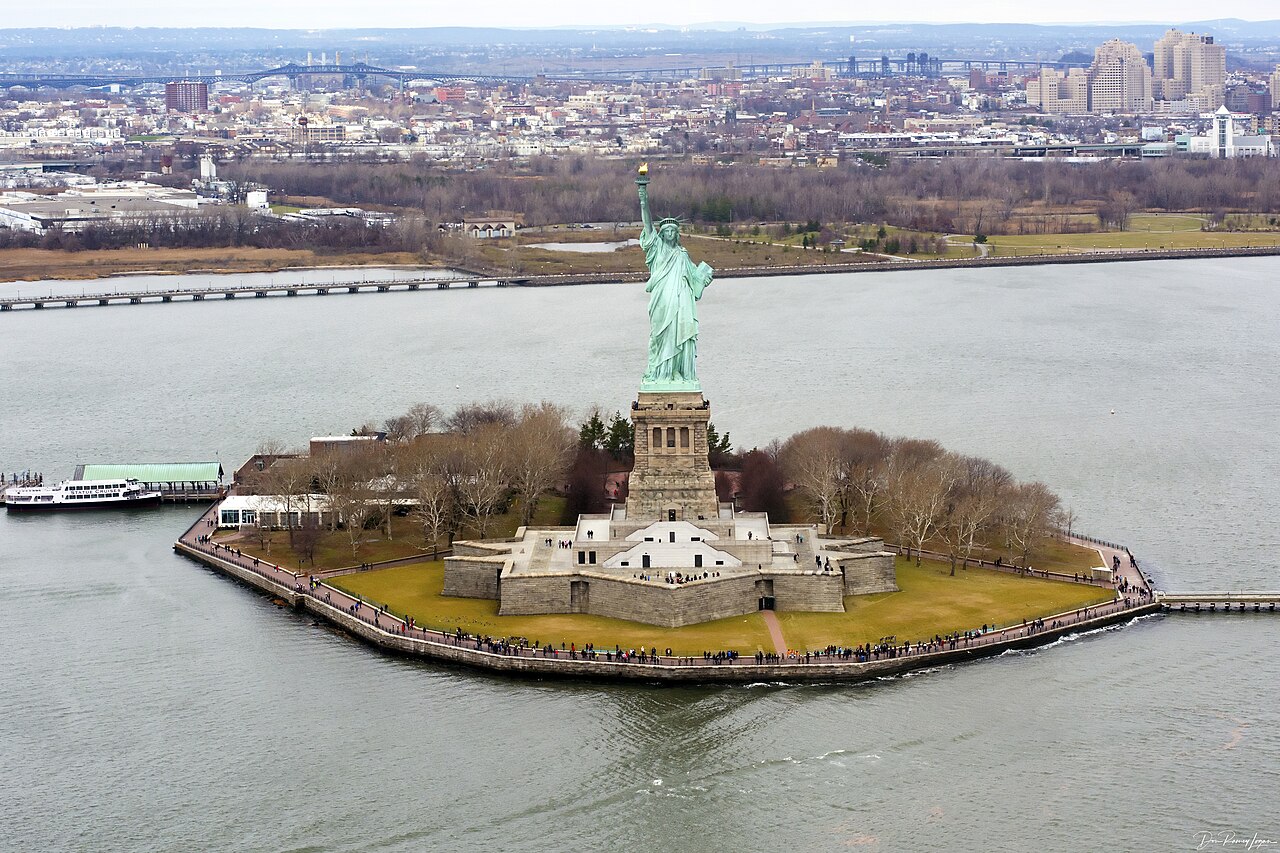
The Statue of Liberty (Liberty Enlightening the World) is a colossal neoclassical sculpture located on Liberty Island in New York Harbor. Dedicated in 1886, it was designed by French sculptor Frédéric Auguste Bartholdi, with structural engineering by Gustave Eiffel. The monument was conceived as a gift from France to the United States to commemorate the centennial of American independence and to symbolize political liberty. Constructed of copper sheets over an iron framework, the statue became a prominent landmark for transatlantic arrivals and a material expression of 19th-century ideals of republican governance.
Key Facts
- Materials
- Copper, Iron framework (later stainless steel supports), Concrete pedestal
- Dimensions
- Statue height 46m; total height including pedestal approximately 93m
- Civilization
- French Third Republic; United States
- Date(s)
- 1875-1886 (dedicated 28 October 1886)
- Condition
- Preserved monument and museum site
- Original Function
- Commemorative monument celebrating liberty and Franco-American alliance
- Key Figures
- Frédéric Auguste Bartholdi, Gustave Eiffel, Édouard de Laboulaye
- Architectural Style
- Neoclassical
Concept and Franco-American Origins
1865-1875The idea originated with French political thinker Édouard de Laboulaye, who proposed a monument celebrating American independence and shared republican values following the American Civil War. Fundraising occurred in both France and the United States, with France financing the statue and the United States funding the pedestal.
Design and Construction
1875-1884Bartholdi designed the robed female figure holding a torch and tablet inscribed with the date 4 July 1776. Gustave Eiffel engineered the internal iron framework to support the copper skin. The statue was assembled in Paris, disassembled for shipment, and transported to New York in 1885.
Dedication and Early Reception
1886The statue was dedicated on 28 October 1886 in a ceremony attended by U.S. President Grover Cleveland. Positioned at the entrance to New York Harbor, it became a visible landmark for immigrants arriving through nearby Ellis Island.
20th-Century Preservation
20th centuryThe monument was designated a National Monument in 1924. Major restoration occurred in 1984-1986, including replacement of the original iron armature with stainless steel supports. It was inscribed as a UNESCO World Heritage Site in 1984.
Contemporary Management
21st centuryThe statue is administered by the U.S. National Park Service. Access includes museum exhibits in the pedestal and regulated entry to the crown. Security measures increased after 2001, and visitor management now relies on timed ticketing.
Cultural Significance
The Statue of Liberty became associated with immigration and national identity, particularly in the late 19th and early 20th centuries. Although not originally conceived as an immigration monument, its location near Ellis Island linked it to the experience of arrival in the United States. The monument’s imagery has been invoked in political discourse concerning civil rights, democracy, and international relations. Emma Lazarus’s 1883 poem “The New Colossus,” later mounted inside the pedestal, reinforced the statue’s symbolic association with refuge and opportunity.
Interpretive Notes
Scholarly debates and areas of uncertainty
Scholars debate the extent to which the statue’s meaning evolved beyond its original diplomatic intent. While conceived as a celebration of republican governance, it later became closely tied to narratives of immigration and American exceptionalism. Art historians also examine the monument’s classical influences and its relationship to 19th-century imperial symbolism, questioning how universal its representation of liberty was within contemporary political contexts.
Visiting Information
Entry Rules
Paid admission required for ferry access to Liberty Island. Separate tickets required for pedestal and crown access; crown tickets are limited and require advance reservation. Security screening mandatory.
Best Times to Visit
Morning ferry departures reduce wait times. Summer months experience high attendance. Weather conditions in New York Harbor can affect ferry schedules.
Photography
Personal photography permitted. Tripods restricted in interior spaces. Drones prohibited. Commercial filming requires National Park Service permit.
Preservation Notes
Interior access involves stairs; crown access is physically demanding and not wheelchair accessible. The monument undergoes periodic maintenance; sections may close temporarily.
Nearby POIs
11 shownSources & Further Reading
- [1]Lady Liberty: The Story of the Statue of Liberty — Doreen Rappaport. Candlewick Press (2008)
- [2]Liberty's Torch: The Great Adventure to Build the Statue of Liberty — Elizabeth Mitchell. Atlantic Monthly Press (2014)
- [3]The Statue of Liberty — Edward Berenson. Yale University Press (2012)
Key Facts
- Materials
- Copper, Iron framework (later stainless steel supports), Concrete pedestal
- Dimensions
- Statue height 46m; total height including pedestal approximately 93m
- Civilization
- French Third Republic; United States
- Date(s)
- 1875-1886 (dedicated 28 October 1886)
- Condition
- Preserved monument and museum site
- Original Function
- Commemorative monument celebrating liberty and Franco-American alliance
- Key Figures
- Frédéric Auguste Bartholdi, Gustave Eiffel, Édouard de Laboulaye
- Architectural Style
- Neoclassical