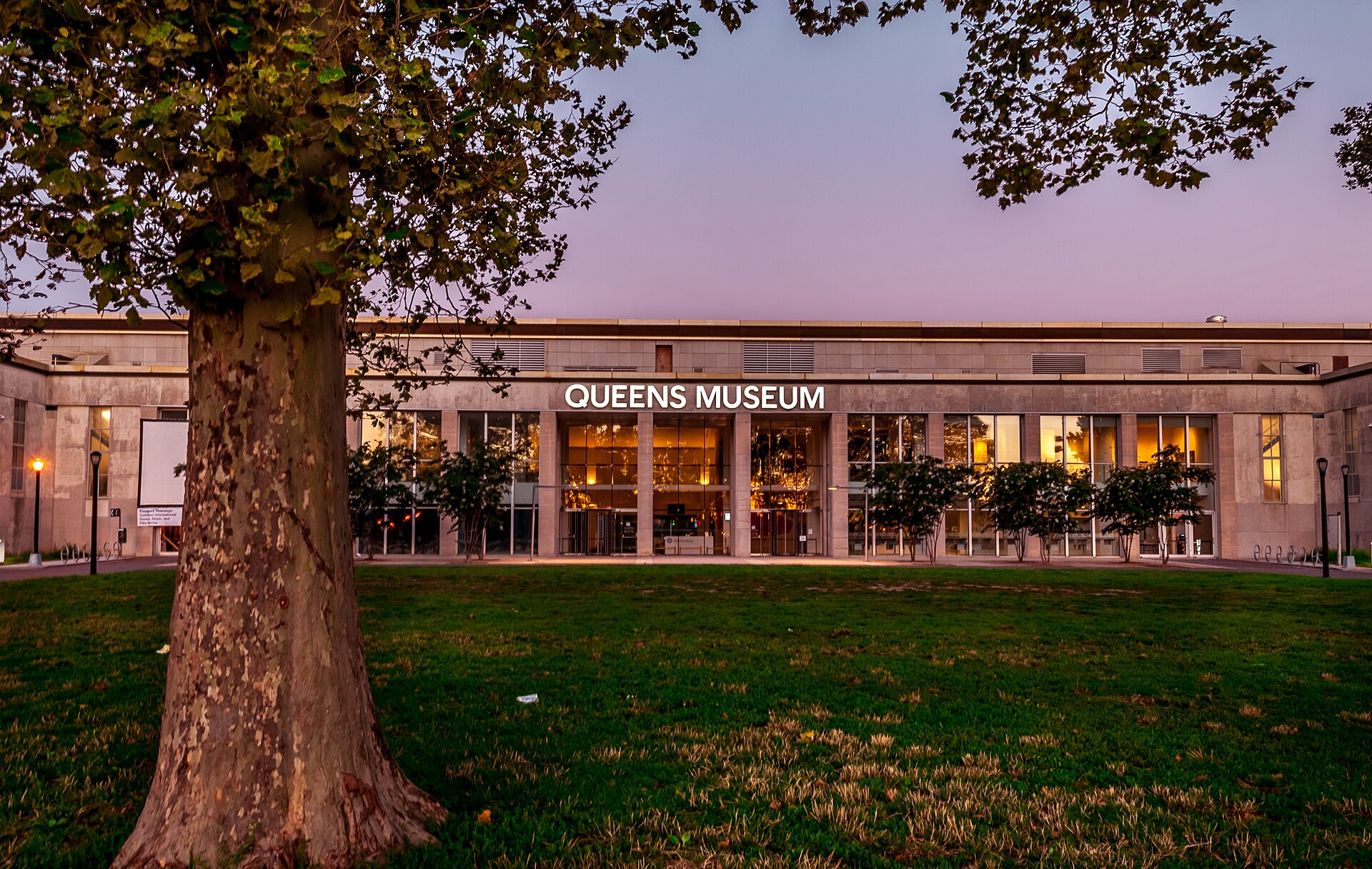
The Queens Museum is an art museum and educational center located in Flushing Meadows-Corona Park in New York City. Housed in the New York City Building, which was originally constructed for the 1939 New York World's Fair, the museum serves as a cultural hub for one of the most ethnically diverse urban areas in the world.
The museum is best known for housing the Panorama of the City of New York, a massive, room-sized architectural scale model of the five boroughs originally built for the 1964 New York World's Fair. In addition to its permanent collection of World's Fair artifacts, the institution hosts rotating contemporary art exhibitions and community-focused programming.
Key Facts
- Materials
- Steel, Concrete, Glass
- Civilization
- United States
- Accessibility
- Fully wheelchair accessible
- Date(s)
- 1937-1939
- Condition
- Active museum
- Original Function
- New York City Pavilion (1939 World's Fair)
- Key Figures
- Robert Moses, Aymar Embury II
World's Fair Origins
1939The building was designed by Aymar Embury II to serve as the New York City Pavilion for the 1939 World's Fair. It showcased the city's infrastructure and future planning initiatives.
United Nations Era
1946-1950Following the war, the building served as the temporary headquarters for the United Nations General Assembly, hosting sessions that addressed the partition of Palestine and the creation of UNICEF.
1964 World's Fair and Museum Founding
1964-1972The structure was renovated for the 1964 World's Fair, during which the Panorama of the City of New York was unveiled. The Queens Museum was officially established in the building in 1972.
Modern Expansion
2013The museum underwent a major architectural expansion designed by Grimshaw Architects, which doubled the museum's footprint and added new galleries, classrooms, and a glass-enclosed atrium.
Cultural Significance
The Queens Museum occupies a unique position in New York City's cultural landscape by bridging the gap between historical preservation and contemporary community engagement. Its location in Flushing Meadows-Corona Park links it directly to the legacy of 20th-century internationalism and urban planning.
By maintaining the Panorama and the World's Fair archives, the museum acts as a repository for the city's collective memory, while its contemporary art program reflects the diverse immigrant populations of the surrounding Queens borough.
Interpretive Notes
Scholarly debates and areas of uncertainty
Discussions often center on the tension between the museum's role as a steward of historical World's Fair artifacts and its mission as a contemporary art space. Scholars also debate the legacy of Robert Moses, who was instrumental in the park's development and the building's reuse, in the context of urban displacement and mid-century planning.
Visiting Information
Entry Rules
Open Wednesday through Sunday. Admission is suggested for adults, with free entry for children under 12. Visitors are encouraged to book timed tickets online in advance.
Best Times to Visit
Weekday mornings are generally quieter. The museum is a popular destination during the summer months when park activities are in full swing.
Photography
Personal photography is permitted without flash or tripods. Professional photography or filming requires prior authorization from the museum's communications department.
Preservation Notes
The Panorama of the City of New York is a delicate scale model; visitors must remain behind the designated railings at all times. Please refrain from touching any artifacts or display cases.
Nearby POIs
11 shown- New York Hall of Science0.4 km
- Museum of the City of New York10.3 km
- Cooper Hewitt, Smithsonian Design Museum10.3 km
- Solomon R. Guggenheim Museum10.3 km
- Metropolitan Museum of Art10.5 km
- Frick Collection10.5 km
- Chrysler Building10.9 km
- St. Patrick's Cathedral11 km
- Museum of Modern Art11.2 km
- Morgan Library & Museum11.4 km
- American Museum of Natural History11.5 km
Sources & Further Reading
- [1]
- [2]The World's Fair Buildings of Flushing Meadows — Joseph Tirella. New York Historical Society (2014)
Key Facts
- Materials
- Steel, Concrete, Glass
- Civilization
- United States
- Accessibility
- Fully wheelchair accessible
- Date(s)
- 1937-1939
- Condition
- Active museum
- Original Function
- New York City Pavilion (1939 World's Fair)
- Key Figures
- Robert Moses, Aymar Embury II
Nearby POIs
11 shown- New York Hall of Science0.4 km
- Museum of the City of New York10.3 km
- Cooper Hewitt, Smithsonian Design Museum10.3 km
- Solomon R. Guggenheim Museum10.3 km
- Metropolitan Museum of Art10.5 km
- Frick Collection10.5 km
- Chrysler Building10.9 km
- St. Patrick's Cathedral11 km
- Museum of Modern Art11.2 km
- Morgan Library & Museum11.4 km
- American Museum of Natural History11.5 km