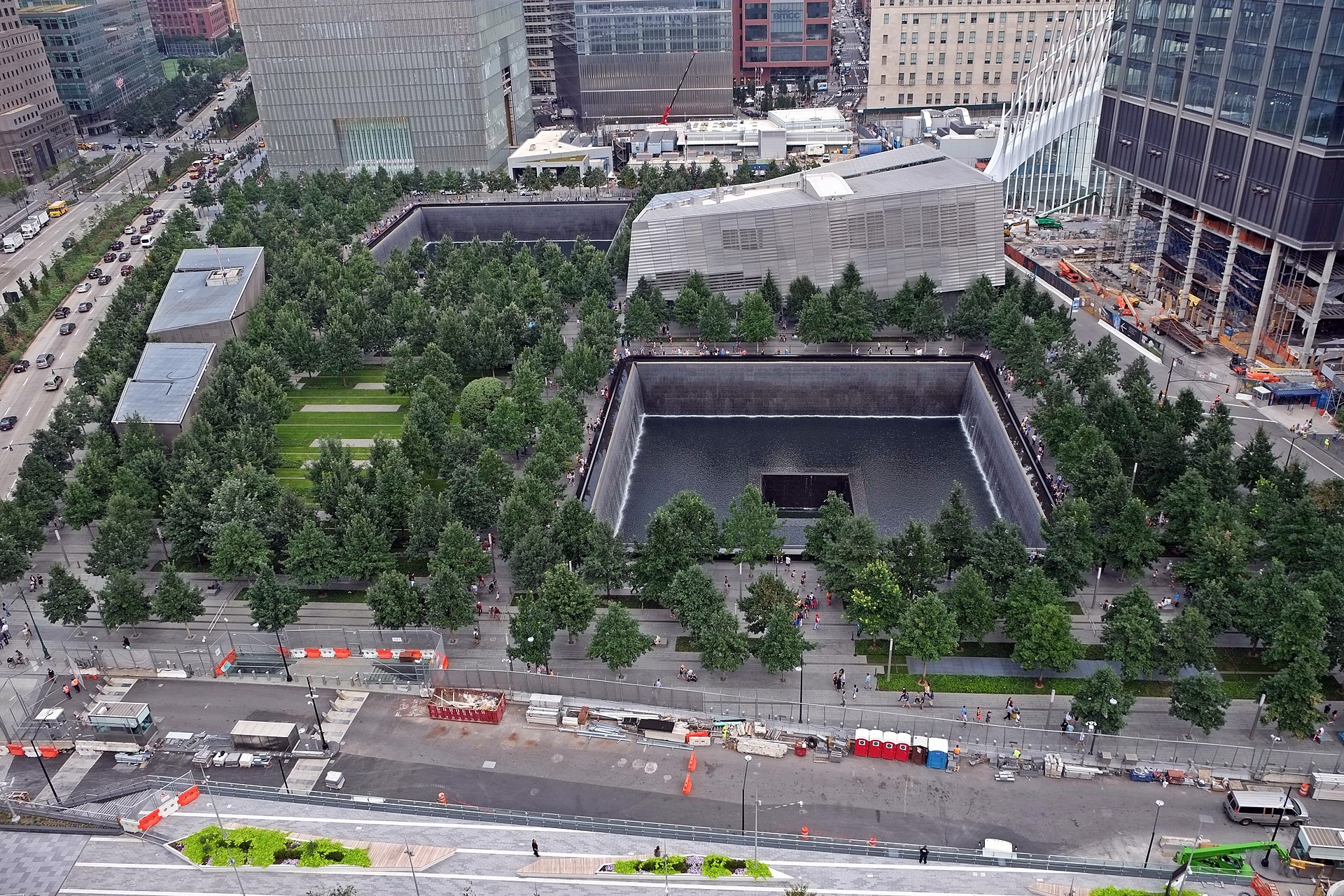
The National September 11 Memorial & Museum is located at the World Trade Center site in Lower Manhattan, occupying the footprint of the original Twin Towers. The memorial consists of two massive reflecting pools set within the footprints of the North and South Towers, surrounded by a plaza of swamp white oak trees. The names of the 2,977 victims of the September 11, 2001, attacks and the 1993 World Trade Center bombing are inscribed in bronze panels along the edges of the pools.
The museum, situated primarily underground, houses a vast collection of artifacts, personal stories, and multimedia exhibits documenting the events of September 11, 2001, and the February 26, 1993, bombing. It serves as a place of commemoration and education, preserving the history of the attacks while honoring the lives lost and the emergency responders who participated in the rescue and recovery efforts.
Key Facts
- Materials
- Bronze, Granite, Steel, Glass, Concrete
- Civilization
- United States
- Accessibility
- Fully ADA compliant with elevator access to all levels
- Date(s)
- 2006-2014
- Condition
- Active
- Original Function
- Memorial and Museum
- Key Figures
- Michael Arad, Peter Walker, Daniel Libeskind
Site Transformation
2001-2006Following the destruction of the World Trade Center, the site underwent a complex process of recovery and planning. In 2003, an international design competition was launched to create a memorial, resulting in the selection of 'Reflecting Absence' by architect Michael Arad and landscape architect Peter Walker.
Memorial Construction
2006-2011Construction of the memorial plaza began in 2006. The memorial was officially dedicated on September 11, 2011, the tenth anniversary of the attacks, and opened to the public the following day.
Museum Opening
2014The museum, designed by Snøhetta, was dedicated on May 15, 2014, and opened to the general public on May 21, 2014. It provides access to the bedrock of the original towers and houses significant structural remnants, including the 'Survivor Stairs'.
Cultural Significance
The site serves as the primary location for national remembrance of the 9/11 attacks. It plays a critical role in the collective memory of the United States, balancing the need for a solemn space of mourning with the educational mission of explaining the geopolitical and social consequences of the events.
Interpretive Notes
Scholarly debates and areas of uncertainty
Debates have occurred regarding the appropriate balance between commercial interests and the sanctity of the site, as well as the ethical presentation of human remains within the museum's repository, which is located in a restricted area of the facility.
Visiting Information
Entry Rules
The Memorial plaza is open daily to the public. The Museum requires a timed-entry ticket for admission. Visitors must pass through security screening upon entry to the museum pavilion.
Best Times to Visit
Early morning or late afternoon on weekdays to avoid peak weekend crowds. The memorial is particularly poignant during the evening when the pools are illuminated.
Photography
Personal photography is permitted in the memorial plaza and most areas of the museum. Flash photography and tripods are prohibited inside the museum galleries.
Preservation Notes
Visitors are requested to maintain a respectful demeanor. The site is a place of reflection; please refrain from loud conversation near the reflecting pools.
Nearby POIs
11 shownKey Facts
- Materials
- Bronze, Granite, Steel, Glass, Concrete
- Civilization
- United States
- Accessibility
- Fully ADA compliant with elevator access to all levels
- Date(s)
- 2006-2014
- Condition
- Active
- Original Function
- Memorial and Museum
- Key Figures
- Michael Arad, Peter Walker, Daniel Libeskind