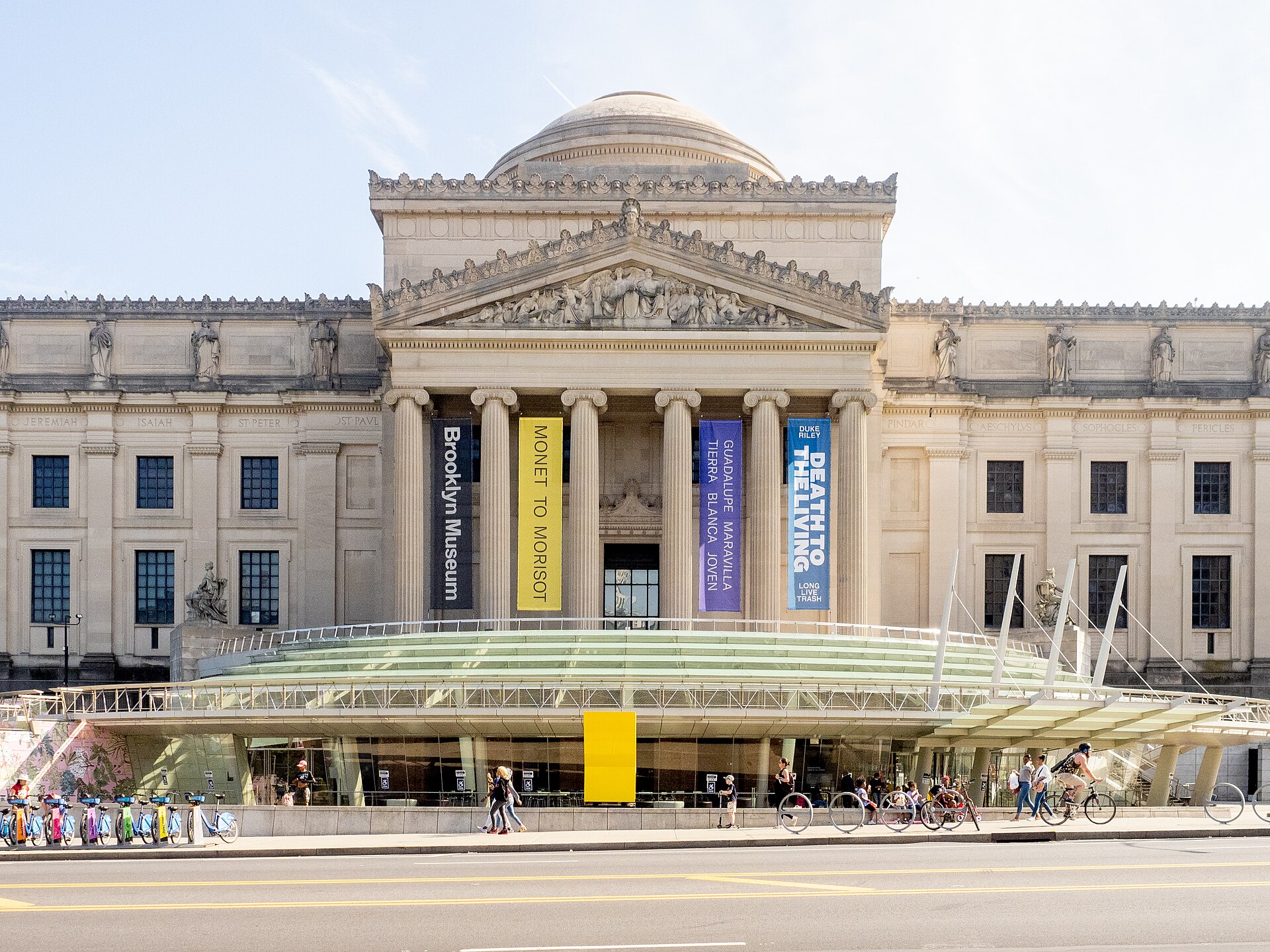
The Brooklyn Museum is an art museum located in the New York City borough of Brooklyn. Founded in 1895 and housed in a Beaux-Arts building designed by the architectural firm McKim, Mead & White, it is the second-largest art museum in New York City. The institution holds a vast collection of approximately 500,000 objects, ranging from ancient Egyptian masterpieces to contemporary art.
The museum is renowned for its comprehensive holdings of Egyptian antiquities, which span over 3,000 years, and its significant collections of African, Oceanic, and Japanese art. Beyond its permanent galleries, the museum serves as a center for community engagement and social activism, frequently hosting exhibitions that address contemporary political and cultural issues.
Key Facts
- Materials
- Limestone, Granite, Steel, Glass
- Civilization
- American
- Accessibility
- Fully wheelchair accessible
- Date(s)
- 1895-1897
- Condition
- Active, well-maintained
- Original Function
- Art and natural history museum
- Key Figures
- Daniel Chester French, McKim, Mead & White, Arnold Lehman
Founding and Architecture
1890sThe museum was established following the consolidation of the City of Brooklyn into New York City. The current Beaux-Arts building was commissioned as part of a larger plan for the Brooklyn Institute of Arts and Sciences, with the first section opening to the public in 1897.
Expansion and Collection Growth
20th CenturyThroughout the 20th century, the museum significantly expanded its global collections, particularly in the fields of Egyptian and Asian art. The building underwent several interior renovations to accommodate the growing number of artifacts and changing exhibition standards.
Modern Era and Social Focus
21st CenturyIn recent decades, the museum has shifted its focus toward community-oriented programming and the inclusion of contemporary art. Major renovations, including the 2004 entrance pavilion designed by Arata Isozaki, have modernized the visitor experience while preserving the historic facade.
Cultural Significance
The Brooklyn Museum plays a vital role in the cultural landscape of New York City, acting as a bridge between historical scholarship and contemporary social discourse. It is recognized for its commitment to diversity and its efforts to make art accessible to the diverse population of Brooklyn.
The museum is also a significant site for the study of Egyptian art, housing one of the most important collections of such artifacts in the United States. Its role as a community hub is reinforced by its public programming, which often highlights local artists and social justice themes.
Interpretive Notes
Scholarly debates and areas of uncertainty
There is ongoing scholarly discussion regarding the provenance of certain artifacts within the museum's extensive collection, particularly those acquired during the early 20th century. The museum actively participates in international dialogues regarding the repatriation of cultural property and the ethical display of non-Western art.
Visiting Information
Entry Rules
Open Wednesday through Sunday. Tickets are available online or at the admissions desk. Admission is timed-entry for special exhibitions. Visitors are encouraged to check the official website for current hours and holiday closures.
Best Times to Visit
Weekday mornings are generally less crowded than weekends. The museum is often busier during major exhibition openings and special community events.
Photography
Non-flash photography is permitted for personal, non-commercial use in most permanent collection galleries. Some special exhibitions may prohibit photography; please check signage at the entrance of each gallery.
Preservation Notes
Do not touch artwork or display cases. Food and drink are prohibited in the galleries. Large bags and backpacks must be checked at the coat check.
Nearby POIs
11 shownSources & Further Reading
- [1]The Brooklyn Museum: A History — Linda S. Ferber. Brooklyn Museum Press (2004)
- [2]McKim, Mead & White: The Architecture of the Brooklyn Museum — Richard Guy Wilson. Journal of the Society of Architectural Historians (1998)
Key Facts
- Materials
- Limestone, Granite, Steel, Glass
- Civilization
- American
- Accessibility
- Fully wheelchair accessible
- Date(s)
- 1895-1897
- Condition
- Active, well-maintained
- Original Function
- Art and natural history museum
- Key Figures
- Daniel Chester French, McKim, Mead & White, Arnold Lehman