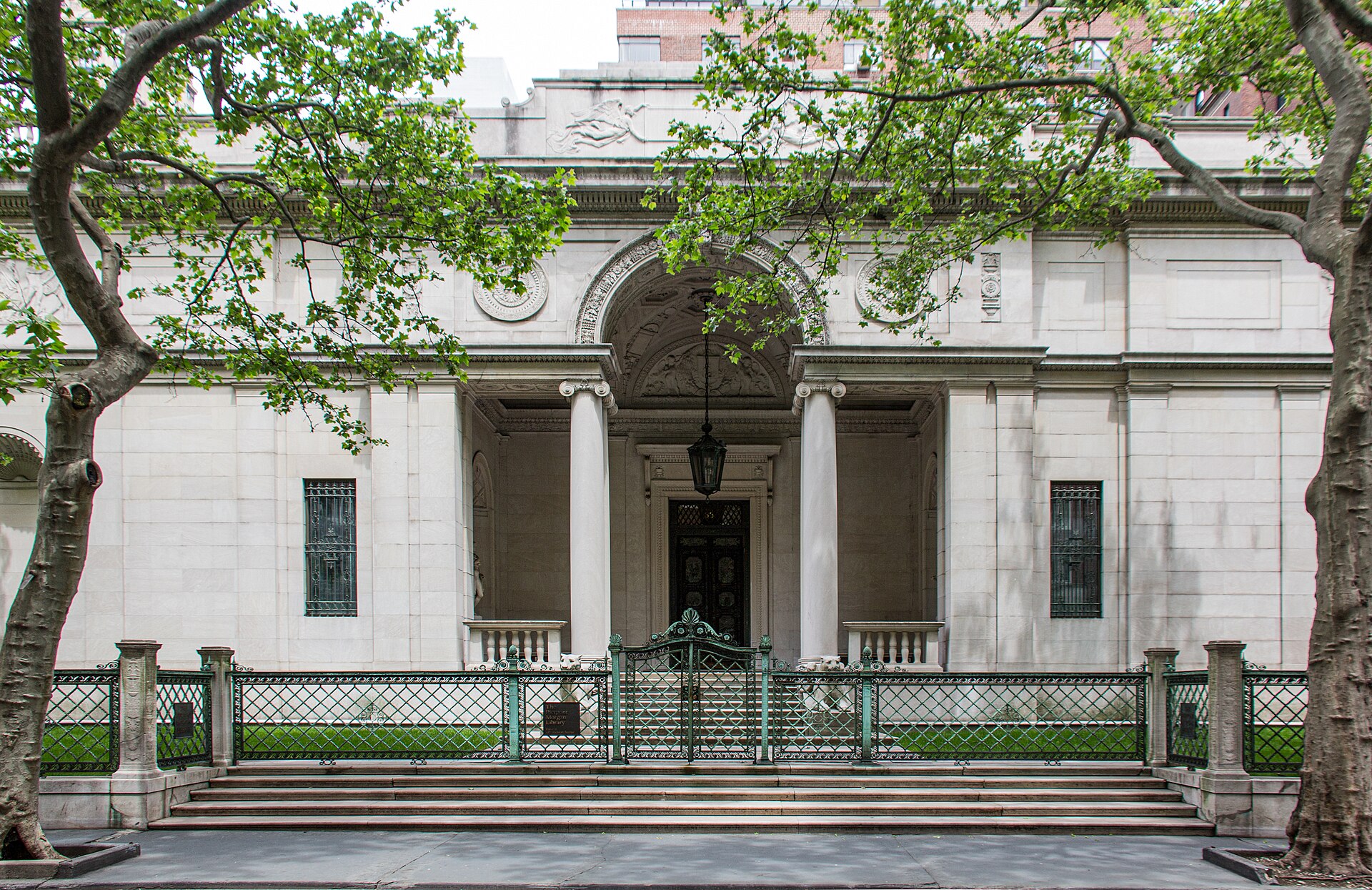
The Morgan Library & Museum, originally the private library of financier J.P. Morgan, is a complex of buildings in Manhattan that houses an extensive collection of rare books, manuscripts, drawings, and artifacts. The core of the institution is the original library building, designed by Charles Follen McKim of the firm McKim, Mead & White and completed in 1906 to house Morgan's personal collection of illuminated, literary, and historical manuscripts.
Following its transition from a private residence to a public institution in 1924, the site has expanded significantly to include modern exhibition spaces and research facilities. It remains a premier center for the study of the history of the book and the arts, maintaining its original Gilded Age interior while serving as a contemporary cultural venue.
Key Facts
- Materials
- Pink Tennessee marble, Bronze, Stained glass
- Civilization
- American
- Accessibility
- Fully wheelchair accessible
- Date(s)
- 1902-1906
- Condition
- Well-preserved and active museum
- Original Function
- Private library and art collection
- Key Figures
- J.P. Morgan, Charles Follen McKim, Belle da Costa Greene
Origins and Design
1902-1906J.P. Morgan commissioned Charles Follen McKim to design a library to house his growing collection of rare books and art. The building was constructed in the Italian Renaissance style, utilizing marble blocks laid without mortar to achieve a seamless exterior appearance.
Transition to Public Institution
1924Following J.P. Morgan's death, his son, J.P. Morgan Jr., transformed the library into a public institution in 1924, honoring his father's wish to make the collection accessible to scholars and the public.
Modern Expansion
2006-presentThe museum underwent a major expansion designed by Renzo Piano, which connected the historic buildings with a glass-enclosed central court, providing modern gallery space while preserving the integrity of the original library rooms.
Cultural Significance
The Morgan Library & Museum represents the pinnacle of Gilded Age private collecting and the subsequent democratization of elite cultural assets. It serves as a vital repository for Western literary and musical history, housing unique items such as original manuscripts by Dickens, Thoreau, and Mozart.
Beyond its collection, the site is significant for its role in the history of American librarianship, particularly through the work of Belle da Costa Greene, who served as the first director and was instrumental in building the library's global reputation as a research institution.
Interpretive Notes
Scholarly debates and areas of uncertainty
Discussions regarding the institution often center on the provenance of specific items acquired during the early 20th century, as well as the ongoing balance between maintaining the site as a historic house museum and its function as a modern, high-traffic exhibition space.
Visiting Information
Entry Rules
Open Tuesday through Sunday. Tickets are required for entry and can be purchased online or at the admissions desk. Visitors are asked to check large bags and coats.
Best Times to Visit
Weekday mornings are generally quieter. The library is particularly popular during special exhibition openings.
Photography
Personal photography is permitted in most galleries without flash or tripods. Photography is strictly prohibited in certain special exhibition areas.
Preservation Notes
The historic library rooms are climate-controlled to protect delicate manuscripts. Visitors are requested not to touch any surfaces or display cases.
Nearby POIs
11 shownKey Facts
- Materials
- Pink Tennessee marble, Bronze, Stained glass
- Civilization
- American
- Accessibility
- Fully wheelchair accessible
- Date(s)
- 1902-1906
- Condition
- Well-preserved and active museum
- Original Function
- Private library and art collection
- Key Figures
- J.P. Morgan, Charles Follen McKim, Belle da Costa Greene