New York City,United States of America
Solomon R. Guggenheim Museum
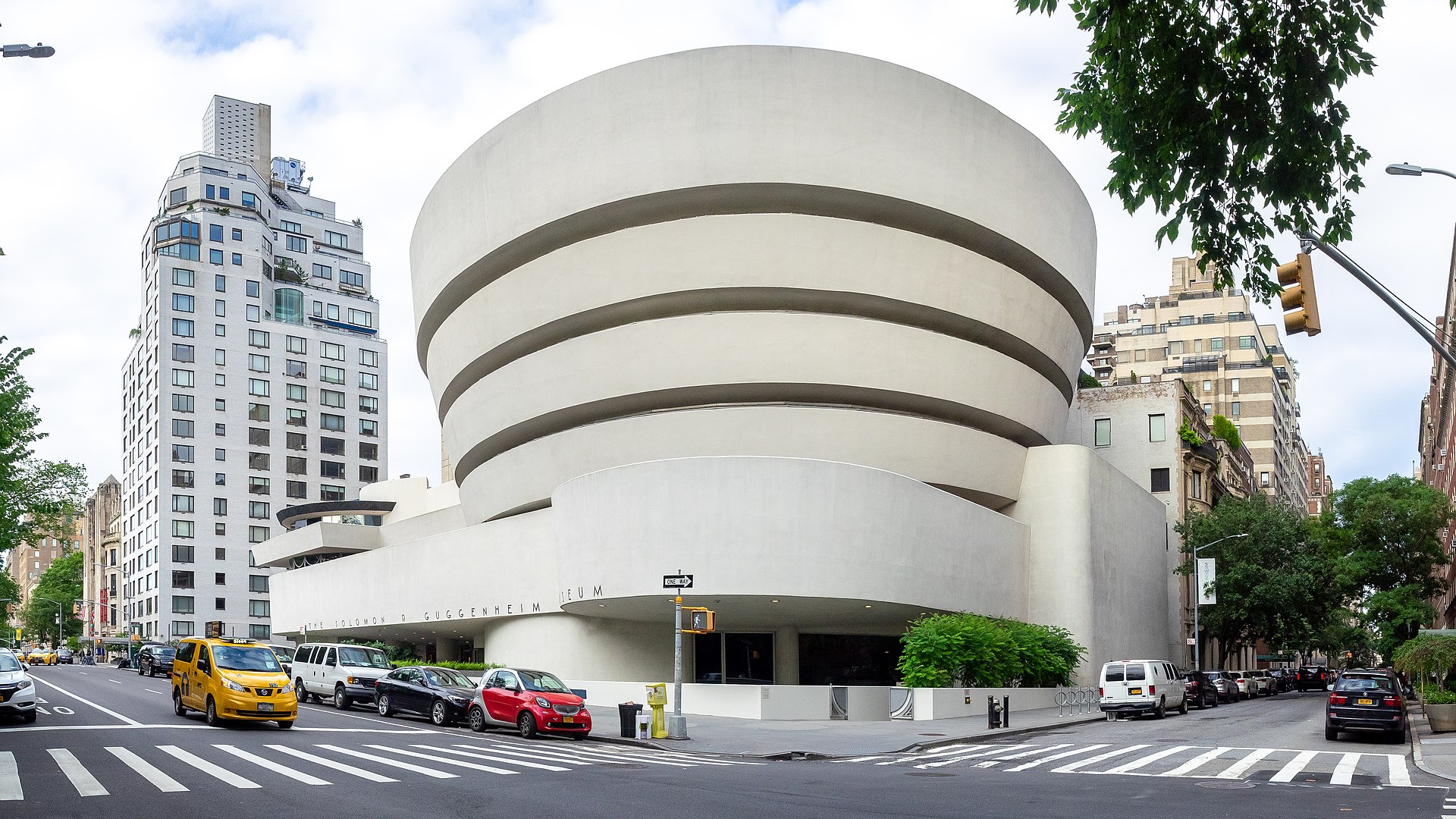
The Solomon R. Guggenheim Museum, located on the Upper East Side of Manhattan, is a premier institution dedicated to modern and contemporary art. Designed by architect Frank Lloyd Wright, the building is celebrated for its unique spiral ramp that allows visitors to experience the collection through a continuous, flowing path. It serves as both a repository for a vast collection of Impressionist, Post-Impressionist, and early Modern works and as a landmark of 20th-century architecture.
Since its opening in 1959, the museum has functioned as a cultural hub, hosting major exhibitions that challenge traditional curatorial practices. Its distinctive cylindrical form and interior rotunda have made it one of the most recognizable structures in New York City, reflecting Wright's vision of organic architecture integrated into the urban grid.
Key Facts
- Materials
- Reinforced concrete, Steel, Glass
- Civilization
- American
- Accessibility
- Fully accessible with elevators and ramp access
- Date(s)
- 1956-1959
- Condition
- Active, well-preserved
- Original Function
- Art Museum
- Key Figures
- Frank Lloyd Wright, Solomon R. Guggenheim, Hilla Rebay
Founding and Vision
1937-1943The Solomon R. Guggenheim Foundation was established in 1937 to foster the appreciation of modern art. In 1943, the foundation commissioned Frank Lloyd Wright to design a permanent home for the collection, which had outgrown its previous space in the Museum of Non-Objective Painting.
Design and Construction
1943-1959Wright's design process spanned over a decade, involving numerous iterations of the spiral concept. Construction began in 1956, facing significant logistical challenges due to the building's unconventional geometry and the use of reinforced concrete. The museum officially opened to the public on October 21, 1959, six months after Wright's death.
Expansion and Recognition
1990s-PresentIn 1992, the museum underwent a major restoration and expansion, which included the addition of an adjacent tower designed by Gwathmey Siegel & Associates. In 2019, the building was inscribed as a UNESCO World Heritage Site as part of 'The 20th-Century Architecture of Frank Lloyd Wright'.
Cultural Significance
The Guggenheim Museum represents a pivotal moment in the history of museum architecture, shifting away from the traditional 'gallery of rooms' model toward an open, experiential space. It has become a symbol of New York's cultural landscape and a testament to the influence of organic architecture on urban environments.
Beyond its architectural impact, the museum has played a crucial role in the canonization of abstract art. Its history is deeply intertwined with the development of the international Guggenheim network, which has expanded the institution's reach and influence globally.
Interpretive Notes
Scholarly debates and areas of uncertainty
A long-standing debate exists regarding the museum's functionality as an exhibition space. Critics often argue that the curved walls and sloping floors of the rotunda create challenges for hanging traditional two-dimensional art, forcing curators to adapt works to the architecture rather than the reverse. Conversely, proponents argue that the space encourages a unique, non-linear engagement with art that remains unmatched by conventional white-cube galleries.
Visiting Information
Entry Rules
Open daily. Tickets are required and can be purchased online in advance. Visitors are subject to security screening upon entry. Large bags and backpacks must be checked in the coatroom.
Best Times to Visit
Weekday mornings shortly after opening to avoid peak tourist crowds. Tuesday and Saturday afternoons are typically the busiest times.
Photography
Personal photography is permitted for non-commercial use. Flash, tripods, and selfie sticks are strictly prohibited. Photography may be restricted in certain special exhibition galleries.
Preservation Notes
Do not touch the artwork or the walls. The building's concrete surfaces are subject to ongoing conservation efforts; please follow all posted signage regarding restricted areas.
Nearby POIs
11 shown- Cooper Hewitt, Smithsonian Design Museum0.2 km
- Metropolitan Museum of Art0.5 km
- Museum of the City of New York1.2 km
- American Museum of Natural History1.3 km
- Frick Collection1.5 km
- Cathedral of St. John the Divine2.3 km
- Museum of Modern Art2.8 km
- St. Patrick's Cathedral3.1 km
- Chrysler Building3.8 km
- Intrepid Museum4 km
- Morgan Library & Museum4.2 km
Sources & Further Reading
- [1]Frank Lloyd Wright: The Guggenheim Museum — Hilla Rebay. Horizon Press (1960)
- [2]The 20th-Century Architecture of Frank Lloyd Wright — UNESCO World Heritage Centre. UNESCO (2019)View
Key Facts
- Materials
- Reinforced concrete, Steel, Glass
- Civilization
- American
- Accessibility
- Fully accessible with elevators and ramp access
- Date(s)
- 1956-1959
- Condition
- Active, well-preserved
- Original Function
- Art Museum
- Key Figures
- Frank Lloyd Wright, Solomon R. Guggenheim, Hilla Rebay
Nearby POIs
11 shown- Cooper Hewitt, Smithsonian Design Museum0.2 km
- Metropolitan Museum of Art0.5 km
- Museum of the City of New York1.2 km
- American Museum of Natural History1.3 km
- Frick Collection1.5 km
- Cathedral of St. John the Divine2.3 km
- Museum of Modern Art2.8 km
- St. Patrick's Cathedral3.1 km
- Chrysler Building3.8 km
- Intrepid Museum4 km
- Morgan Library & Museum4.2 km