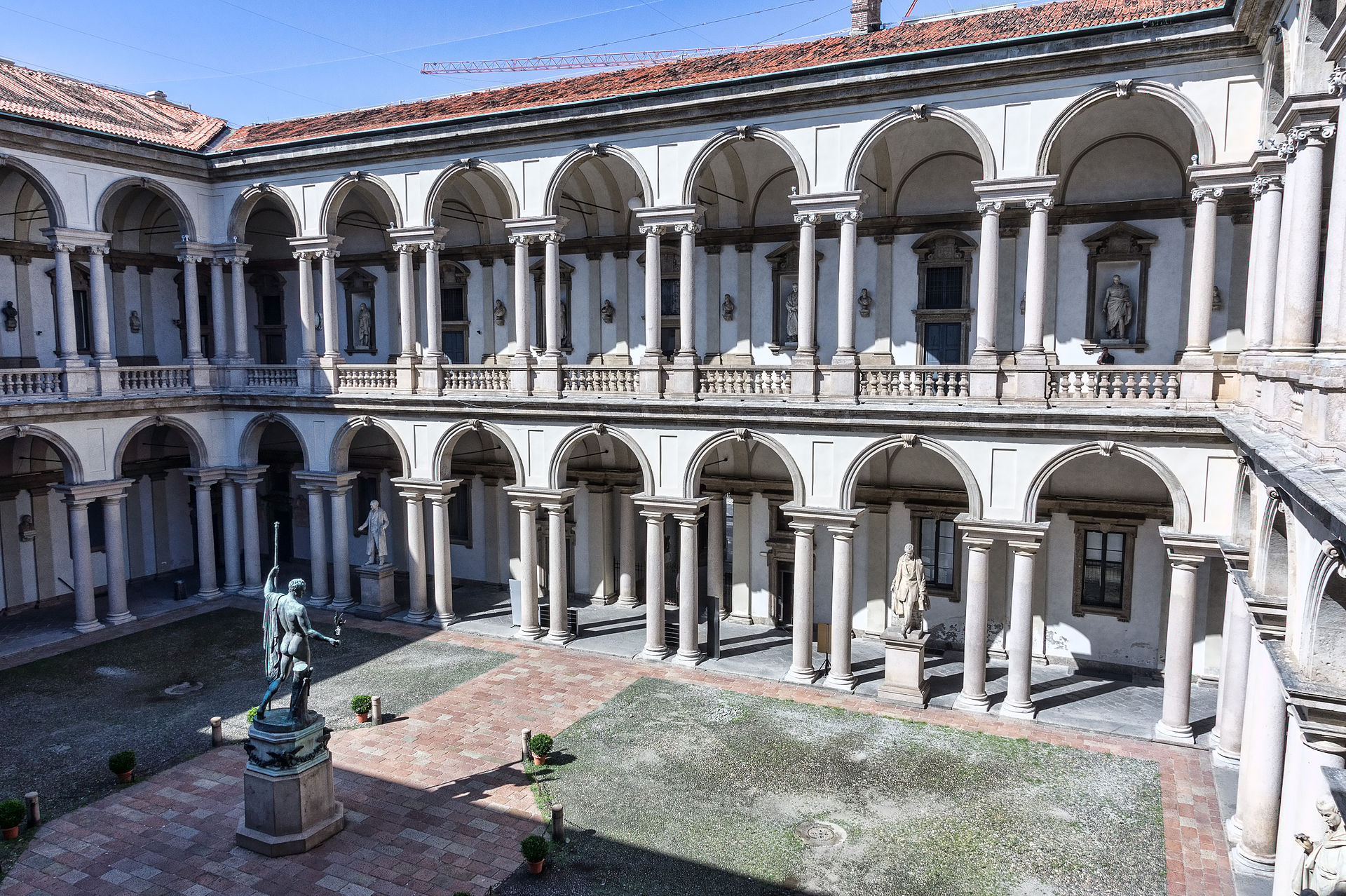
The Pinacoteca di Brera is a national art museum in Milan housed within the Palazzo di Brera. Established in 1809 during the Napoleonic Kingdom of Italy, it was created to assemble significant works of art for educational and public display purposes. The museum’s collection focuses primarily on Italian painting from the 14th to the 20th centuries, with particular strength in Lombard and Venetian schools. It remains part of a larger cultural complex that includes the Accademia di Belle Arti and the Braidense National Library.
Key Facts
- Materials
- Brick, Stone, Stucco
- Civilization
- Kingdom of Italy (Napoleonic administration)
- Date(s)
- Palazzo di Brera largely 16th-17th centuries; museum established 1809
- Condition
- Active national art museum
- Original Function
- Jesuit college (palace); later state art gallery
- Key Figures
- Napoleon Bonaparte, Francesco Hayez
Jesuit Foundation
16th-18th centuriesThe Palazzo di Brera was developed as a Jesuit college beginning in the 16th century. The complex expanded to include educational and scientific institutions, forming an important intellectual center in Milan.
Napoleonic Reorganization
Late 18th - early 19th centuryFollowing the suppression of the Jesuit order and the arrival of Napoleonic administration, the building was repurposed. In 1809 the Pinacoteca di Brera was formally established to display artworks gathered from suppressed religious institutions across northern Italy.
19th Century Expansion
19th centuryThe museum expanded its holdings to include major works of Renaissance and Baroque painting. It functioned alongside the Accademia di Belle Arti, serving as a training resource for artists.
Modern Administration
20th century - presentThe Pinacoteca became part of Italy’s national museum system. Renovation campaigns have modernized exhibition spaces while preserving the historic palace structure.
Cultural Significance
The Pinacoteca di Brera represents the transformation of ecclesiastical and aristocratic art collections into a public national institution. Its formation reflects Napoleonic-era policies that centralized and secularized cultural heritage. The museum remains a key institution in the study of Italian painting, particularly the Lombard tradition, and continues to operate within the broader Brera cultural complex.
Interpretive Notes
Scholarly debates and areas of uncertainty
Scholars analyze the impact of Napoleonic confiscations on the formation of Italian museum collections, including the ethical and political dimensions of relocating religious artworks. Debate also surrounds curatorial strategies for presenting regional artistic schools within a national narrative framework.
Visiting Information
Entry Rules
Paid admission required. Reduced tickets available for eligible categories. Timed entry may be implemented during peak periods.
Best Times to Visit
Weekday mornings generally experience lower visitor volume. Peak attendance occurs during weekends and major exhibitions.
Photography
Personal photography permitted without flash. Tripods and commercial photography require authorization.
Preservation Notes
Do not touch paintings or frames. Maintain distance from canvases and panels. Environmental controls regulate light and humidity levels within galleries.
Nearby POIs
11 shown- Museo Poldi Pezzoli0.4 km
- Museo Teatrale alla Scala0.5 km
- Bagatti Valsecchi Museum0.6 km
- Castello Sforzesco0.7 km
- Palazzo Morando0.7 km
- Duomo di Milano0.8 km
- Palazzo Reale di Milano1 km
- Chiesa di San Maurizio al Monastero Maggiore1 km
- Museo Civico di Storia Naturale di Milano1.1 km
- Triennale di Milano1.1 km
- Basilica di Sant'Ambrogio1.4 km
Sources & Further Reading
- [1]Brera: The Picture Gallery of Milan — Andrea Bayer. Electa (1998)
- [2]Napoleon and the Transformation of Europe — Alexander Grab. Palgrave Macmillan (2003)
- [3]The Brera Palace and its Institutions. Ministero della Cultura (2021)
Key Facts
- Materials
- Brick, Stone, Stucco
- Civilization
- Kingdom of Italy (Napoleonic administration)
- Date(s)
- Palazzo di Brera largely 16th-17th centuries; museum established 1809
- Condition
- Active national art museum
- Original Function
- Jesuit college (palace); later state art gallery
- Key Figures
- Napoleon Bonaparte, Francesco Hayez
Nearby POIs
11 shown- Museo Poldi Pezzoli0.4 km
- Museo Teatrale alla Scala0.5 km
- Bagatti Valsecchi Museum0.6 km
- Castello Sforzesco0.7 km
- Palazzo Morando0.7 km
- Duomo di Milano0.8 km
- Palazzo Reale di Milano1 km
- Chiesa di San Maurizio al Monastero Maggiore1 km
- Museo Civico di Storia Naturale di Milano1.1 km
- Triennale di Milano1.1 km
- Basilica di Sant'Ambrogio1.4 km