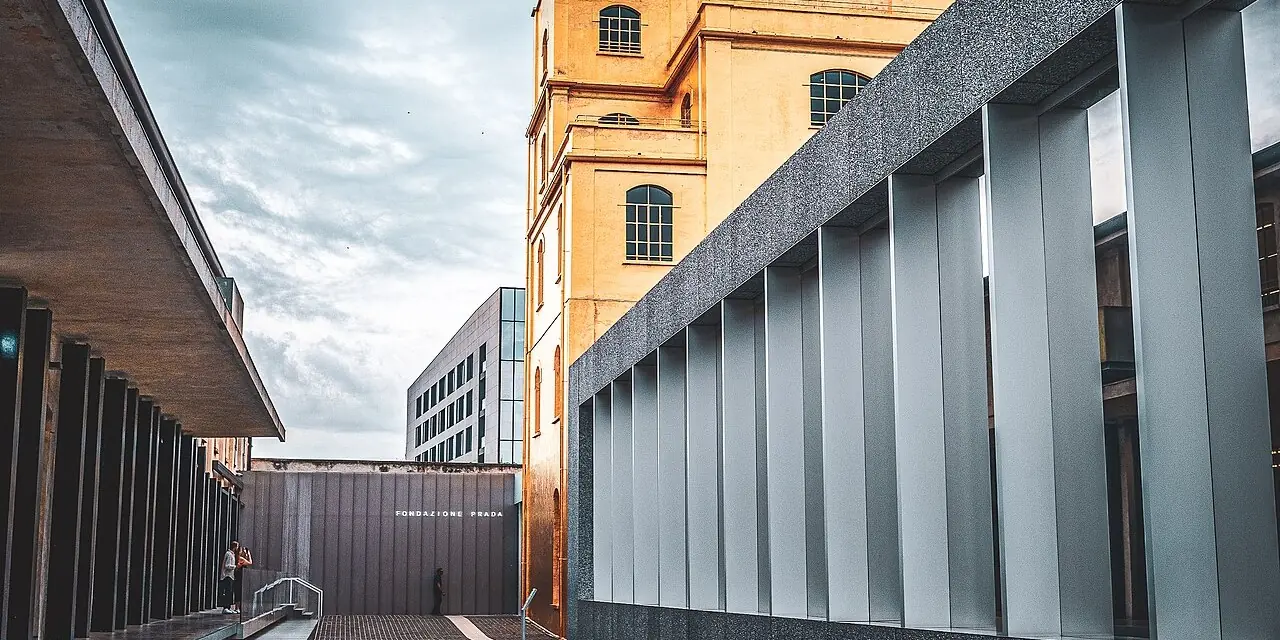
Fondazione Prada is a contemporary art and culture complex located in the Largo Isarco industrial district of Milan. Housed within a repurposed 1910s gin distillery, the site integrates original industrial structures with new architectural interventions designed by Rem Koolhaas and the OMA firm. The campus serves as a multidisciplinary space for exhibitions, film screenings, and research projects.
The site is characterized by its diverse architectural language, ranging from the 'Haunted House'—a four-story building covered in 24-karat gold leaf—to the Podium, a glass-and-aluminum exhibition hall. By blending historical industrial architecture with radical contemporary design, the foundation functions as a laboratory for cultural production and intellectual exchange.
Key Facts
- Materials
- Gold leaf, Concrete, Glass, Aluminum, Polycarbonate
- Civilization
- Contemporary Italian
- Accessibility
- Fully wheelchair accessible
- Date(s)
- 2015
- Condition
- Active cultural institution
- Original Function
- Distillery
- Key Figures
- Miuccia Prada, Patrizio Bertelli, Rem Koolhaas
Industrial Origins
1910sThe site was originally constructed as a distillery complex, serving the industrial needs of early 20th-century Milan. The original layout consisted of warehouses, laboratories, and brewing silos that defined the urban fabric of the Largo Isarco area.
Architectural Transformation
2008-2015Architect Rem Koolhaas and the OMA firm were commissioned to transform the derelict industrial site. The project focused on the coexistence of old and new, preserving the original distillery structures while adding three new buildings: the Podium, the Cinema, and the Torre.
Inauguration and Expansion
2015-2018The foundation officially opened to the public in May 2015. The final phase of the project was completed in 2018 with the opening of the Torre, a nine-story white concrete tower that houses a significant portion of the foundation's permanent contemporary art collection.
Cultural Significance
Fondazione Prada has become a landmark of contemporary cultural production in Milan, shifting the focus of the city's art scene toward the intersection of fashion, architecture, and visual arts. It is recognized for its role in urban regeneration, demonstrating how industrial heritage can be repurposed for high-level cultural programming.
The foundation is also noted for its 'Bar Luce,' designed by film director Wes Anderson, which has become a cultural touchstone in its own right, reflecting the foundation's commitment to blurring the lines between high art and popular culture.
Interpretive Notes
Scholarly debates and areas of uncertainty
The architectural approach of OMA at Fondazione Prada has sparked debate regarding the ethics of 'adaptive reuse.' Some critics argue that the juxtaposition of gold leaf and industrial concrete creates a jarring aesthetic, while others praise the project as a masterclass in architectural layering and the preservation of industrial memory.
Visiting Information
Entry Rules
Open Wednesday through Monday. Tickets can be purchased online or at the entrance. Visitors are subject to security checks upon entry. Large bags and backpacks must be left in the cloakroom.
Best Times to Visit
Weekday mornings are generally quieter. The site is particularly popular during the Milan Design Week (Salone del Mobile) in April.
Photography
Personal photography is permitted for non-commercial use. Tripods, selfie sticks, and flash are strictly prohibited inside exhibition spaces.
Preservation Notes
Visitors are requested to refrain from touching artworks or architectural surfaces. Please follow marked paths, especially within the Torre and the Haunted House.
Nearby POIs
11 shown- Palazzo Reale di Milano2.4 km
- Duomo di Milano2.5 km
- Palazzo Morando2.8 km
- Museo Teatrale alla Scala2.9 km
- Museo Poldi Pezzoli2.9 km
- Bagatti Valsecchi Museum2.9 km
- Basilica di Sant'Ambrogio3 km
- Chiesa di San Maurizio al Monastero Maggiore3.1 km
- Museo Civico di Storia Naturale di Milano3.2 km
- Pinacoteca di Brera3.3 km
- Museo Nazionale Scienza e Tecnologia Leonardo da Vinci3.4 km
Sources & Further Reading
- [1]
- [2]The Architecture of the Fondazione Prada — Francesco Dal Co. Casabella (2016)
Key Facts
- Materials
- Gold leaf, Concrete, Glass, Aluminum, Polycarbonate
- Civilization
- Contemporary Italian
- Accessibility
- Fully wheelchair accessible
- Date(s)
- 2015
- Condition
- Active cultural institution
- Original Function
- Distillery
- Key Figures
- Miuccia Prada, Patrizio Bertelli, Rem Koolhaas
Nearby POIs
11 shown- Palazzo Reale di Milano2.4 km
- Duomo di Milano2.5 km
- Palazzo Morando2.8 km
- Museo Teatrale alla Scala2.9 km
- Museo Poldi Pezzoli2.9 km
- Bagatti Valsecchi Museum2.9 km
- Basilica di Sant'Ambrogio3 km
- Chiesa di San Maurizio al Monastero Maggiore3.1 km
- Museo Civico di Storia Naturale di Milano3.2 km
- Pinacoteca di Brera3.3 km
- Museo Nazionale Scienza e Tecnologia Leonardo da Vinci3.4 km