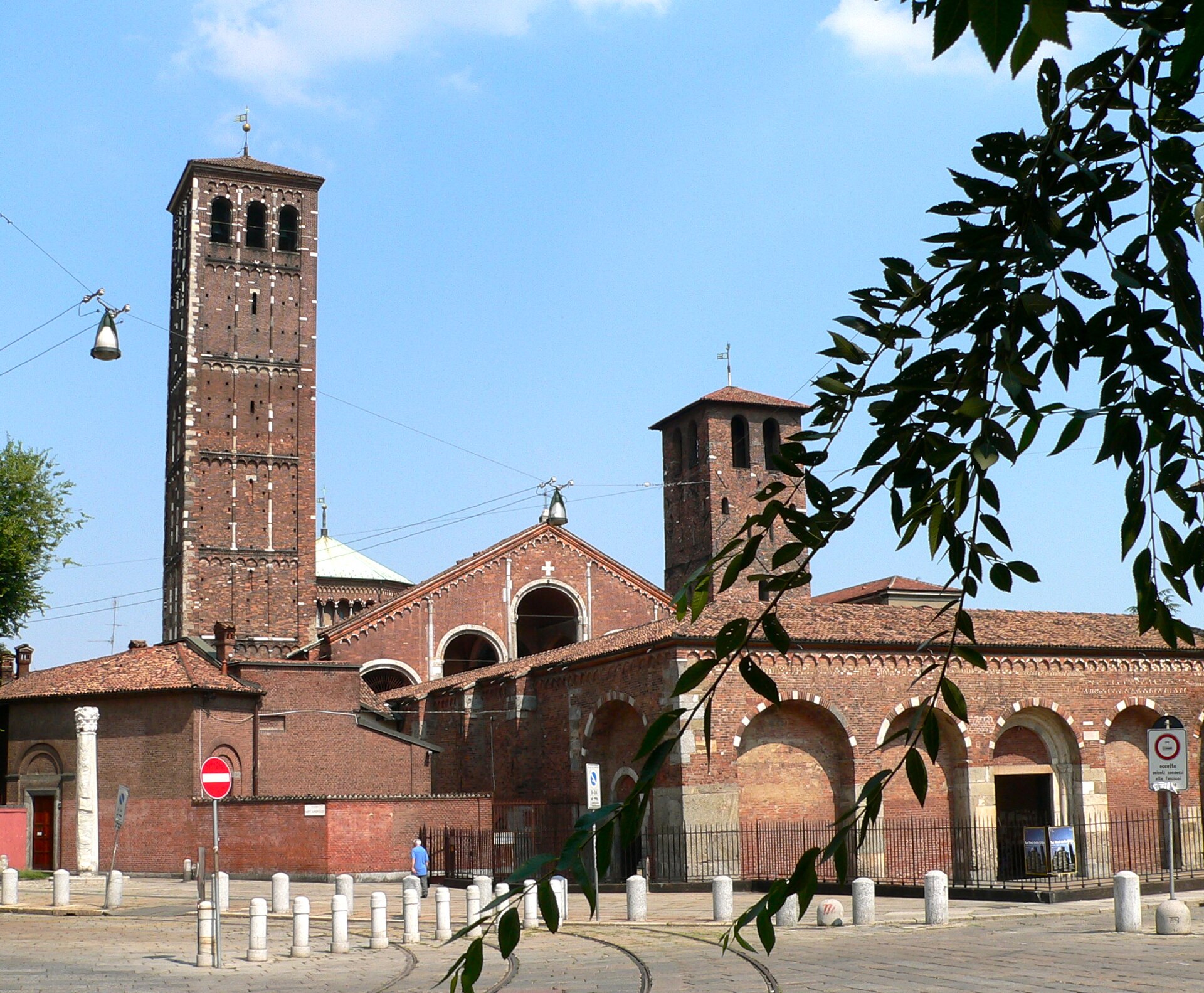
The Basilica of Sant'Ambrogio is one of the oldest churches in Milan, originally constructed by Saint Ambrose in 379 CE on a site where early Christian martyrs were buried. The current structure largely reflects the Romanesque style established during the 11th and 12th centuries, characterized by its distinctive brickwork, two-story atrium, and twin bell towers of varying heights.
Inside, the basilica houses significant liturgical treasures, including the 9th-century golden altar (Paliotto) crafted by Vuolvinus and the sarcophagus of Stilicho. The apse features a notable 12th-century mosaic depicting Christ Pantokrator flanked by saints, serving as a primary example of medieval Lombard art and ecclesiastical architecture.
Key Facts
- Materials
- Brick, Stone, Gold leaf, Marble
- Civilization
- Roman / Lombard
- Accessibility
- Ground level access to atrium and nave
- Date(s)
- 379 CE (original), 11th-12th century (current structure)
- Condition
- Active parish church and historical monument
- Original Function
- Martyrium and Basilica
- Key Figures
- Saint Ambrose, Vuolvinus, Stilicho
Founding and Early History
4th century CEThe church was founded by Bishop Ambrose in 379 CE as the Basilica Martyrum, intended to house the remains of martyrs Gervasius and Protasius. Ambrose himself was interred here upon his death in 397 CE.
Romanesque Reconstruction
11th-12th centuryFollowing damage and the evolution of architectural tastes, the basilica underwent a major reconstruction. This phase introduced the characteristic Lombard Romanesque features, including the vaulted nave and the iconic two-story atrium.
Modern Era and Restoration
20th centuryThe basilica suffered significant damage during Allied bombing raids in 1943. Subsequent restoration efforts focused on repairing the atrium and the damaged sections of the nave, preserving the medieval integrity of the structure.
Cultural Significance
The Basilica of Sant'Ambrogio serves as a cornerstone of Milanese religious identity, dedicated to the city's patron saint. It represents the transition from Late Antique architectural forms to the robust Romanesque style that would define Northern Italian ecclesiastical building for centuries.
Beyond its religious role, the site is a repository of Carolingian and Ottonian art. The golden altar remains one of the most important surviving examples of medieval metalwork, reflecting the wealth and artistic patronage of the Carolingian period in Milan.
Interpretive Notes
Scholarly debates and areas of uncertainty
The exact original layout of the 4th-century basilica remains a subject of archaeological investigation. While the current Romanesque footprint is well-documented, the precise extent of the original Constantinian-era foundations continues to be debated as excavations beneath the nave reveal conflicting structural evidence.
Visiting Information
Entry Rules
Open daily to the public. As an active place of worship, visitors are requested to maintain silence and dress modestly. Entry to the main basilica is free, though specific areas like the treasury or crypt may require a small donation or ticket.
Best Times to Visit
Weekday mornings are generally quieter. Avoid Sunday mornings during mass services to ensure respectful access to the interior.
Photography
Photography is permitted for personal use without flash. Tripods and professional equipment require prior authorization from the parish office.
Preservation Notes
The basilica is a fragile historic site. Visitors are asked to refrain from touching the marble surfaces or the golden altar. Please remain within designated visitor areas to avoid interfering with ongoing liturgical activities.
Nearby POIs
11 shown- Museo Nazionale Scienza e Tecnologia Leonardo da Vinci0.4 km
- Chiesa di San Maurizio al Monastero Maggiore0.4 km
- Basilica di San Vittore al Corpo0.5 km
- Basilica di Santa Maria delle Grazie0.6 km
- Castello Sforzesco0.9 km
- Triennale di Milano1.1 km
- Duomo di Milano1.2 km
- Museo Teatrale alla Scala1.2 km
- Palazzo Reale di Milano1.2 km
- Pinacoteca di Brera1.4 km
- Museo Poldi Pezzoli1.4 km
Sources & Further Reading
- [1]The Basilica of Sant'Ambrogio in Milan — Richard Krautheimer. Journal of the Society of Architectural Historians (1950)View
- [2]Early Medieval Art and Architecture in the Lombard Kingdom — Jane Hawkes. Oxford University Press (2018)
Key Facts
- Materials
- Brick, Stone, Gold leaf, Marble
- Civilization
- Roman / Lombard
- Accessibility
- Ground level access to atrium and nave
- Date(s)
- 379 CE (original), 11th-12th century (current structure)
- Condition
- Active parish church and historical monument
- Original Function
- Martyrium and Basilica
- Key Figures
- Saint Ambrose, Vuolvinus, Stilicho
Nearby POIs
11 shown- Museo Nazionale Scienza e Tecnologia Leonardo da Vinci0.4 km
- Chiesa di San Maurizio al Monastero Maggiore0.4 km
- Basilica di San Vittore al Corpo0.5 km
- Basilica di Santa Maria delle Grazie0.6 km
- Castello Sforzesco0.9 km
- Triennale di Milano1.1 km
- Duomo di Milano1.2 km
- Museo Teatrale alla Scala1.2 km
- Palazzo Reale di Milano1.2 km
- Pinacoteca di Brera1.4 km
- Museo Poldi Pezzoli1.4 km