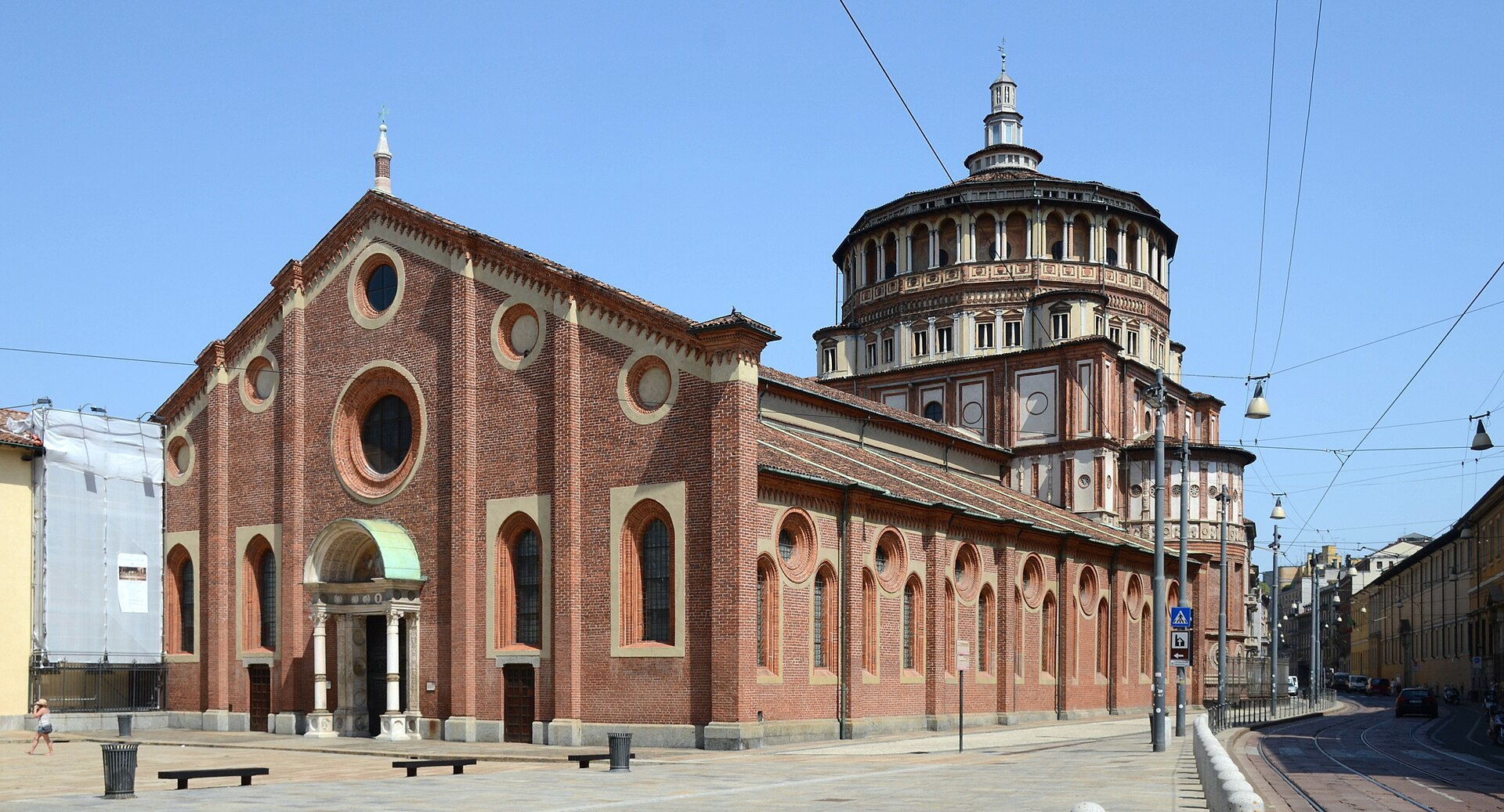
The Basilica di Santa Maria delle Grazie is a church and Dominican convent in Milan, Italy, renowned for housing Leonardo da Vinci's mural, The Last Supper. Commissioned by Duke Ludovico Sforza, the complex serves as a primary example of Lombard Renaissance architecture, blending traditional Gothic elements with the innovative spatial designs of the late 15th century.
The church was designed by Guiniforte Solari, with the tribune and apse later redesigned by Donato Bramante. Despite suffering significant damage during Allied bombing raids in 1943, the structure was meticulously restored, preserving the refectory wall that holds the world-famous mural, which remains one of the most studied and influential works of Western art.
Key Facts
- Materials
- Brick, Terracotta, Marble
- Civilization
- Italian Renaissance
- Accessibility
- Limited; refectory requires advance booking
- Date(s)
- 1463-1497
- Condition
- Active church and museum site
- Original Function
- Dominican convent and church
- Key Figures
- Ludovico Sforza, Leonardo da Vinci, Donato Bramante, Guiniforte Solari
Founding and Early Construction
1463-1469The convent and church were commissioned by Duke Francesco I Sforza, with construction beginning in 1463 under the direction of Guiniforte Solari. The initial design followed a traditional Gothic style common in the region.
Bramante's Expansion
1492-1497Ludovico Sforza decided to make the church the Sforza family burial site and commissioned Donato Bramante to redesign the eastern end. Bramante added a large square tribune, a spacious apse, and a dome, introducing Renaissance proportions to the structure.
The Last Supper
1495-1498During the renovation, Leonardo da Vinci was commissioned to paint The Last Supper on the north wall of the convent's refectory. He utilized an experimental tempera and oil technique on dry wall, which began to deteriorate shortly after completion.
War Damage and Restoration
1943-presentDuring World War II, an Allied bombing raid destroyed the roof and several walls of the refectory. The wall containing The Last Supper survived due to protective sandbagging, and subsequent decades have seen extensive restoration efforts to stabilize both the architecture and the mural.
Cultural Significance
The site represents the intersection of religious devotion and the political ambitions of the Sforza dynasty. It is a cornerstone of Renaissance art history, primarily due to the presence of Leonardo da Vinci's masterpiece, which transformed the refectory into a site of global pilgrimage.
Beyond the mural, the architecture of the tribune by Bramante is considered a pivotal moment in the development of Renaissance spatial theory, influencing architects across Europe for centuries.
Interpretive Notes
Scholarly debates and areas of uncertainty
The primary debate concerns the conservation of The Last Supper. Because Leonardo used an experimental technique rather than traditional fresco, the mural has been subject to centuries of degradation and controversial restoration attempts. Scholars continue to debate the extent to which the original pigment remains versus the layers of later overpainting.
Visiting Information
Entry Rules
The church is open for worship. Access to the refectory to view The Last Supper is strictly regulated, requires a pre-booked ticket, and is limited to 15-minute intervals.
Best Times to Visit
Early morning or late afternoon to avoid the peak tourist crowds. Booking tickets months in advance is essential for the refectory.
Photography
Photography is permitted in the church, but strictly prohibited inside the refectory where The Last Supper is located.
Preservation Notes
The refectory maintains a strictly controlled climate to protect the mural. Visitors must pass through a filtration chamber before entering the viewing area.
Nearby POIs
11 shown- Museo Nazionale Scienza e Tecnologia Leonardo da Vinci0.4 km
- Basilica di San Vittore al Corpo0.4 km
- Basilica di Sant'Ambrogio0.6 km
- Chiesa di San Maurizio al Monastero Maggiore0.6 km
- Triennale di Milano0.7 km
- Castello Sforzesco0.8 km
- Museo Teatrale alla Scala1.4 km
- Pinacoteca di Brera1.5 km
- Duomo di Milano1.6 km
- Palazzo Reale di Milano1.6 km
- Museo Poldi Pezzoli1.7 km
Sources & Further Reading
- [1]Leonardo da Vinci: The Last Supper — Pinin Brambilla Barcilon. University of Chicago Press (2001)
- [2]Bramante and the Architecture of the Renaissance — Arnaldo Bruschi. Thames & Hudson (1977)
Key Facts
- Materials
- Brick, Terracotta, Marble
- Civilization
- Italian Renaissance
- Accessibility
- Limited; refectory requires advance booking
- Date(s)
- 1463-1497
- Condition
- Active church and museum site
- Original Function
- Dominican convent and church
- Key Figures
- Ludovico Sforza, Leonardo da Vinci, Donato Bramante, Guiniforte Solari
Nearby POIs
11 shown- Museo Nazionale Scienza e Tecnologia Leonardo da Vinci0.4 km
- Basilica di San Vittore al Corpo0.4 km
- Basilica di Sant'Ambrogio0.6 km
- Chiesa di San Maurizio al Monastero Maggiore0.6 km
- Triennale di Milano0.7 km
- Castello Sforzesco0.8 km
- Museo Teatrale alla Scala1.4 km
- Pinacoteca di Brera1.5 km
- Duomo di Milano1.6 km
- Palazzo Reale di Milano1.6 km
- Museo Poldi Pezzoli1.7 km