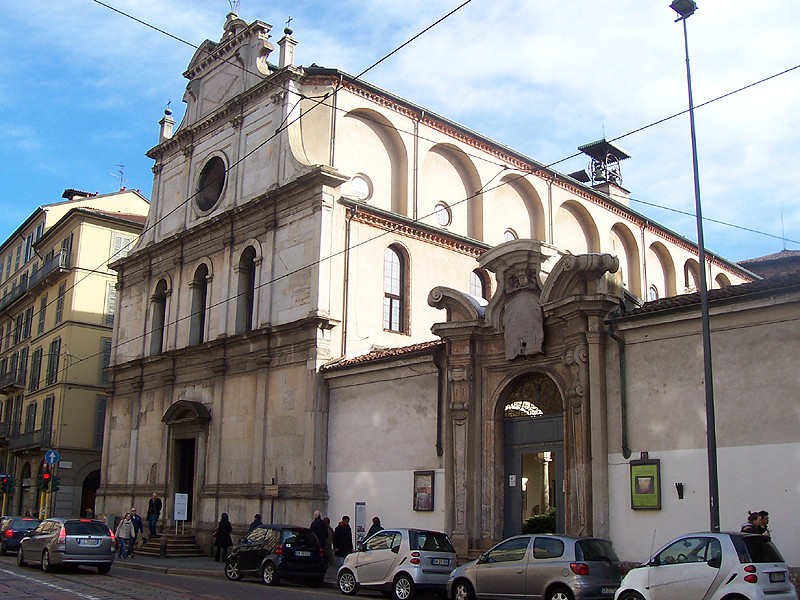
Chiesa di San Maurizio al Monastero Maggiore is a 16th-century church in Milan, originally serving as the principal chapel for the Benedictine nuns of the Monastero Maggiore. The interior is renowned for its extensive cycle of frescoes, which cover nearly every surface, earning it the nickname the 'Sistine Chapel of Milan.'
The structure is divided into two distinct sections: the Hall of the Nuns and the Hall of the Faithful, separated by a partition wall. This layout allowed the cloistered nuns to attend mass while remaining hidden from the public. Today, the site functions as a museum and concert hall, while also hosting liturgical celebrations for the Byzantine Rite.
Key Facts
- Materials
- Brick, Stucco, Fresco pigments
- Civilization
- Italian Renaissance
- Accessibility
- Ground level access, limited space in some areas
- Date(s)
- 1503-1519
- Condition
- Well-preserved, active as a museum and concert venue
- Original Function
- Monastic church for the Benedictine order
- Key Figures
- Gian Giacomo Dolcebuono, Bernardino Luini, Giovanni Antonio Boltraffio
Foundation and Construction
1503-1519The church was commissioned by the Bentivoglio family and built on the site of an earlier Roman-era structure. Architect Gian Giacomo Dolcebuono designed the building, which was completed in the early 16th century to serve the adjacent Benedictine monastery.
Artistic Decoration
16th centuryThe interior decoration was executed primarily by Bernardino Luini and his pupils. The frescoes represent a pinnacle of Lombard Renaissance art, depicting biblical scenes, saints, and the patrons of the church, effectively transforming the interior into a continuous narrative space.
Suppression and Modern Use
18th century - presentFollowing the suppression of the monastery in the late 18th century, the church was deconsecrated for a period. It has since been restored and repurposed as a cultural venue, housing the Archaeological Museum of Milan in the former monastic cloisters.
Cultural Significance
San Maurizio is a primary example of the integration of architecture and painting in Lombardy. Its unique 'double-hall' design provides critical insight into the social and religious constraints placed on cloistered communities during the Renaissance.
Beyond its religious history, the church serves as a vital repository of Milanese art history. The preservation of the Luini frescoes allows scholars and visitors to study the stylistic evolution of the period in a singular, immersive environment.
Interpretive Notes
Scholarly debates and areas of uncertainty
The attribution of certain secondary frescoes within the church remains a subject of minor academic discussion, as the collaborative nature of the Luini workshop makes it difficult to distinguish the master's hand from that of his assistants in specific decorative panels.
Visiting Information
Entry Rules
Open Tuesday to Sunday. Entry is free, though donations are encouraged. No specific dress code is strictly enforced, but respectful attire is expected as it remains a consecrated space.
Best Times to Visit
Weekday mornings are generally quieter. The church is a popular destination for school groups and tourists, so arriving at opening time is recommended to view the frescoes without crowds.
Photography
Personal photography is permitted without flash or tripods. Professional photography requires prior authorization from the museum administration.
Preservation Notes
The frescoes are highly sensitive to humidity and light. Visitors are requested to refrain from touching the walls and to maintain a quiet demeanor to preserve the atmosphere of the space.
Nearby POIs
11 shown- Basilica di Sant'Ambrogio0.4 km
- Castello Sforzesco0.6 km
- Basilica di Santa Maria delle Grazie0.6 km
- Museo Nazionale Scienza e Tecnologia Leonardo da Vinci0.7 km
- Basilica di San Vittore al Corpo0.8 km
- Museo Teatrale alla Scala0.8 km
- Triennale di Milano0.9 km
- Duomo di Milano0.9 km
- Palazzo Reale di Milano1 km
- Pinacoteca di Brera1 km
- Museo Poldi Pezzoli1.1 km
Sources & Further Reading
- [1]Bernardino Luini and the Renaissance in Milan — Giovanni Romano. Electa (2002)
- [2]The Monastero Maggiore in Milan: History and Art — Maria Teresa Fiorio. Silvana Editoriale (2010)
Key Facts
- Materials
- Brick, Stucco, Fresco pigments
- Civilization
- Italian Renaissance
- Accessibility
- Ground level access, limited space in some areas
- Date(s)
- 1503-1519
- Condition
- Well-preserved, active as a museum and concert venue
- Original Function
- Monastic church for the Benedictine order
- Key Figures
- Gian Giacomo Dolcebuono, Bernardino Luini, Giovanni Antonio Boltraffio
Nearby POIs
11 shown- Basilica di Sant'Ambrogio0.4 km
- Castello Sforzesco0.6 km
- Basilica di Santa Maria delle Grazie0.6 km
- Museo Nazionale Scienza e Tecnologia Leonardo da Vinci0.7 km
- Basilica di San Vittore al Corpo0.8 km
- Museo Teatrale alla Scala0.8 km
- Triennale di Milano0.9 km
- Duomo di Milano0.9 km
- Palazzo Reale di Milano1 km
- Pinacoteca di Brera1 km
- Museo Poldi Pezzoli1.1 km