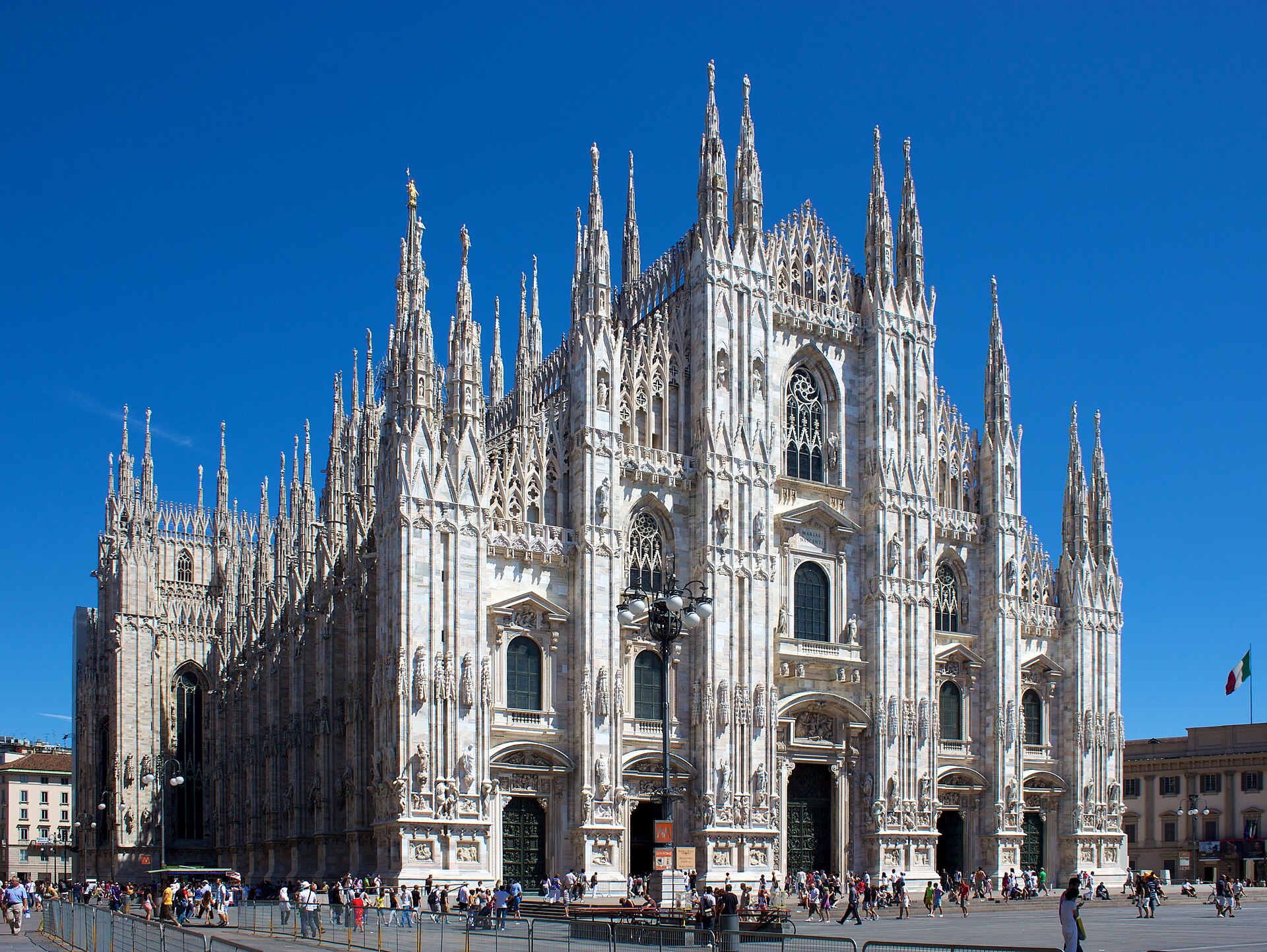
The Duomo di Milano is the cathedral church of the Archdiocese of Milan and one of the largest Gothic cathedrals in Europe. Construction began in 1386 under Gian Galeazzo Visconti and continued in phases for several centuries, resulting in a structure that integrates Late Gothic forms with later Renaissance and 19th-century interventions. Built primarily of Candoglia marble, the cathedral is defined by its dense forest of pinnacles, flying buttresses, and sculptural program. It functions both as a liturgical center and as a monument reflecting Milan’s political ambitions, civic identity, and long-standing role within northern Italy.
Key Facts
- Materials
- Candoglia marble, Brick
- Dimensions
- Approximately 158m long; façade width 92m; spire height 108.5m
- Civilization
- Duchy of Milan; Kingdom of Italy
- Date(s)
- 1386 - 1965 (consecrated 1572)
- Condition
- Active cathedral; continuously maintained and restored
- Original Function
- Cathedral church of Milan
- Key Figures
- Gian Galeazzo Visconti, Carlo Borromeo, Napoleon Bonaparte
- Architectural Style
- Gothic with later Renaissance and Neo-Gothic elements
Foundation and Visconti Patronage
1386-15th centuryConstruction began in 1386 under Duke Gian Galeazzo Visconti, who sought to consolidate political authority and elevate Milan's status. The project replaced earlier ecclesiastical structures on the site. Northern European Gothic models influenced the design, and foreign architects and craftsmen were consulted through the Fabbrica del Duomo, the governing body established to oversee construction.
Renaissance Adjustments
16th centuryDuring the Counter-Reformation, Archbishop Carlo Borromeo promoted liturgical reforms that affected the cathedral's interior arrangement. Although primarily Gothic in structure, Renaissance architects contributed proposals for the façade and decorative elements. The cathedral was formally consecrated in 1572 despite ongoing construction.
Napoleonic Completion Efforts
1805Napoleon Bonaparte ordered accelerated completion of the façade prior to his coronation as King of Italy in 1805. The Neo-Gothic façade visible today reflects this intervention, combining earlier design concepts with 19th-century stylistic interpretation.
Modern Restoration and Maintenance
19th century - presentWork on decorative elements and spires continued into the 19th century, and technical completion was declared in 1965. The cathedral requires continuous restoration due to marble weathering and urban pollution. The Veneranda Fabbrica del Duomo remains responsible for conservation and administration.
Cultural Significance
The Duomo di Milano functions as both a religious center and a civic symbol. Its prolonged construction reflects shifting political regimes, from Visconti and Sforza rule to Spanish, Austrian, Napoleonic, and unified Italian authority. The cathedral’s scale and ornamentation expressed Milan’s economic power and ambition within the Italian peninsula. The Madonnina statue atop the main spire has become an emblem of the city. Municipal tradition long discouraged buildings from surpassing its height, reinforcing the cathedral’s symbolic dominance within Milan’s urban identity.
Interpretive Notes
Scholarly debates and areas of uncertainty
Scholars continue to debate the extent to which the cathedral can be considered purely Gothic, given its extended construction timeline and later stylistic revisions. The façade in particular reflects 19th-century Neo-Gothic interpretation rather than a unified medieval plan. Architectural historians also examine the international influences present in the design, including French and German Gothic models, raising questions about regional adaptation versus direct stylistic importation.
Visiting Information
Entry Rules
Paid admission required for cathedral interior, archaeological area, and rooftop terraces. Reduced rates for children and students. Modest dress required (shoulders and knees covered). Separate ticket for rooftop access.
Best Times to Visit
Early morning on weekdays for shorter security lines. Religious holidays and weekends experience higher attendance. Rooftop visits are clearer in stable weather conditions; access may close during rain or high wind.
Photography
Non-flash photography permitted inside the cathedral. Tripods and commercial filming require authorization. Drone use prohibited.
Preservation Notes
Do not touch marble sculptures or climb restricted areas. Ongoing conservation work may limit access to certain sections. Rooftop pathways include stairs and uneven surfaces.
Nearby POIs
11 shown- Palazzo Reale di Milano0.1 km
- Museo Teatrale alla Scala0.4 km
- Museo Poldi Pezzoli0.5 km
- Palazzo Morando0.7 km
- Bagatti Valsecchi Museum0.7 km
- Pinacoteca di Brera0.8 km
- Chiesa di San Maurizio al Monastero Maggiore0.9 km
- Castello Sforzesco1.1 km
- Basilica di Sant'Ambrogio1.2 km
- Museo Civico di Storia Naturale di Milano1.3 km
- Basilica di Santa Maria delle Grazie1.6 km
Sources & Further Reading
- [1]Il Duomo di Milano — Veneranda Fabbrica del Duomo. Silvana Editoriale
- [2]Italian Gothic Architecture — Paul Frankl. Yale University Press
- [3]Architecture in Italy 1400-1500 — Ludwig H. Heydenreich and Wolfgang Lotz. Yale University Press
Key Facts
- Materials
- Candoglia marble, Brick
- Dimensions
- Approximately 158m long; façade width 92m; spire height 108.5m
- Civilization
- Duchy of Milan; Kingdom of Italy
- Date(s)
- 1386 - 1965 (consecrated 1572)
- Condition
- Active cathedral; continuously maintained and restored
- Original Function
- Cathedral church of Milan
- Key Figures
- Gian Galeazzo Visconti, Carlo Borromeo, Napoleon Bonaparte
- Architectural Style
- Gothic with later Renaissance and Neo-Gothic elements
Nearby POIs
11 shown- Palazzo Reale di Milano0.1 km
- Museo Teatrale alla Scala0.4 km
- Museo Poldi Pezzoli0.5 km
- Palazzo Morando0.7 km
- Bagatti Valsecchi Museum0.7 km
- Pinacoteca di Brera0.8 km
- Chiesa di San Maurizio al Monastero Maggiore0.9 km
- Castello Sforzesco1.1 km
- Basilica di Sant'Ambrogio1.2 km
- Museo Civico di Storia Naturale di Milano1.3 km
- Basilica di Santa Maria delle Grazie1.6 km