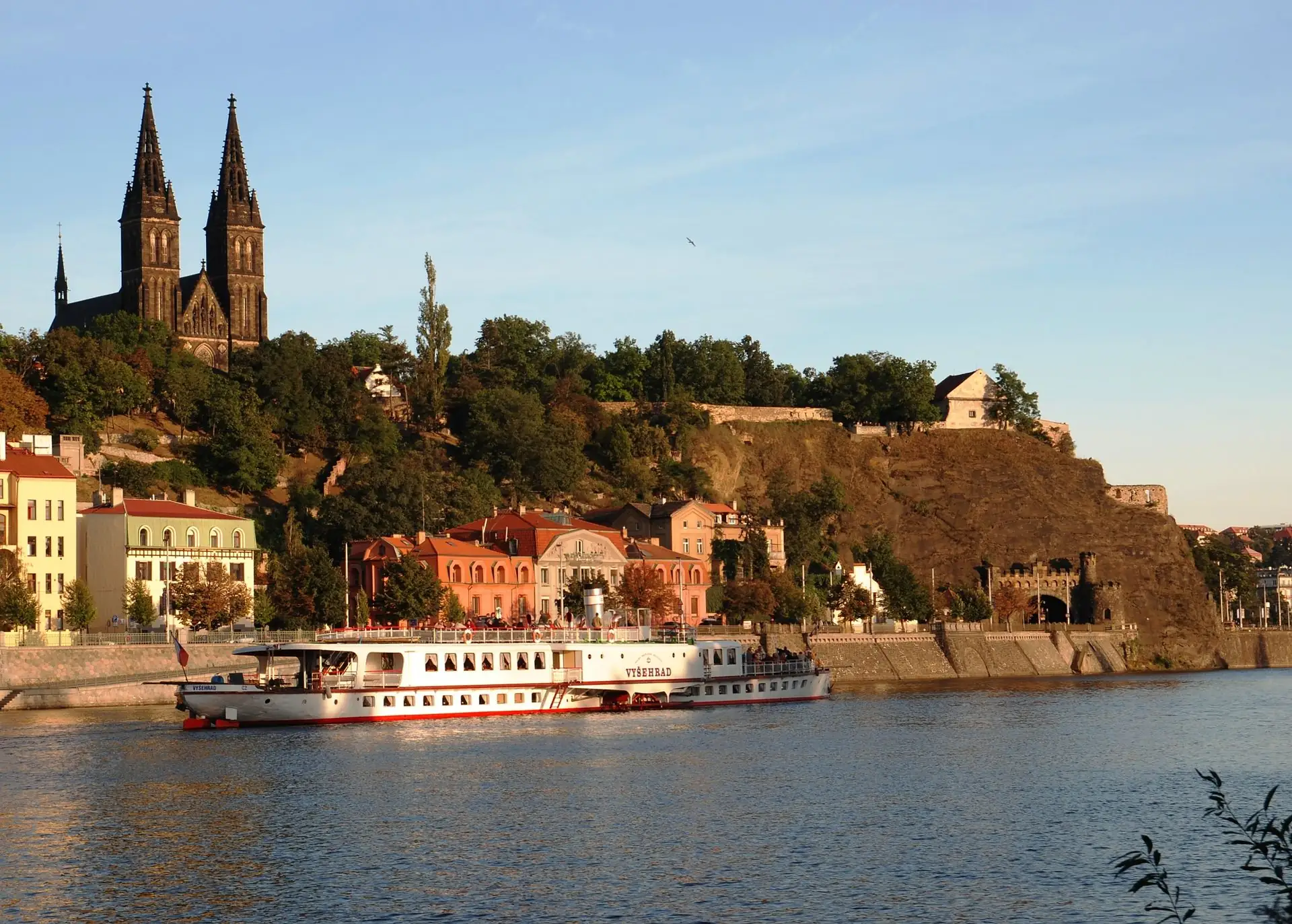
Vyšehrad is a historic fortified complex situated on a rocky promontory above the Vltava River in Prague. Traditionally associated with early Czech legends and the Přemyslid dynasty, the site functioned as a political and military center from at least the 10th century. Although often overshadowed by Prague Castle, Vyšehrad played a significant role in the early formation of the Bohemian state. The complex includes fortification walls, the Basilica of St. Peter and St. Paul, the Rotunda of St. Martin, and the Vyšehrad Cemetery. Much of the present defensive structure dates to major Baroque fortification works of the 17th century, reflecting its continued strategic importance.
Key Facts
- Materials
- Stone masonry, Brick, Earthwork ramparts
- Civilization
- Přemyslid Bohemia
- Accessibility
- Open public access; uneven terrain and historic pathways
- Date(s)
- 10th century origins; major Baroque fortifications 17th century
- Condition
- Preserved historic fortress complex and public park
- Original Function
- Fortified royal residence and military stronghold
- Key Figures
- Přemyslid dynasty, Charles IV
Early Medieval Origins
10th–11th centuriesArchaeological evidence indicates settlement at Vyšehrad by the 10th century. It became associated with the ruling Přemyslid dynasty and developed as a fortified residence. Medieval chronicles later linked the site to legendary figures such as Princess Libuše, embedding it in Czech national mythology.
Romanesque & Gothic Development
11th–14th centuriesIn the 11th century, Vratislaus II established a royal chapter at Vyšehrad, elevating its ecclesiastical importance. Romanesque structures, including the Rotunda of St. Martin, date from this period. Under Charles IV in the 14th century, the site was incorporated into Prague’s expanded fortification system and briefly regained political prominence.
Decline & Baroque Fortification
15th–17th centuriesFollowing the Hussite Wars, Vyšehrad’s political significance diminished. In the 17th century, however, it was transformed into a Baroque fortress as part of Habsburg defensive strategies. Bastions and ramparts reshaped the landscape, giving the complex much of its present appearance.
National Revival & Modern Role
19th century–presentDuring the 19th-century Czech National Revival, Vyšehrad was reinterpreted as a symbol of early Czech statehood and legend. The adjacent cemetery became the burial site of prominent Czech cultural figures. Today the area functions as both a historic monument and a public recreational space.
Cultural Significance
Vyšehrad occupies a central place in Czech cultural memory due to its association with foundational legends and early rulers. Medieval chronicles portrayed it as the seat of Princess Libuše, linking the site to narratives of prophecy and state formation. In the 19th century, national revivalists emphasized Vyšehrad’s symbolic value as a counterpart to Prague Castle. The cemetery established there became a pantheon of Czech cultural identity, reinforcing the site’s role in shaping historical consciousness.
Interpretive Notes
Scholarly debates and areas of uncertainty
Scholars debate the historical accuracy of early medieval chronicles that describe Vyšehrad as a primary royal seat, as archaeological evidence suggests a more complex political landscape between Vyšehrad and Prague Castle. There is also discussion regarding the extent to which 19th-century nationalist reinterpretations reshaped public perception of the site’s medieval importance, blending documented history with legend.
Visiting Information
Entry Rules
Open year-round as a public park and historic complex; free entry to outdoor areas. Ticketed entry required for the basilica interior and select exhibitions. Cemetery accessible during posted hours.
Best Times to Visit
Early morning and late afternoon offer quieter conditions. The site is exposed and can be windy; plan accordingly. Combining with riverside walks allows efficient route planning.
Photography
Personal photography permitted in outdoor areas. Flash photography may be restricted inside the basilica. Drone use prohibited without authorization.
Preservation Notes
Stay on marked paths near ramparts and bastions. Some fortification areas have steep drops. Respect cemetery regulations and posted quiet zones.
Nearby POIs
11 shownSources & Further Reading
- [1]Vyšehrad. National Cultural Heritage Institute of the Czech Republic (2023)
- [2]The Czechs and the Lands of the Bohemian Crown — Hugh Agnew. Hoover Institution Press (2004)
- [3]Medieval Prague — Jiří Fajt. Karolinum Press (2012)
Key Facts
- Materials
- Stone masonry, Brick, Earthwork ramparts
- Civilization
- Přemyslid Bohemia
- Accessibility
- Open public access; uneven terrain and historic pathways
- Date(s)
- 10th century origins; major Baroque fortifications 17th century
- Condition
- Preserved historic fortress complex and public park
- Original Function
- Fortified royal residence and military stronghold
- Key Figures
- Přemyslid dynasty, Charles IV