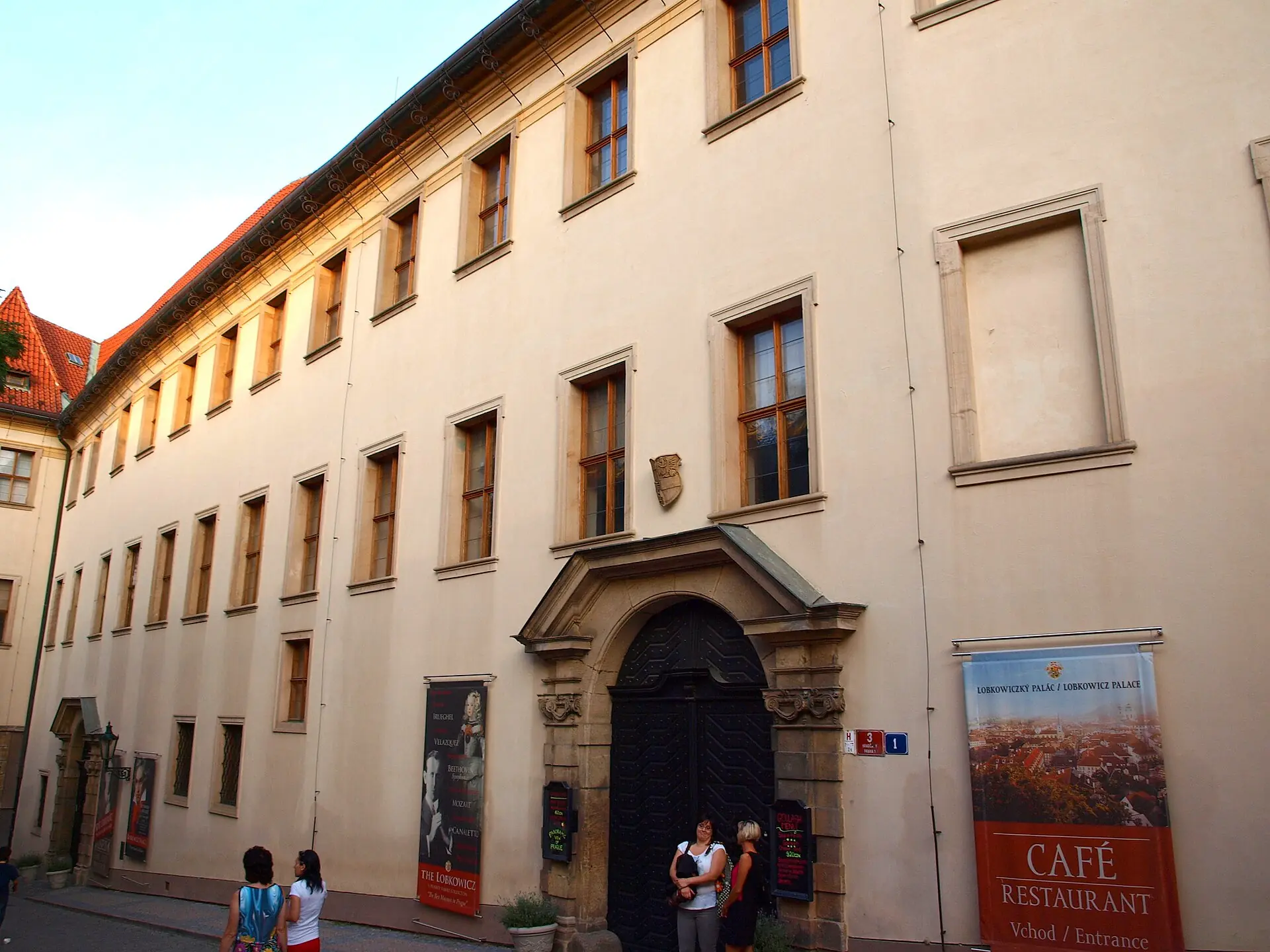
Lobkowicz Palace is a 16th-century noble residence located within the Prague Castle complex. It is the only privately owned building inside the castle grounds and has long been associated with the Lobkowicz family, one of the most prominent aristocratic dynasties in Bohemian history. The palace was constructed in the Renaissance style and later modified with Baroque elements following damage during 17th-century conflicts. Over the centuries, the palace functioned as a family residence, a site of political negotiation, and a repository of significant cultural collections. Confiscated by the Nazi regime in 1939 and again by the Communist government after 1948, it was returned to the Lobkowicz family in the 1990s. Today it houses the Lobkowicz Collections Museum, displaying art, manuscripts, musical scores, and historical artifacts.
Key Facts
- Materials
- Stone masonry, Brick, Stucco, Timber roofing
- Civilization
- Kingdom of Bohemia
- Accessibility
- Partial wheelchair access; historic layout includes stairs
- Date(s)
- 16th century (c. 1550s); Baroque modifications 17th century
- Condition
- Restored palace functioning as a private museum
- Original Function
- Aristocratic residence
- Key Figures
- Lobkowicz family, Polyxena of Lobkowicz
Renaissance Construction
16th centuryThe palace was constructed in the mid-16th century as a Renaissance residence for the Lobkowicz family, reflecting their rising political influence within the Kingdom of Bohemia. Its position within Prague Castle underscored the family’s close relationship with royal authority.
Thirty Years’ War & Baroque Adaptation
17th centuryDuring the upheavals of the Thirty Years’ War, the palace played a role in political events surrounding the Bohemian Revolt. After sustaining damage, it was remodeled with Baroque features. The Lobkowicz family continued to expand their art and music collections during this period.
Confiscation & Restitution
20th centuryThe palace and its collections were confiscated by the Nazi regime in 1939 and later by the Communist government in 1948. Following the Velvet Revolution of 1989, the property was restituted to the Lobkowicz family, marking one of the earliest major post-Communist restitutions in the Czech Republic.
Museum Era
1990s–presentAfter restoration, the palace reopened as a museum presenting the Lobkowicz Collections. Exhibits include paintings by European masters, decorative arts, and original musical manuscripts, including works associated with Beethoven and Mozart, reflecting the family’s patronage of the arts.
Cultural Significance
Lobkowicz Palace reflects the role of aristocratic families in shaping Bohemian political and cultural life. The Lobkowicz dynasty maintained close ties to the Habsburg court and were significant patrons of music and visual arts, contributing to Central European cultural networks. The palace’s restitution after 1989 became symbolic of broader efforts to address property confiscations under totalitarian regimes. Its reopening as a museum represents both the preservation of private cultural heritage and its integration into the public historical landscape of Prague Castle.
Interpretive Notes
Scholarly debates and areas of uncertainty
Scholars debate aspects of the palace’s early architectural phases due to limited documentation from the 16th century. Reconstruction of its original Renaissance appearance relies on later records and comparative analysis with similar noble residences. There is also ongoing academic discussion concerning the ethics and legal frameworks of post-Communist restitution, with Lobkowicz Palace often cited as a case study in cultural property return and private museum management.
Visiting Information
Entry Rules
Open daily; ticketed entry required. Separate admission from the general Prague Castle circuit. Audio guides included with entry. Closed on select public holidays.
Best Times to Visit
Morning hours generally offer quieter access. Combining a visit with other Prague Castle sites allows efficient use of time within the complex.
Photography
Personal photography permitted without flash or tripods. Some temporary exhibitions may restrict photography. Commercial filming requires prior permission.
Preservation Notes
Do not touch artworks or furnishings. Bags may be subject to inspection. Remain within designated gallery spaces.
Nearby POIs
11 shownSources & Further Reading
- [1]
- [2]The Thirty Years War — Peter H. Wilson. Belknap Press (2009)
- [3]Restitution and Cultural Property in Post-Communist Europe — Catherine Baker. Routledge (2014)
Key Facts
- Materials
- Stone masonry, Brick, Stucco, Timber roofing
- Civilization
- Kingdom of Bohemia
- Accessibility
- Partial wheelchair access; historic layout includes stairs
- Date(s)
- 16th century (c. 1550s); Baroque modifications 17th century
- Condition
- Restored palace functioning as a private museum
- Original Function
- Aristocratic residence
- Key Figures
- Lobkowicz family, Polyxena of Lobkowicz