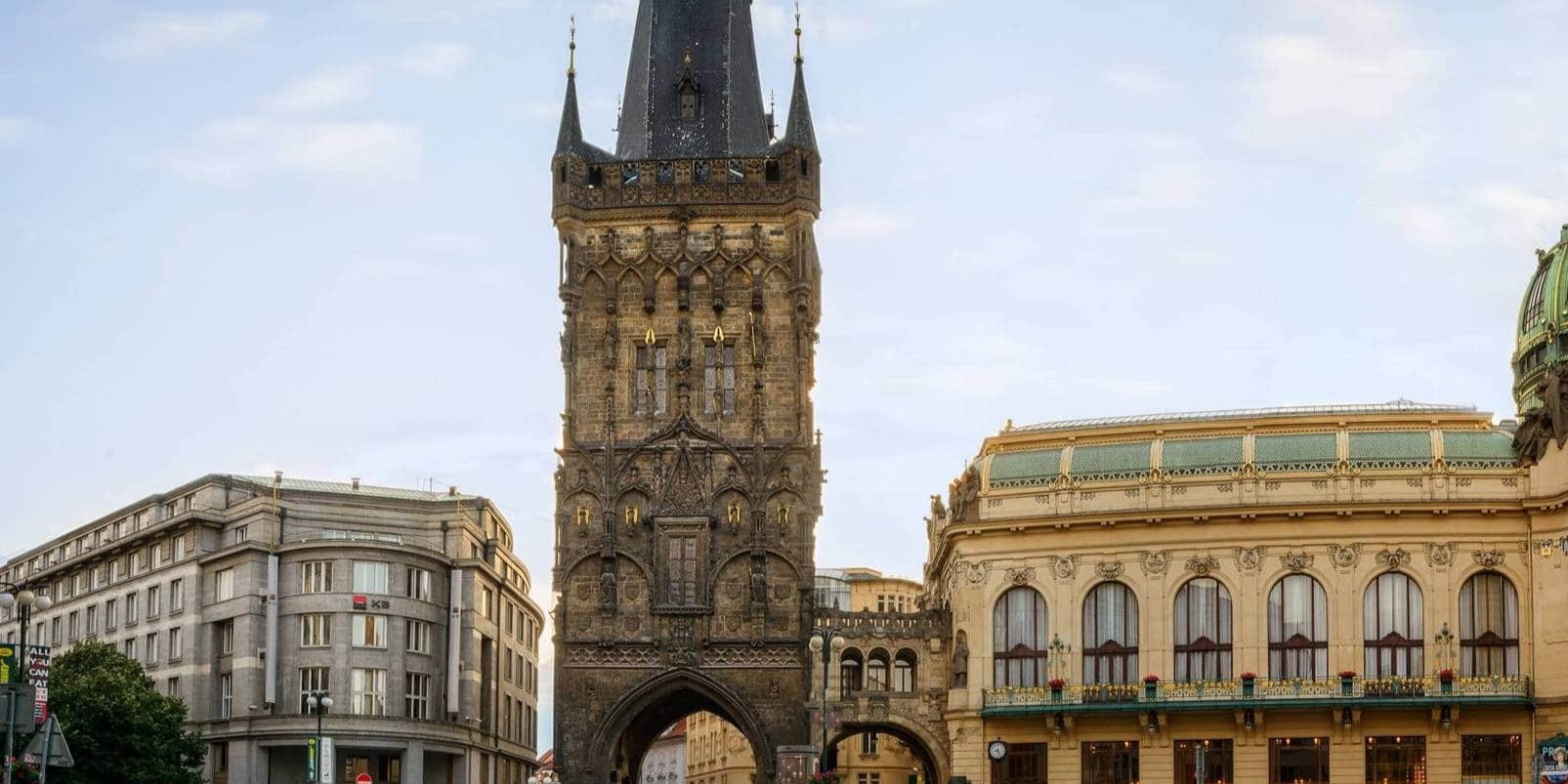
The Powder Tower (Prašná brána) is a late Gothic city gate in Prague that once formed part of the medieval fortifications separating the Old Town from the New Town. Construction began in 1475 during the reign of King Vladislaus II on the site of an earlier 13th-century gate. The tower was intended to serve as a ceremonial entrance for royal coronation processions traveling along the Royal Route toward Prague Castle. Although never fully integrated into a completed defensive system, the structure became a symbolic rather than military landmark. In the 17th century it was used to store gunpowder, which gave the tower its current name. Restored in the 19th century in a Neo-Gothic style, it remains one of Prague’s most prominent medieval monuments.
Key Facts
- Height
- Approximately 65 meters
- Materials
- Sandstone
- Civilization
- Kingdom of Bohemia
- Date(s)
- 1475-early 16th century
- Condition
- Restored; open to visitors with exhibition space and viewing gallery
- Original Function
- Ceremonial city gate and part of fortifications
- Key Figures
- Vladislaus II of Hungary and Bohemia
- Architectural Style
- Late Gothic
Medieval Origins
13th-15th centuryThe site originally held one of the Old Town’s early defensive gates, constructed in the 13th century as part of Prague’s expanding fortification system. By the late 15th century, the older structure had fallen into disrepair, prompting plans for a new, more monumental gate.
Construction under Vladislaus II
1475-early 16th centuryConstruction began in 1475 under King Vladislaus II. Designed in the Late Gothic style, the tower was conceived as a grand ceremonial entrance marking the beginning of the Royal Route. Political and financial constraints halted work before completion, leaving parts of the intended decorative program unfinished.
Early Modern Use
17th-18th centuryDuring the 17th century the tower was used to store gunpowder, leading to its present name. Damage sustained during conflicts and neglect altered its original appearance. Its defensive role diminished as fortification strategies evolved.
19th-Century Restoration
19th centuryIn the 1870s the tower underwent major restoration led by architect Josef Mocker, who aimed to revive its Gothic character in line with contemporary historicist principles. The restoration reshaped much of its exterior ornamentation and established the tower’s present form.
Modern Role
20th century-presentToday the tower functions as a historical monument and museum space. Visitors can access an interior exhibition and ascend to the viewing gallery, which provides views over the Old Town. The structure forms part of Prague’s UNESCO-listed historic center.
Cultural Significance
The Powder Tower marked the ceremonial threshold between Prague’s Old Town and the royal road leading to Prague Castle. As the starting point of coronation processions, it symbolized the authority of Bohemian rulers and the political importance of Prague within Central Europe. In modern Prague, the tower remains embedded in the city’s historical identity. Its preservation reflects 19th-century nationalist efforts to emphasize Gothic heritage as a defining feature of Czech cultural history.
Visiting Information
Entry Rules
Open daily. Entry is ticketed for access to the interior exhibition and viewing gallery. Hours vary seasonally.
Best Times to Visit
Early morning shortly after opening for reduced crowds. Late afternoon offers fewer tour groups. Summer midday can be congested due to its location along a primary tourist corridor.
Photography
Personal photography permitted without flash or tripods. Commercial filming and drone use require prior authorization from city authorities.
Preservation Notes
Visitors must remain on designated pathways and staircases inside the tower. The structure includes narrow spiral stairs that may not be suitable for those with mobility limitations.
Nearby POIs
11 shown- Museum of Communism0.2 km
- Church of Our Lady before Tyn0.4 km
- Prague Astronomical Clock0.5 km
- Museum of Bricks Prague0.8 km
- Klementinum0.8 km
- Museum of Decorative Arts in Prague0.9 km
- Prague National Museum1 km
- Prague National Technical Museum1.2 km
- Museum Kampa1.4 km
- Lobkowicz Palace1.7 km
- Church of Saint Nicholas1.8 km
Sources & Further Reading
- [1]Prague: Art and Architecture — Milada Vilímková and Pavel Preiss. Springer (1991)
- [2]The Architecture of Prague — Andrew Lawler. Architectural History Review (2003)
Key Facts
- Height
- Approximately 65 meters
- Materials
- Sandstone
- Civilization
- Kingdom of Bohemia
- Date(s)
- 1475-early 16th century
- Condition
- Restored; open to visitors with exhibition space and viewing gallery
- Original Function
- Ceremonial city gate and part of fortifications
- Key Figures
- Vladislaus II of Hungary and Bohemia
- Architectural Style
- Late Gothic
Nearby POIs
11 shown- Museum of Communism0.2 km
- Church of Our Lady before Tyn0.4 km
- Prague Astronomical Clock0.5 km
- Museum of Bricks Prague0.8 km
- Klementinum0.8 km
- Museum of Decorative Arts in Prague0.9 km
- Prague National Museum1 km
- Prague National Technical Museum1.2 km
- Museum Kampa1.4 km
- Lobkowicz Palace1.7 km
- Church of Saint Nicholas1.8 km