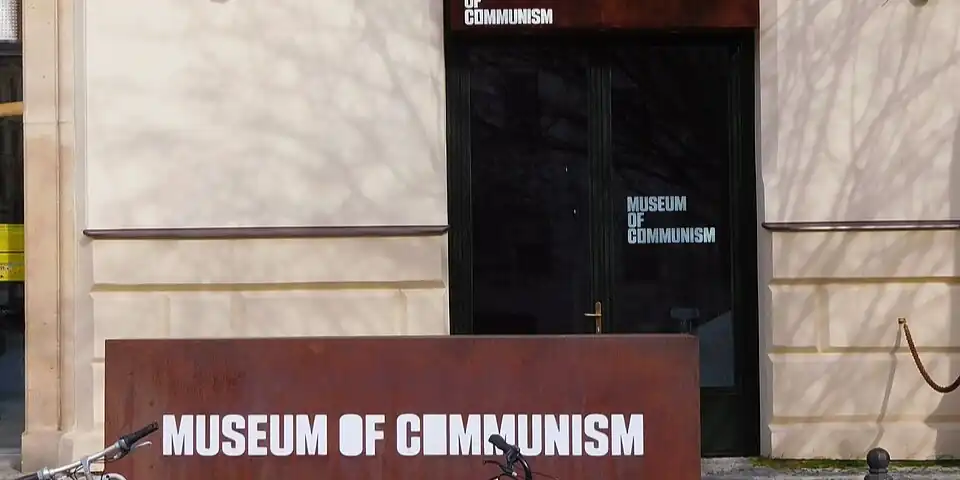
The Museum of Communism in Prague documents the political, social, and cultural history of Czechoslovakia under Communist rule from 1948 to 1989. Through photographs, archival footage, propaganda materials, reconstructed interiors, and personal testimonies, the museum examines the mechanisms of state control, daily life, censorship, surveillance, and resistance during the period. The exhibition traces the rise of the Communist Party following the February 1948 coup, the consolidation of power under a centralized planned economy, and the eventual collapse of the regime during the Velvet Revolution of 1989. It situates the Czech experience within the broader context of the Eastern Bloc and Cold War Europe.
Key Facts
- Civilization
- Czechoslovakia (Communist period 1948-1989)
- Focus Period
- 1948-1989
- Accessibility
- Located in a central Prague building; elevator access available
- Date(s)
- 2001
- Condition
- Active museum with permanent exhibition
- Original Function
- Museum documenting the Communist period
- Key Figures
- Klement Gottwald, Alexander Dubček, Václav Havel
Communist Takeover
1948In February 1948, the Communist Party of Czechoslovakia consolidated power in a political coup, establishing a single-party state aligned with the Soviet Union. The event marked the beginning of four decades of authoritarian governance.
Consolidation and Control
1950s-1960sThe early decades of Communist rule were characterized by nationalization of industry, collectivization of agriculture, political repression, and the use of secret police surveillance. Show trials and censorship reinforced party control over public life.
Prague Spring and Normalization
1968-1970sIn 1968, reformist leader Alexander Dubček introduced policies aimed at creating "socialism with a human face." The Warsaw Pact invasion in August 1968 ended these reforms and ushered in a period of political normalization and renewed repression.
Velvet Revolution
1989Mass demonstrations in late 1989 led to the peaceful collapse of the Communist regime during the Velvet Revolution. Dissident playwright Václav Havel emerged as a central figure and later became president of the newly democratic state.
Founding of the Museum
2001-presentThe Museum of Communism opened in 2001 to provide historical context and educational interpretation of the Communist era. It presents both institutional history and personal narratives, contributing to ongoing public discussion about memory and post-socialist identity.
Cultural Significance
The museum plays a role in shaping public memory of the Communist period in the Czech Republic. It addresses generational differences in how the era is remembered, ranging from experiences of repression to everyday adaptation within a controlled system. Its location in central Prague places the narrative of 20th-century political transformation within the broader historical landscape of the city, linking medieval, imperial, and modern histories in close physical proximity.
Visiting Information
Entry Rules
Open daily. Entry is ticketed. Discounted rates available for students and seniors.
Best Times to Visit
Late morning on weekdays typically has fewer visitors. Visiting in conjunction with sites connected to the Velvet Revolution can provide historical continuity.
Photography
Personal photography permitted without flash. Tripods and commercial filming require prior permission.
Preservation Notes
Exhibits include original documents and multimedia installations. Visitors should follow posted guidelines and avoid touching display materials unless indicated as interactive.
Nearby POIs
11 shownSources & Further Reading
- [1]The Prague Spring and its Aftermath — Kieran Williams. Cambridge University Press (1997)
- [2]Czechoslovakia: The State That Failed — Mary Heimann. Yale University Press (2009)
- [3]Velvet Revolution. Encyclopaedia Britannica
Key Facts
- Civilization
- Czechoslovakia (Communist period 1948-1989)
- Focus Period
- 1948-1989
- Accessibility
- Located in a central Prague building; elevator access available
- Date(s)
- 2001
- Condition
- Active museum with permanent exhibition
- Original Function
- Museum documenting the Communist period
- Key Figures
- Klement Gottwald, Alexander Dubček, Václav Havel