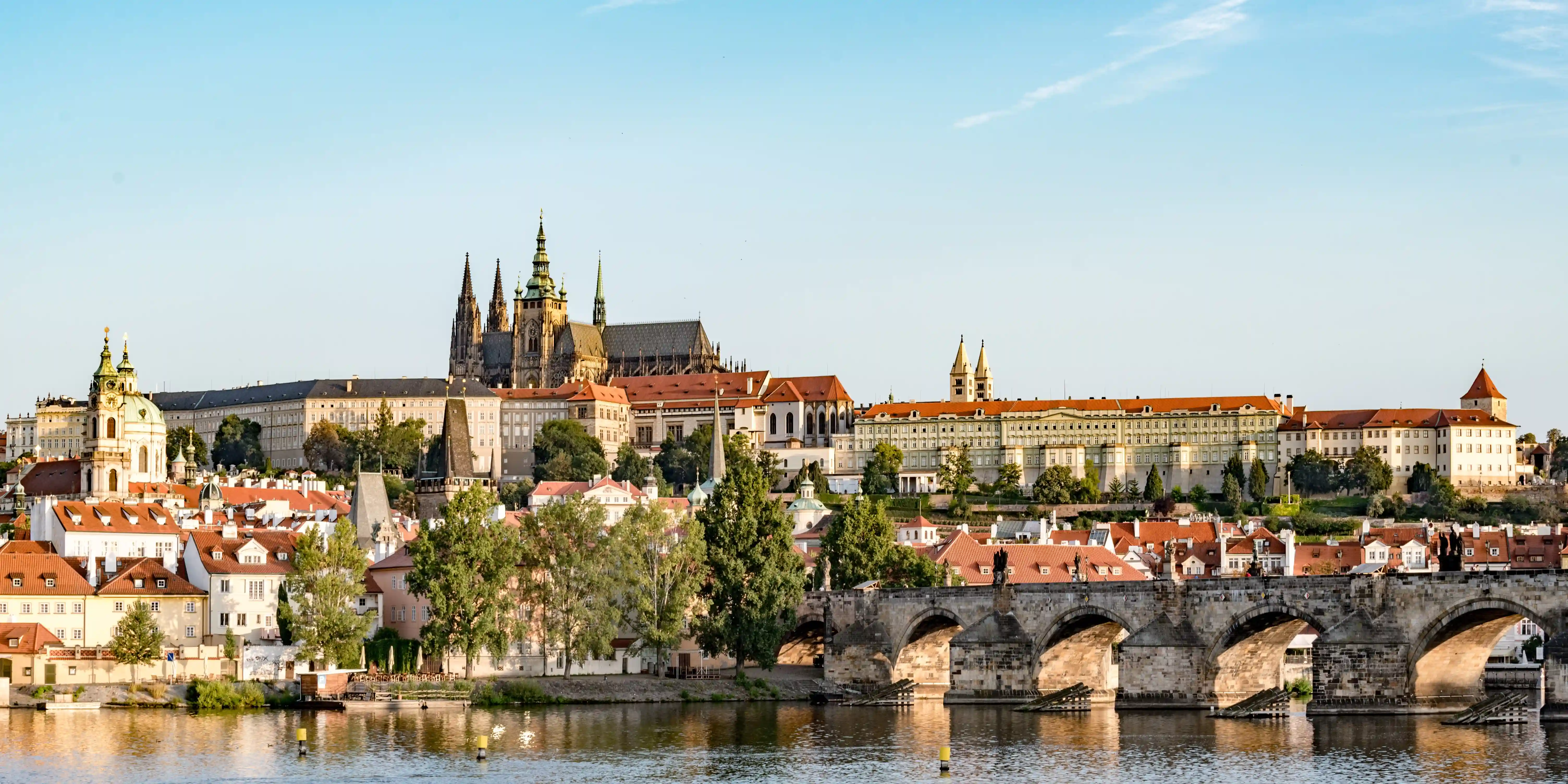
Prague Castle is a historic castle complex overlooking the Vltava River in Prague and has served as the seat of Czech rulers since the 9th century. Founded around 880 by Prince Bořivoj of the Přemyslid dynasty, it developed into the political and religious center of the Kingdom of Bohemia and later the Holy Roman Empire under Charles IV. Over centuries, successive rulers expanded and rebuilt the complex, resulting in a layered architectural ensemble that includes palaces, churches, courtyards, fortifications, and administrative buildings. The castle contains major monuments such as St. Vitus Cathedral, the Old Royal Palace, St. George’s Basilica, and Golden Lane. It has functioned as the residence of Bohemian kings, Holy Roman Emperors, Habsburg rulers, and today the President of the Czech Republic. Rather than a single structure, Prague Castle is a continuously evolving compound reflecting more than a millennium of Central European political and architectural history.
Key Facts
- Materials
- Stone masonry, Sandstone, Brick
- Civilization
- Přemyslid dynasty; later Kingdom of Bohemia and Habsburg Monarchy
- Date(s)
- Founded c. 880 CE
- Condition
- Preserved historic complex; official residence of the President of the Czech Republic
- Original Function
- Fortified princely residence and seat of government
- Key Figures
- Bořivoj I, Charles IV, Rudolf II
- Architectural Style
- Romanesque, Gothic, Renaissance, Baroque
Early Medieval Foundations
9th–12th centuriesPrague Castle was established around 880 by Prince Bořivoj I as a fortified residence. Early structures included a wooden palace and stone churches, such as the Basilica of St. George. By the 10th century, it had become the principal seat of the Přemyslid rulers and the political center of the emerging Czech state.
Gothic Expansion under Charles IV
14th centuryDuring the reign of Charles IV, Prague became an imperial capital of the Holy Roman Empire. Major Gothic reconstruction transformed the castle, including the foundation of St. Vitus Cathedral in 1344 and the rebuilding of the royal palace. The castle complex expanded to reflect Prague’s elevated political and religious status.
Renaissance and Habsburg Era
16th–18th centuriesUnder Habsburg rule, Renaissance and later Baroque elements were added. Emperor Rudolf II made Prague his primary residence in the late 16th century, turning the castle into a center of art, science, and court culture. Subsequent centuries saw continued modifications, including defensive improvements and palace renovations.
Modern State Symbol
1918–presentAfter the establishment of Czechoslovakia in 1918, the castle became the official residence of the president. Architect Jože Plečnik carried out significant early 20th-century adaptations to modernize the complex while preserving its historic character. Today, it functions both as a working seat of government and a major cultural and tourist site.
Cultural Significance
Prague Castle has served continuously as the symbolic and administrative heart of the Czech lands. It was the coronation site of Bohemian kings and the residence of Holy Roman Emperors when Prague functioned as an imperial capital. Its architectural evolution mirrors shifts in political authority, religious life, and artistic patronage across Central Europe. In the modern era, the castle represents Czech statehood and national continuity. It houses the Bohemian Crown Jewels and remains the official seat of the President of the Czech Republic, reinforcing its role as both a historic monument and a living institution of governance.
Interpretive Notes
Scholarly debates and areas of uncertainty
Scholars debate the precise layout and appearance of the earliest 9th-century fortifications, as archaeological evidence for the original wooden and early stone structures is limited. Interpretations rely on fragmentary remains and later written sources. There is also ongoing discussion about the degree to which 20th-century restorations, particularly those led by Jože Plečnik, should be viewed as preservation versus creative reinterpretation of the medieval complex.
Visiting Information
Entry Rules
Open daily. Entry to the castle grounds is free. Access to major interiors, including St. Vitus Cathedral (full circuit), the Old Royal Palace, St. George’s Basilica, and Golden Lane, requires a Prague Castle ticket. Security screening is required at all entrances.
Best Times to Visit
Arrive at opening time to minimize security line delays. Midday and summer months see the highest visitor volume. Weekdays outside peak tourist season offer more manageable access to interior exhibitions.
Photography
Personal photography permitted without flash or tripods in most areas. Some exhibitions and treasury rooms prohibit photography. Commercial photography and drone use require official authorization.
Preservation Notes
Remain within marked visitor routes and respect barriers protecting historic interiors. Portions of the complex may be closed during official state events or restoration work.
Nearby POIs
11 shownSources & Further Reading
- [1]
- [2]Prague: The Crown of Bohemia, 1347–1437 — Barbara Drake Boehm and Jiří Fajt. Metropolitan Museum of Art (2005)
- [3]The Architecture of Prague — Andrew Lees. University of Chicago Press (2008)
Key Facts
- Materials
- Stone masonry, Sandstone, Brick
- Civilization
- Přemyslid dynasty; later Kingdom of Bohemia and Habsburg Monarchy
- Date(s)
- Founded c. 880 CE
- Condition
- Preserved historic complex; official residence of the President of the Czech Republic
- Original Function
- Fortified princely residence and seat of government
- Key Figures
- Bořivoj I, Charles IV, Rudolf II
- Architectural Style
- Romanesque, Gothic, Renaissance, Baroque