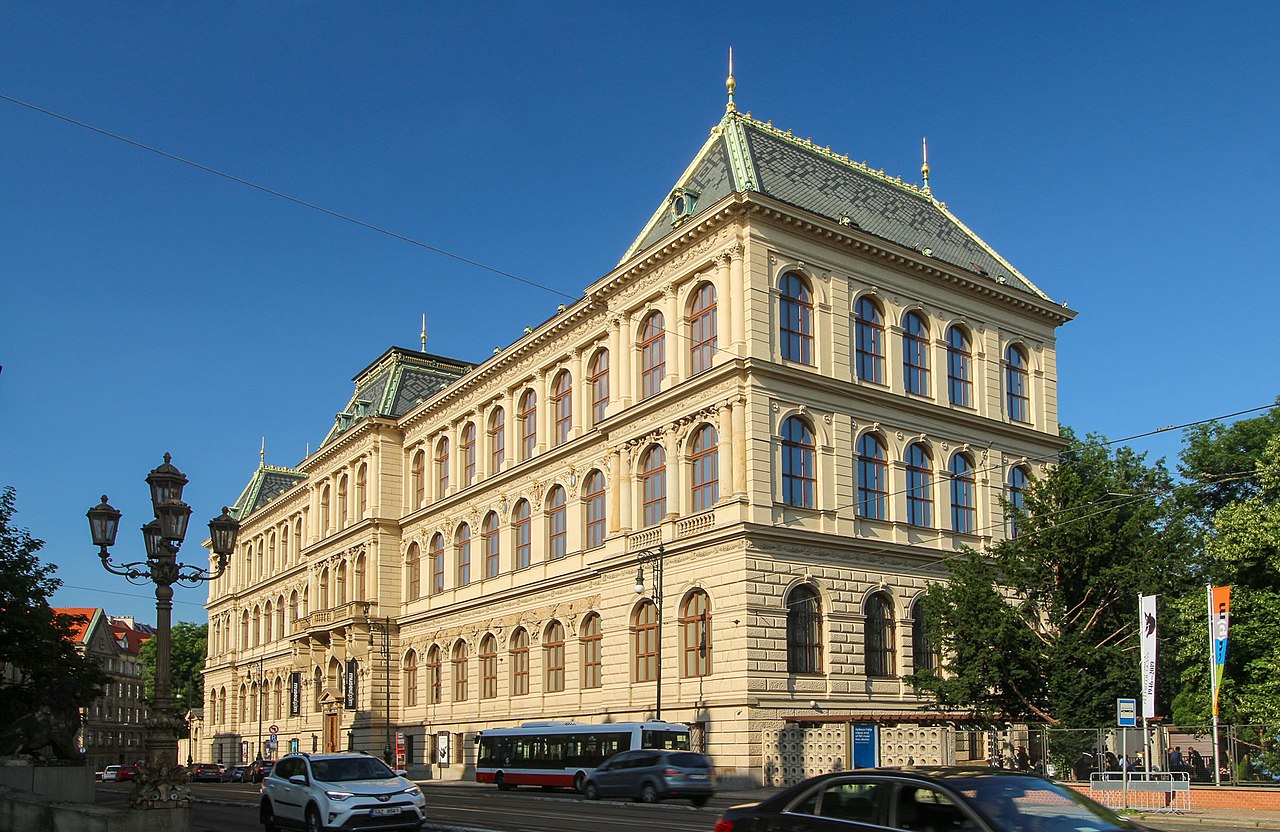
Museum of Decorative Arts in Prague
The Museum of Decorative Arts in Prague (Uměleckoprůmyslové museum v Praze) is housed in a prominent Neo-Renaissance building designed by architect Josef Schulz and completed in 1900. The institution was founded in 1885 to preserve and document the history of applied arts and craftsmanship, serving as a repository for European and Czech design traditions.
The museum's extensive collections encompass a wide range of media, including historical glass, ceramics, textiles, furniture, and graphic art. These holdings provide a comprehensive overview of artistic development from late antiquity through the modern era, highlighting the evolution of Czech craftsmanship and its integration into broader European design movements.
Key Facts
- Materials
- Sandstone, Brick, Iron, Glass
- Civilization
- Czech
- Accessibility
- Wheelchair accessible with elevator access to exhibition floors
- Date(s)
- 1897-1900
- Condition
- Well-preserved, active museum
- Original Function
- Museum of applied arts
- Key Figures
- Josef Schulz
Founding and Vision
1885The museum was established by the Chamber of Trade and Commerce in Prague. Its initial mission was to serve as a center for artistic education and a repository for high-quality examples of applied arts to inspire local manufacturers and craftsmen.
Construction of the Current Building
1897-1900To accommodate the growing collection, a new purpose-built facility was commissioned. Architect Josef Schulz designed the Neo-Renaissance structure, which stands opposite the Rudolfinum, reflecting the architectural grandeur of late 19th-century Prague.
Expansion and Modernization
20th CenturyThroughout the 20th century, the museum significantly expanded its holdings, particularly in the fields of graphic design and photography. It survived the political shifts of the era, maintaining its status as a premier institution for the study of decorative arts in Central Europe.
Contemporary Status
21st CenturyToday, the museum continues to host major temporary exhibitions alongside its permanent displays. Recent renovations have focused on modernizing visitor facilities while preserving the historic integrity of the Schulz building.
Cultural Significance
The museum serves as a vital record of Czech cultural identity, documenting the transition from traditional artisanal crafts to industrial design. It plays a crucial role in the preservation of Bohemian glassmaking traditions, which are globally recognized for their technical and aesthetic excellence.
Beyond its role as a repository, the museum acts as a hub for design discourse in Prague, bridging the gap between historical heritage and contemporary creative practice. It remains a key institution for researchers studying the intersection of Central European history and the decorative arts.
Interpretive Notes
Scholarly debates and areas of uncertainty
There is ongoing academic discussion regarding the classification of 'applied arts' versus 'fine arts' within the museum's curatorial framework. Scholars debate how the institution should balance the display of functional objects as historical artifacts versus their presentation as autonomous aesthetic works.
Visiting Information
Entry Rules
Open Tuesday through Sunday. Tickets can be purchased at the entrance or online. Visitors are requested to leave large bags in the cloakroom. No food or drink is permitted in the exhibition halls.
Best Times to Visit
Weekday mornings are generally quieter. The museum is a popular destination during the Prague Design Week and other seasonal cultural festivals.
Photography
Non-commercial photography without flash is permitted in permanent exhibition areas. Tripods and selfie sticks are prohibited.
Preservation Notes
Please refrain from touching display cases or artifacts. Maintain a respectful distance from textiles and paper-based exhibits, which are sensitive to light and humidity.
Nearby POIs
11 shownSources & Further Reading
- [1]The Museum of Decorative Arts in Prague: History and Collections — Helena Koenigsmarková. UPM Press (2015)
- [2]Josef Schulz and the Architecture of Prague's Museums — Petr Kratochvíl. Czech Architectural Review (2018)
Key Facts
- Materials
- Sandstone, Brick, Iron, Glass
- Civilization
- Czech
- Accessibility
- Wheelchair accessible with elevator access to exhibition floors
- Date(s)
- 1897-1900
- Condition
- Well-preserved, active museum
- Original Function
- Museum of applied arts
- Key Figures
- Josef Schulz