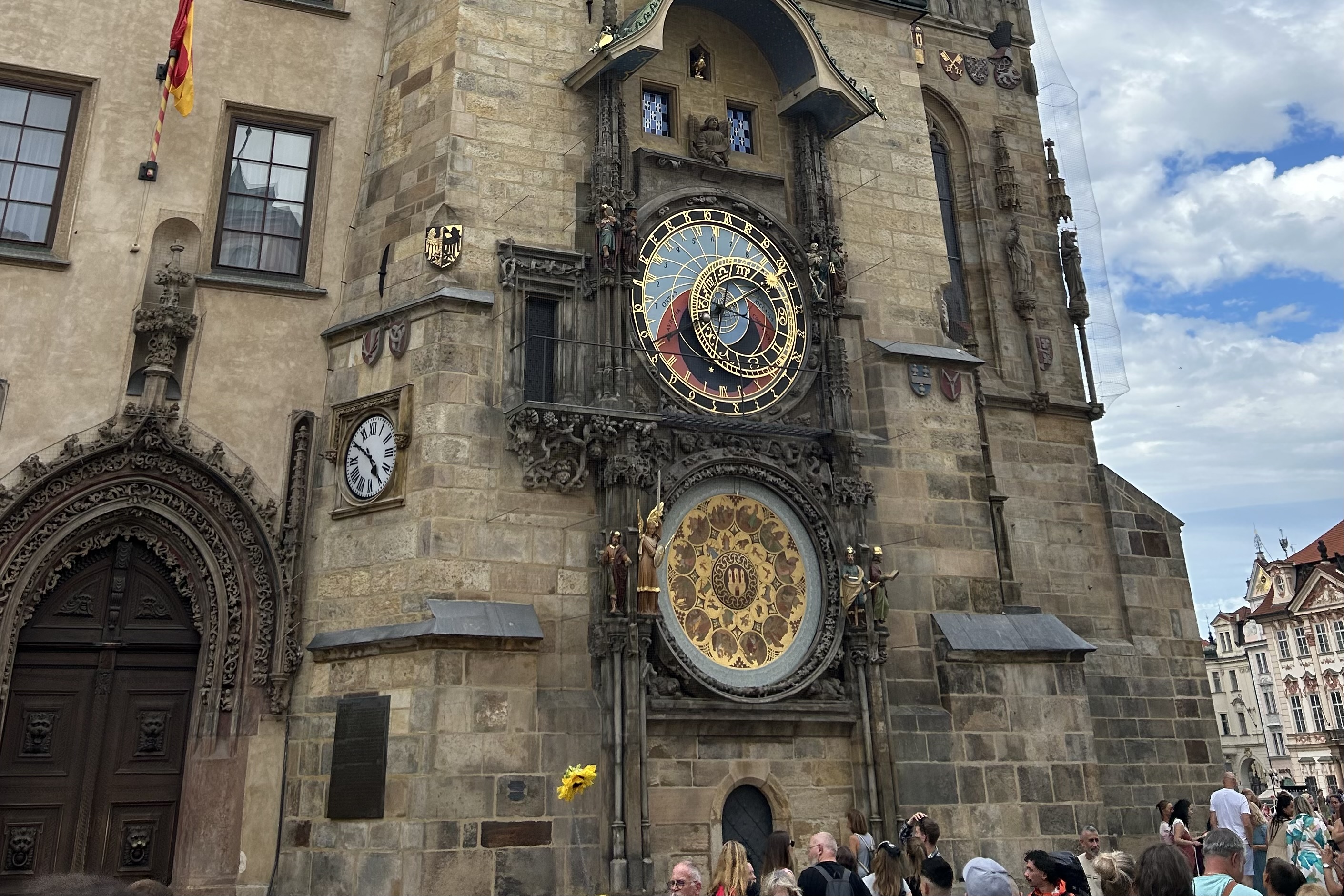
The Prague Astronomical Clock (Orloj) is a medieval astronomical clock mounted on the southern wall of the Old Town Hall in Prague’s Old Town Square. Installed in 1410, it is one of the oldest functioning astronomical clocks in the world and the oldest still in operation. The clock was constructed by clockmaker Mikuláš of Kadaň and astronomer Jan Šindel, later expanded with sculptural and mechanical additions. The device combines astronomical and calendrical functions with a mechanical procession of figures that appear hourly. Its main dial displays the position of the Sun and Moon, zodiacal information, and multiple time systems used in medieval Central Europe. Over centuries, the clock has become a defining civic monument of Prague, blending scientific craftsmanship, religious symbolism, and urban identity.
Key Facts
- Materials
- Stone, Wood, Metal
- Civilization
- Kingdom of Bohemia
- Date(s)
- 1410 CE
- Condition
- Restored and operational
- Original Function
- Public astronomical timekeeping device
- Key Figures
- Mikuláš of Kadaň, Jan Šindel
- Architectural Setting
- Old Town Hall, Prague
Medieval Installation
1410 CEThe clock mechanism was installed in 1410, combining astronomical calculation with public time display. It reflected the advanced scientific knowledge of the period and Prague’s status as an intellectual center in Central Europe.
Additions and Modifications
15th–16th centuriesIn 1490, the calendar dial and additional decorative elements were added. Moving figures, including allegorical statues representing Vanity, Greed, Death, and Lust, were incorporated over time. These additions enhanced the clock’s didactic and moral symbolism.
Damage and Restoration
17th–20th centuriesThe clock required periodic repairs due to mechanical wear. It suffered severe damage during the Prague Uprising in 1945 when the Old Town Hall was set on fire. Extensive restoration efforts were undertaken after the war to reconstruct the mechanism and repaint the calendar dial.
Modern Preservation
Late 20th century – presentThe clock continues to function as both a working timepiece and a major tourist attraction. Conservation efforts focus on preserving its original mechanical components while ensuring operational stability. Regular maintenance keeps the astronomical display and hourly procession in working order.
Cultural Significance
The Prague Astronomical Clock functioned historically as a public demonstration of cosmic order, linking civic life to celestial cycles. Its display of multiple time systems—Old Czech time, Babylonian time, and Central European time—reflects the complexity of medieval temporal reckoning. The inclusion of zodiac signs and planetary symbolism illustrates the integration of astronomy and astrology in late medieval thought. As a civic monument, the clock symbolizes Prague’s long-standing association with science, craftsmanship, and municipal autonomy. Its continued operation reinforces its identity as both a technical artifact and a cultural emblem of the city.
Interpretive Notes
Scholarly debates and areas of uncertainty
Scholarly debate surrounds the legend attributing later enhancements of the clock to Master Hanuš, a figure traditionally credited with major improvements. Modern research suggests that this attribution emerged from later chronicles and may not reflect historical fact. There is also discussion about how much of the current mechanism remains original, given the extensive restorations following 1945 damage and subsequent maintenance interventions.
Visiting Information
Entry Rules
The clock is mounted on the exterior of the Old Town Hall and is freely visible at all times. The hourly mechanical procession occurs daily from morning until evening. Entry to the Old Town Hall interior and tower requires a ticket.
Best Times to Visit
Arrive a few minutes before a new hour to view the mechanical procession. Early morning offers better visibility with fewer crowds. Peak tourist season significantly increases congestion in Old Town Square.
Photography
Personal photography permitted without tripods. Commercial filming and drone use require municipal authorization.
Preservation Notes
Visitors should remain clear of the Old Town Hall façade and avoid obstructing pedestrian movement during hourly displays. Restoration work may temporarily limit access to certain viewing angles.
Nearby POIs
11 shown- Church of Our Lady before Tyn0.2 km
- Klementinum0.3 km
- Museum of Decorative Arts in Prague0.4 km
- Museum of Bricks Prague0.5 km
- Powder Tower0.5 km
- Museum of Communism0.7 km
- Museum Kampa0.9 km
- Prague National Museum1.2 km
- Prague National Technical Museum1.2 km
- Lobkowicz Palace1.2 km
- Church of Saint Nicholas1.3 km
Sources & Further Reading
- [1]The Prague Astronomical Clock. City of Prague Official Tourism Portal (2023)
- [2]Time in the Medieval World — Gerhard Dohrn-van Rossum. University of Chicago Press (1996)
- [3]Astronomical Clocks of Europe — John North. Oxford University Press (2005)
Key Facts
- Materials
- Stone, Wood, Metal
- Civilization
- Kingdom of Bohemia
- Date(s)
- 1410 CE
- Condition
- Restored and operational
- Original Function
- Public astronomical timekeeping device
- Key Figures
- Mikuláš of Kadaň, Jan Šindel
- Architectural Setting
- Old Town Hall, Prague
Nearby POIs
11 shown- Church of Our Lady before Tyn0.2 km
- Klementinum0.3 km
- Museum of Decorative Arts in Prague0.4 km
- Museum of Bricks Prague0.5 km
- Powder Tower0.5 km
- Museum of Communism0.7 km
- Museum Kampa0.9 km
- Prague National Museum1.2 km
- Prague National Technical Museum1.2 km
- Lobkowicz Palace1.2 km
- Church of Saint Nicholas1.3 km