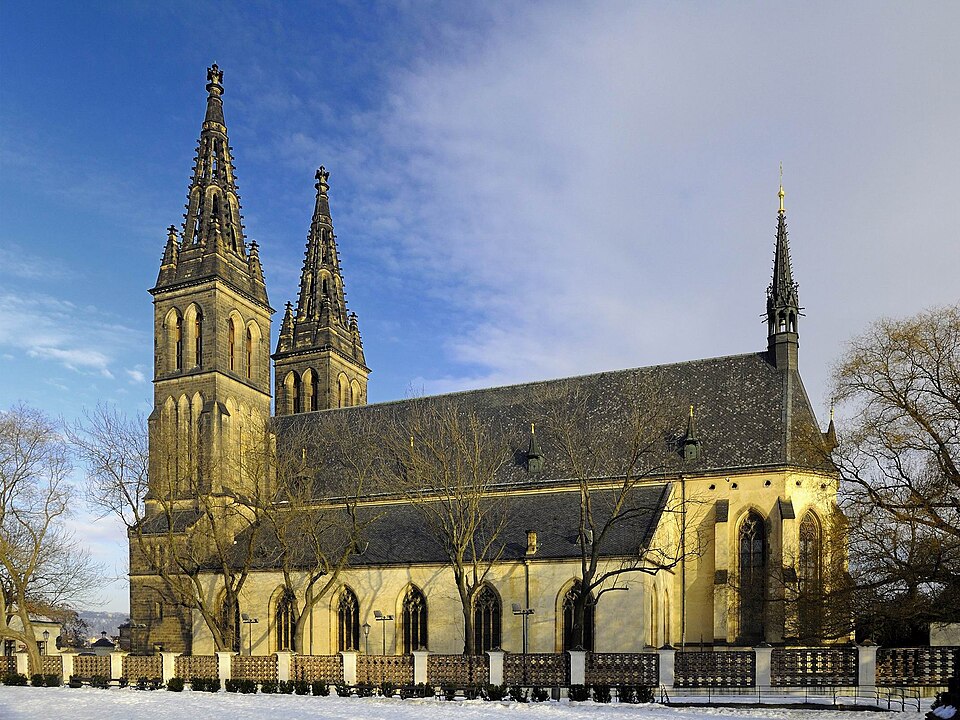
Basilica of St. Peter and St. Paul
The Basilica of St. Peter and St. Paul is a prominent Neo-Gothic church located within the Vyšehrad fortress complex in Prague. Originally founded in 1070–1080 by King Vratislaus II as a Romanesque basilica, it was established as the seat of a royal collegiate chapter intended to rival Prague Castle’s ecclesiastical authority. Over the centuries, the structure underwent Gothic modifications and later Baroque alterations following damage during the Hussite Wars. Its current Neo-Gothic appearance dates largely from an extensive late 19th-century reconstruction (1885–1903), which gave the church its distinctive twin spires that now form a recognizable feature of Prague’s skyline.
Key Facts
- Materials
- Stone masonry, Brick, Stucco
- Civilization
- Medieval Kingdom of Bohemia
- Current Function
- Active Roman Catholic basilica
- Date(s)
- Founded 1070–1080; major Neo-Gothic reconstruction 1885–1903
- Key Figures
- Vratislaus II, Charles IV
Romanesque Foundation
11th centuryFounded by Vratislaus II, the basilica served as the center of an independent chapter directly subordinate to the Pope rather than the Prague bishop. This elevated its prestige and reinforced Vyšehrad’s political importance.
Gothic & Baroque Transformations
14th–18th centuriesUnder Charles IV, Vyšehrad regained ceremonial significance, and the church received Gothic elements. Damage during the Hussite Wars led to later Baroque repairs and stylistic modifications.
Neo-Gothic Reconstruction
19th centuryBetween 1885 and 1903, the basilica was comprehensively rebuilt in Neo-Gothic style. Architects Josef Mocker and František Mikš redesigned much of the structure, creating the present façade with twin towers approximately 58 meters high.
Modern Significance
20th century–presentIn 2003, the church was elevated to the status of Minor Basilica. It remains an active parish church and a focal point of Czech cultural memory, situated adjacent to the Vyšehrad Cemetery where many notable Czech figures are buried.
Cultural Significance
The basilica occupies a central role in Czech national symbolism. During the 19th-century National Revival, its Neo-Gothic reconstruction aligned with efforts to emphasize medieval Czech heritage. Its proximity to the Vyšehrad Cemetery further strengthened its association with national identity, as the cemetery became the burial place of leading Czech cultural figures.
Interpretive Notes
Scholarly debates and areas of uncertainty
Architectural historians note that the extensive 19th-century reconstruction significantly altered the medieval fabric of the church, raising questions about historical authenticity versus revivalist interpretation. The Neo-Gothic style reflects 19th-century ideals rather than the basilica’s original Romanesque character.
Visiting Information
Entry Rules
Open daily; admission fee required for interior visits. Active liturgical services held regularly. Check current hours before visiting, as they may vary seasonally.
Best Times to Visit
Morning hours offer quieter access before tour groups arrive. Sunday mornings may be limited due to Mass. Combine with other Vyšehrad sites for efficient routing.
Photography
Morning hours offer quieter access before tour groups arrive. Sunday mornings may be limited due to Mass. Combine with other Vyšehrad sites for efficient routing.
Preservation Notes
Remain behind barriers in the sanctuary and crypt areas. Respect ongoing religious services. Follow posted quiet guidelines.
Nearby POIs
11 shownSources & Further Reading
- [1]Vyšehrad Chapter and Basilica. National Cultural Heritage Institute of the Czech Republic (2023)
- [2]The Czechs and the Lands of the Bohemian Crown — Hugh Agnew. Hoover Institution Press (2004)
- [3]Gothic Revival Architecture in Central Europe — Václav Ledvinka. Karolinum Press (2012)
Key Facts
- Materials
- Stone masonry, Brick, Stucco
- Civilization
- Medieval Kingdom of Bohemia
- Current Function
- Active Roman Catholic basilica
- Date(s)
- Founded 1070–1080; major Neo-Gothic reconstruction 1885–1903
- Key Figures
- Vratislaus II, Charles IV