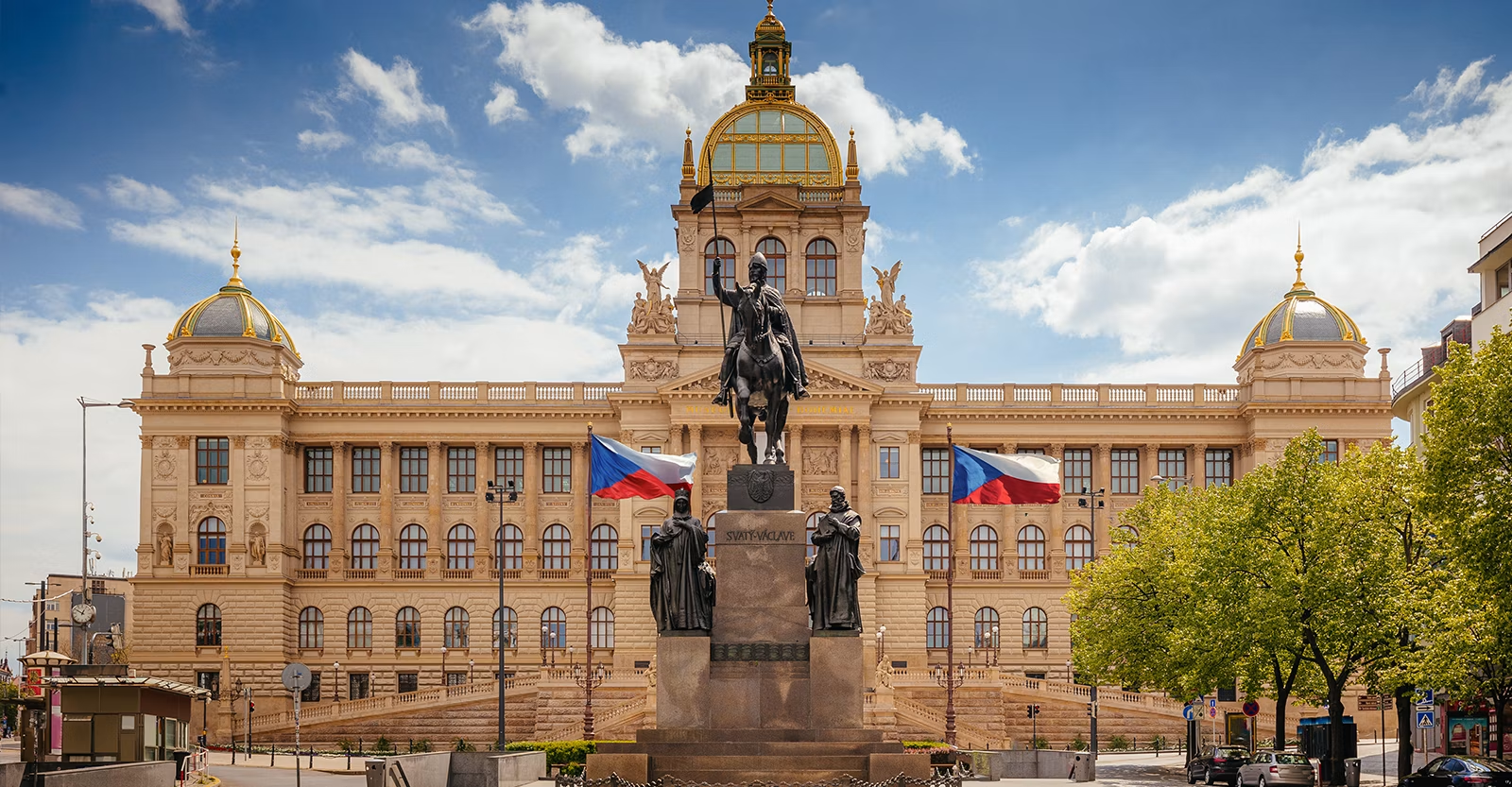
The Prague National Museum (Národní muzeum) is the largest and oldest museum institution in the Czech Republic. Founded in 1818 during the period of the Czech National Revival, it was established to collect, preserve, and present materials related to the natural sciences, history, archaeology, art, and cultural development of the Czech lands. Its main building dominates the upper end of Wenceslas Square in Prague. The current Neo-Renaissance main building was constructed between 1885 and 1891 according to designs by architect Josef Schulz. The museum complex today includes multiple specialized buildings and collections throughout Prague, but the historic main building remains its symbolic and architectural centerpiece.
Key Facts
- Materials
- Sandstone, Brick, Stone masonry, Decorative stucco
- Civilization
- Austro-Hungarian Empire / Czech lands
- Accessibility
- Wheelchair accessible; elevators and step-free access available
- Date(s)
- 1885–1891 (main building)
- Condition
- Fully restored and active museum (major renovation completed 2019)
- Original Function
- National museum for natural sciences, history, and culture
- Key Figures
- Josef Schulz, František Palacký
Foundation & National Revival
1818–mid 19th centuryThe museum was founded in 1818 as the Patriotic Museum of Bohemia during the Czech National Revival, a cultural movement aimed at strengthening Czech language, scholarship, and identity within the Habsburg monarchy. Early collections focused on natural history and historical artifacts, serving both scientific research and national cultural aspirations.
Construction of the Main Building
1885–1891As the collections expanded, a monumental building was commissioned at the top of Wenceslas Square. Architect Josef Schulz designed the Neo-Renaissance structure, integrating allegorical sculpture and symbolic decorative programs that emphasized science, history, and national culture. The building quickly became a landmark within Prague’s urban landscape.
20th Century & Political Transformations
1918–1989Following the establishment of Czechoslovakia in 1918, the museum became a central institution of the new state. During the Nazi occupation and later the Communist period, the museum continued operating under shifting ideological frameworks, though its scientific and historical collections remained central to its mission.
Damage, Restoration & Modernization
1968–presentThe building sustained damage during the Warsaw Pact invasion in 1968, when it was mistakenly shelled by Soviet forces. A comprehensive renovation project began in 2011 and concluded in 2019, restoring historic interiors and modernizing exhibition spaces. Today the museum operates as a major research and exhibition institution, connected via an underground corridor to the adjacent New Building.
Cultural Significance
The Prague National Museum emerged as a central institution of the Czech National Revival, functioning not only as a scientific repository but also as a symbol of cultural autonomy within the Habsburg Empire. Its collections and exhibitions reinforced Czech-language scholarship and historical consciousness at a time when national identity was politically contested. Located at the head of Wenceslas Square, the building has witnessed major political demonstrations and turning points in Czech history, including events in 1918, 1968, and 1989. As a result, it serves both as a cultural institution and as a symbolic backdrop to modern Czech statehood.
Interpretive Notes
Scholarly debates and areas of uncertainty
Scholars debate the extent to which the museum’s early collecting practices were driven primarily by scientific goals versus nationalist ideology. While its founders emphasized universal scholarship, the institutional framework was closely aligned with the Czech National Revival. There is also ongoing discussion regarding restoration philosophy during the 2011–2019 renovation, particularly balancing historical authenticity with contemporary exhibition technology and visitor accessibility.
Visiting Information
Entry Rules
Open daily. Ticketed entry; combination and single-exhibition tickets available. Reduced admission for students and seniors. Closed on selected public holidays. Security screening at entrance.
Best Times to Visit
Weekday mornings (9:00–11:00) for lower visitor volume. Avoid late afternoons on weekends. Visiting in combination with nearby historical landmarks in central Prague allows efficient planning.
Photography
Personal photography permitted without flash or tripods. Commercial filming and drone use require prior authorization from museum administration.
Preservation Notes
Do not touch exhibited objects unless explicitly permitted. Large bags may require cloakroom storage. Some galleries may close temporarily for exhibition changes.
Nearby POIs
11 shown- Museum of Bricks Prague0.9 km
- Powder Tower1 km
- Museum of Communism1 km
- Church of Our Lady before Tyn1.1 km
- Prague Astronomical Clock1.2 km
- Klementinum1.4 km
- Museum of Decorative Arts in Prague1.6 km
- Museum Kampa1.7 km
- Vysehrad1.8 km
- Basilica of St. Peter and St. Paul1.9 km
- Prague National Technical Museum2.1 km
Sources & Further Reading
- [1]
- [2]The Czech National Revival — Hugh Agnew. Cambridge University Press (2004)
- [3]Prague: A Cultural and Literary History — Richard D. E. Burton. Signal Books (2003)
Key Facts
- Materials
- Sandstone, Brick, Stone masonry, Decorative stucco
- Civilization
- Austro-Hungarian Empire / Czech lands
- Accessibility
- Wheelchair accessible; elevators and step-free access available
- Date(s)
- 1885–1891 (main building)
- Condition
- Fully restored and active museum (major renovation completed 2019)
- Original Function
- National museum for natural sciences, history, and culture
- Key Figures
- Josef Schulz, František Palacký
Nearby POIs
11 shown- Museum of Bricks Prague0.9 km
- Powder Tower1 km
- Museum of Communism1 km
- Church of Our Lady before Tyn1.1 km
- Prague Astronomical Clock1.2 km
- Klementinum1.4 km
- Museum of Decorative Arts in Prague1.6 km
- Museum Kampa1.7 km
- Vysehrad1.8 km
- Basilica of St. Peter and St. Paul1.9 km
- Prague National Technical Museum2.1 km