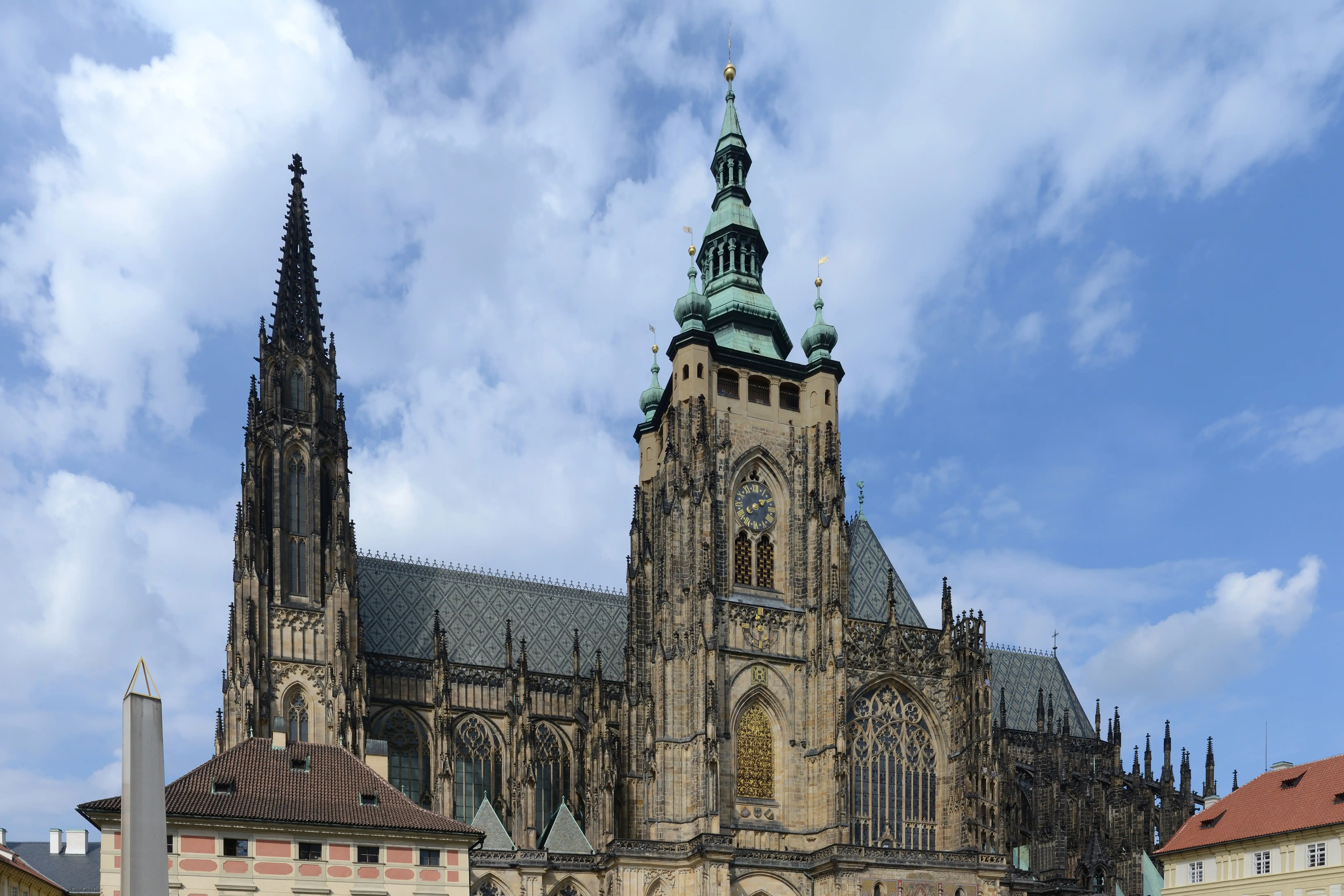
St. Vitus Cathedral is the principal cathedral of Prague and the seat of the Archbishop of Prague. Located within Prague Castle, it has served as the spiritual center of the Czech lands for over six centuries. Construction began in 1344 under the reign of Charles IV, King of Bohemia and later Holy Roman Emperor, replacing an earlier Romanesque rotunda and basilica dedicated to St. Vitus. The cathedral was designed initially by Matthias of Arras and later continued by Peter Parler, whose innovations shaped its distinctive High Gothic character. The structure functioned as the site of royal coronations, burials of Bohemian kings and Holy Roman Emperors, and the housing of important relics, including those of St. Wenceslas. Although begun in the 14th century, the cathedral was not fully completed until 1929, when the western façade and nave were finished in a Neo-Gothic style. Today it remains an active place of worship and a central monument of Czech political and religious identity.
Key Facts
- Materials
- Sandstone, Stone masonry
- Civilization
- Kingdom of Bohemia
- Date(s)
- 1344–1929 CE
- Condition
- Completed and active cathedral within Prague Castle
- Original Function
- Seat of the Archbishop of Prague and royal coronation church
- Key Figures
- Charles IV, Matthias of Arras, Peter Parler, St. Wenceslas
- Architectural Style
- High Gothic with Neo-Gothic completion
Early Foundations
10th–13th centuriesThe site originally housed a 10th-century rotunda founded by Duke Wenceslas, later replaced by a Romanesque basilica in the 11th century. These earlier structures established the location as the principal ecclesiastical center of Prague.
Gothic Construction under Charles IV
1344–15th centuryIn 1344 Prague was elevated to an archbishopric, prompting the construction of a new Gothic cathedral. Matthias of Arras began the project following French Gothic models. After his death, Peter Parler introduced innovative vaulting systems, sculptural decoration, and the distinctive triforium busts depicting contemporary figures. Construction slowed during the Hussite Wars, leaving the cathedral incomplete for centuries.
Habsburg and Baroque Additions
16th–18th centuriesDuring the Habsburg period, the cathedral continued to serve as a coronation church and royal mausoleum. Baroque elements were added, including certain chapels and interior modifications, reflecting changing artistic preferences and liturgical practices.
Completion in the Modern Era
19th–20th centuriesA renewed national interest in Gothic heritage led to the cathedral’s completion between 1873 and 1929 in a Neo-Gothic style. The western façade and nave were constructed to harmonize with the medieval portions. The cathedral was formally consecrated in 1929 on the millennium of St. Wenceslas’ death.
Cultural Significance
St. Vitus Cathedral has served as the coronation church of Bohemian kings and queens and later of Holy Roman Emperors ruling from Prague. It houses the Crown Jewels of Bohemia and the tombs of prominent rulers, including Charles IV and St. Wenceslas. As such, it functioned not only as a religious center but also as a ceremonial and dynastic monument. In modern Czech history, the cathedral symbolizes national continuity and statehood. Its long construction period and eventual completion in the 20th century became intertwined with Czech cultural revival and identity within the Austro-Hungarian Empire and later the independent Czechoslovak state.
Interpretive Notes
Scholarly debates and areas of uncertainty
Scholarly debate surrounds the extent to which Peter Parler’s architectural innovations represent a departure from French Gothic norms versus a localized development within Central Europe. His net vaulting techniques and sculptural integration have been interpreted both as stylistic evolution and as a conscious assertion of Bohemian artistic identity. There is also discussion regarding the 19th- and 20th-century completion, particularly how faithfully the Neo-Gothic additions reflect the medieval design intentions versus expressing modern nationalist aesthetics.
Visiting Information
Entry Rules
Open daily. Entry to the front section of the cathedral is free; access to the full nave, chapels, and tower requires a Prague Castle ticket. Security screening is required at Prague Castle entrances.
Best Times to Visit
Early morning shortly after opening provides quieter access. Midday tour groups significantly increase crowd levels. Winter months generally see fewer visitors than peak summer season.
Photography
Personal photography permitted without flash or tripods. Commercial photography requires authorization. Photography may be restricted in certain chapels or during services.
Preservation Notes
Visitors should remain within designated pathways and avoid touching historic surfaces. Portions of the cathedral may be closed during liturgical services or restoration work.
Nearby POIs
11 shownSources & Further Reading
- [1]
- [2]Peter Parler and the Parler Workshop — Paul Crossley. The Burlington Magazine (1992)
- [3]Prague: A Cultural and Literary History — Richard D. E. Burton. Signal Books (2003)
Key Facts
- Materials
- Sandstone, Stone masonry
- Civilization
- Kingdom of Bohemia
- Date(s)
- 1344–1929 CE
- Condition
- Completed and active cathedral within Prague Castle
- Original Function
- Seat of the Archbishop of Prague and royal coronation church
- Key Figures
- Charles IV, Matthias of Arras, Peter Parler, St. Wenceslas
- Architectural Style
- High Gothic with Neo-Gothic completion