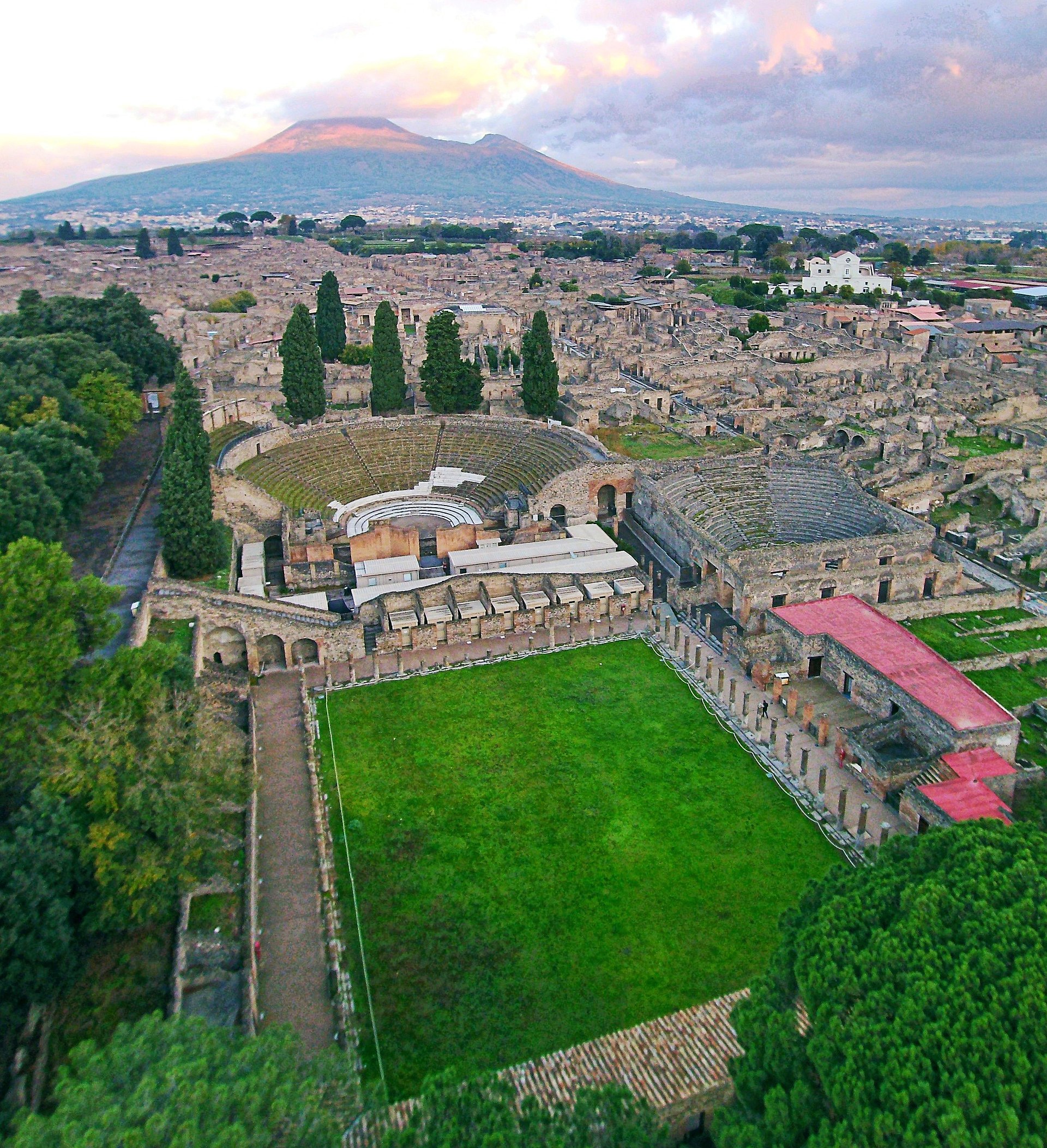
Pompeii was an ancient Roman city located near the Bay of Naples. Founded by the Oscans and later controlled by the Samnites before becoming a Roman colony in 80 BCE, it developed into a prosperous urban center with temples, bath complexes, theaters, markets, and private villas. In 79 CE, Mount Vesuvius erupted and buried the city under layers of ash and pumice. The sudden burial preserved buildings, wall paintings, inscriptions, and even human remains, creating one of the most detailed archaeological records of daily life in the Roman world.
Key Facts
- Materials
- Volcanic stone, Tuff, Brick, Concrete
- Dimensions
- Approximately 66 hectares enclosed by city walls
- Civilization
- Samnite; Roman
- Date(s)
- Founded prior to 6th century BCE; destroyed 79 CE
- Condition
- Extensive ruins preserved by volcanic ash; ongoing excavation and conservation
- Original Function
- Urban settlement and regional commercial center
- Key Figures
- Pliny the Younger, Emperor Titus
Early Settlement and Samnite Control
6th-4th century BCEArchaeological evidence indicates Oscan-speaking populations settled the area before the 6th century BCE. By the 5th century BCE, Pompeii came under Samnite control. Fortifications and early temple structures date to this phase, reflecting regional Italic architectural traditions.
Roman Incorporation
3rd century BCE - 80 BCEPompeii entered the Roman sphere following the Samnite Wars. It retained a degree of local autonomy until the Social War (91-88 BCE), after which it was besieged by Roman forces under Sulla. In 80 BCE it was refounded as the colony Colonia Cornelia Veneria Pompeianorum, settling Roman veterans in the city.
Imperial Prosperity
1st century BCE - 79 CEUnder the Roman Empire, Pompeii functioned as a commercial hub tied to agricultural production, particularly wine and garum. Public amenities expanded, including the amphitheater, large bath complexes, and elaborately decorated domestic residences. An earthquake in 62 CE caused widespread damage, and reconstruction was ongoing at the time of the eruption.
Eruption of Mount Vesuvius
79 CEOn 24 August (or possibly later in autumn) 79 CE, Mount Vesuvius erupted, burying Pompeii beneath several meters of ash and pumice. Pyroclastic surges caused structural collapse and fatalities. The event was described by Pliny the Younger in letters to Tacitus, providing a primary literary account.
Rediscovery and Excavation
18th century - presentSystematic excavation began in 1748 under the Bourbon rulers of Naples. Early efforts prioritized artifact recovery, while 19th- and 20th-century archaeology focused on stratigraphic documentation and conservation. Modern preservation addresses structural instability, weathering, and visitor impact across the exposed urban area.
Cultural Significance
Pompeii provides direct archaeological evidence of daily life in a Roman provincial city, preserving graffiti, electoral notices, commercial signage, and household objects. These materials have reshaped scholarly understanding of literacy, social mobility, slavery, and urban economy in the early Roman Empire. The site has also influenced modern conceptions of Roman civilization, shaping museum practices, conservation science, and public archaeology. Its excavation history reflects evolving methodologies, from treasure extraction to systematic urban archaeology.
Interpretive Notes
Scholarly debates and areas of uncertainty
The exact date of the eruption remains debated. While traditionally dated to 24 August 79 CE based on manuscript transmission of Pliny's letters, archaeological evidence such as autumnal fruits and coin finds suggests a later date in October. Interpretations of social structure within Pompeii also vary. Scholars continue to debate the degree of economic mobility among freedpersons and the extent to which domestic decoration reflected status versus commercial enterprise.
Visiting Information
Entry Rules
Paid admission. Combined ticket includes Pompeii, Oplontis, and Boscoreale (valid 3 days). Hours vary seasonally; last entry approximately 90 minutes before closing. Managed by the Parco Archeologico di Pompei.
Best Times to Visit
Arrive at opening (typically 9:00) to avoid peak tour groups. Summer midday temperatures are high with limited shade. Weekdays outside major Italian holidays see reduced attendance.
Photography
Personal photography permitted. Tripods, drones, and commercial filming require authorization from park authorities.
Preservation Notes
Remain on designated paths. Do not enter restricted domus. Many structures are fragile due to exposure after excavation; sections may close without notice for conservation work.
Nearby POIs
11 shown- Castel Nuovo21.8 km
- Palazzo Reale di Napoli21.9 km
- Basilica di San Francesco di Paola22.1 km
- Cattedrale di Santa Maria Assunta22.1 km
- Basilica di Santa Chiara22.2 km
- Cappella Sansevero22.3 km
- Galleria Borbonica22.3 km
- Naples Underground Geothermal Zone22.3 km
- Chiesa di Gesu Nuovo22.4 km
- Museo Archeologico Nazionale di Napoli22.8 km
- Museo Nazionale di San Martino23 km
Sources & Further Reading
- [1]Pompeii: The Life of a Roman Town — Mary Beard. Profile Books (2008)
- [2]The Fires of Vesuvius: Pompeii Lost and Found — Mary Beard. Harvard University Press (2008)
- [3]Pompeii and Herculaneum — John J. Dobbins and Pedar W. Foss (eds.). Routledge (2007)
Key Facts
- Materials
- Volcanic stone, Tuff, Brick, Concrete
- Dimensions
- Approximately 66 hectares enclosed by city walls
- Civilization
- Samnite; Roman
- Date(s)
- Founded prior to 6th century BCE; destroyed 79 CE
- Condition
- Extensive ruins preserved by volcanic ash; ongoing excavation and conservation
- Original Function
- Urban settlement and regional commercial center
- Key Figures
- Pliny the Younger, Emperor Titus
Nearby POIs
11 shown- Castel Nuovo21.8 km
- Palazzo Reale di Napoli21.9 km
- Basilica di San Francesco di Paola22.1 km
- Cattedrale di Santa Maria Assunta22.1 km
- Basilica di Santa Chiara22.2 km
- Cappella Sansevero22.3 km
- Galleria Borbonica22.3 km
- Naples Underground Geothermal Zone22.3 km
- Chiesa di Gesu Nuovo22.4 km
- Museo Archeologico Nazionale di Napoli22.8 km
- Museo Nazionale di San Martino23 km