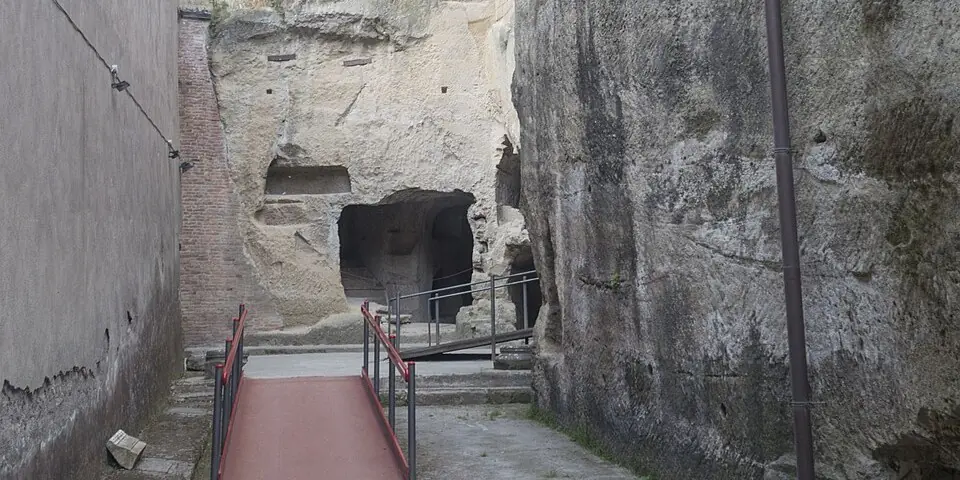
The Catacombs of San Gennaro are an extensive underground burial site located in the Rione Sanità district of Naples. Originating as a private family tomb in the 2nd century CE, the site expanded significantly over the following centuries, eventually becoming the final resting place of Saint Januarius (San Gennaro) in the 5th century. The complex is organized across two levels, featuring a unique architectural layout that includes spacious vestibules and vaulted ceilings, which distinguish it from the more cramped catacombs found in Rome.
The site served as a vital center for early Christian worship and pilgrimage. It contains a wealth of artistic heritage, including 2nd-century frescoes and 5th-century mosaics that reflect the transition from pagan to Christian iconography. Following the translation of Saint Januarius's remains to the Naples Cathedral in the 9th century, the catacombs fell into disuse and were largely forgotten until their rediscovery and subsequent preservation efforts in the modern era.
Key Facts
- Materials
- Tuff (volcanic rock), Plaster, Mosaic tiles
- Civilization
- Roman / Early Christian
- Accessibility
- Partially accessible; some uneven terrain and stairs
- Date(s)
- 2nd century CE
- Condition
- Well-preserved, active site for cultural tourism
- Original Function
- Funerary complex and pilgrimage site
- Key Figures
- Saint Januarius, Saint Agrippinus
Origins and Early Expansion
2nd - 4th century CEThe lower level of the catacombs began as a small, private burial chamber. As the Christian community in Naples grew, the site expanded into the surrounding volcanic tuff, incorporating the tomb of Saint Agrippinus, the first patron saint of Naples.
The Cult of Saint Januarius
5th century CEThe site gained immense religious importance following the transfer of the remains of Saint Januarius to the upper level. This prompted the construction of the 'Basilica of the Bishop,' a large underground church carved directly into the rock to accommodate pilgrims.
Decline and Rediscovery
9th - 19th centuryAfter the relics of the saint were moved to the city center, the catacombs were abandoned and suffered from neglect and looting. They remained largely inaccessible until systematic archaeological interest was renewed in the 19th and 20th centuries.
Modern Restoration
20th century - presentExtensive restoration projects have stabilized the structure and cleaned the ancient frescoes. Today, the site is managed by the La Paranza cooperative, which integrates the catacombs into the social and economic revitalization of the Sanità district.
Cultural Significance
The Catacombs of San Gennaro are a cornerstone of Neapolitan identity, representing the city's deep-rooted connection to its patron saint. They serve as a physical record of the evolution of early Christian art and burial practices in Southern Italy, standing as a testament to the endurance of the local community through centuries of historical change.
Beyond their religious history, the catacombs have become a model for community-led heritage management. The site's operation by local youth cooperatives has transformed the Rione Sanità from an area of social exclusion into a vibrant cultural hub, demonstrating how ancient heritage can drive contemporary urban development.
Interpretive Notes
Scholarly debates and areas of uncertainty
There is ongoing academic discussion regarding the exact chronology of the transition between the pagan and Christian burial phases within the lower level. Additionally, scholars debate the extent to which the architectural design of the 'Basilica of the Bishop' was influenced by contemporary Roman subterranean structures versus local Neapolitan engineering techniques.
Visiting Information
Entry Rules
Access is by guided tour only. Tickets should be purchased in advance via the official website. Visitors are advised to wear comfortable shoes and bring a light jacket, as the temperature remains constant at approximately 15-18°C year-round.
Best Times to Visit
Weekday mornings are recommended to avoid weekend crowds. The site is open year-round, but visiting during the shoulder seasons (spring and autumn) allows for a more comfortable experience in the surrounding neighborhood.
Photography
Personal photography is permitted without flash. Tripods and professional lighting equipment require prior authorization from the site management.
Preservation Notes
Do not touch the frescoes or wall surfaces, as the oils from human skin accelerate the degradation of the ancient pigments. Stay with the guided group at all times to ensure the safety of the archaeological deposits.
Nearby POIs
11 shown- Museo di Capodimonte0.4 km
- Museo Archeologico Nazionale di Napoli1.3 km
- Cattedrale di Santa Maria Assunta1.7 km
- Cappella Sansevero1.9 km
- Chiesa di Gesu Nuovo2 km
- Basilica di Santa Chiara2.1 km
- Castel Sant'Elmo2.5 km
- Museo Nazionale di San Martino2.5 km
- Castel Nuovo3 km
- Naples Underground Geothermal Zone3.1 km
- Palazzo Reale di Napoli3.2 km
Sources & Further Reading
- [1]The Catacombs of Naples — Amalia Galdi. Edizioni Scientifiche Italiane (2015)
- [2]Early Christian Art in Southern Italy — Fabrizio Bisconti. Pontificio Istituto di Archeologia Cristiana (2018)
Key Facts
- Materials
- Tuff (volcanic rock), Plaster, Mosaic tiles
- Civilization
- Roman / Early Christian
- Accessibility
- Partially accessible; some uneven terrain and stairs
- Date(s)
- 2nd century CE
- Condition
- Well-preserved, active site for cultural tourism
- Original Function
- Funerary complex and pilgrimage site
- Key Figures
- Saint Januarius, Saint Agrippinus
Nearby POIs
11 shown- Museo di Capodimonte0.4 km
- Museo Archeologico Nazionale di Napoli1.3 km
- Cattedrale di Santa Maria Assunta1.7 km
- Cappella Sansevero1.9 km
- Chiesa di Gesu Nuovo2 km
- Basilica di Santa Chiara2.1 km
- Castel Sant'Elmo2.5 km
- Museo Nazionale di San Martino2.5 km
- Castel Nuovo3 km
- Naples Underground Geothermal Zone3.1 km
- Palazzo Reale di Napoli3.2 km