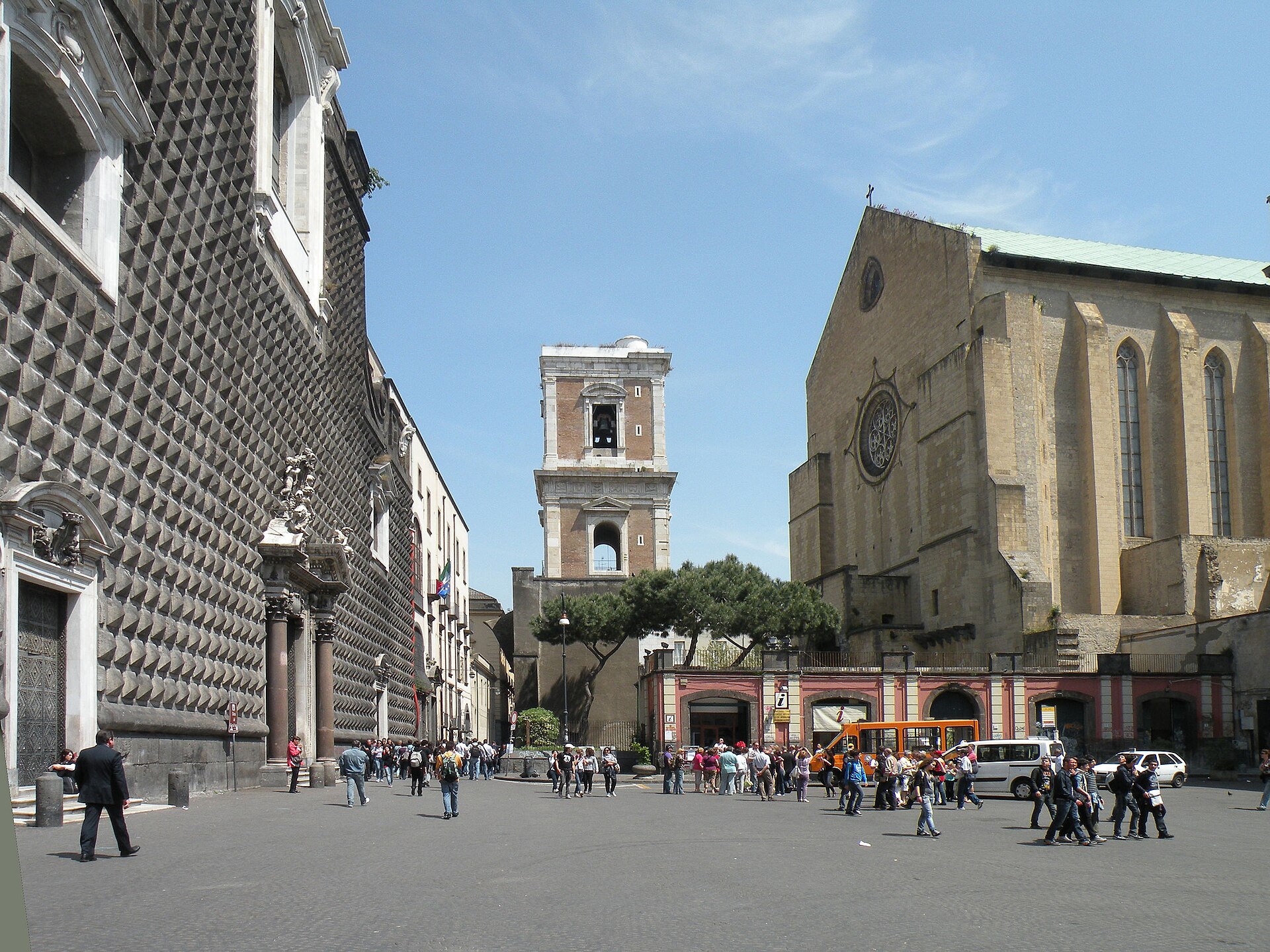
The Basilica di Santa Chiara is a religious complex in Naples, Italy, originally constructed in the 14th century as a Poor Clare convent. Commissioned by King Robert of Anjou and Queen Sancha of Majorca, the church was built in the Provençal Gothic style, characterized by its vast, single-nave interior and lack of side chapels, which was intended to emphasize the austerity of the Franciscan order.
Following severe damage during Allied bombing raids in 1943, the church underwent a significant restoration that stripped away later Baroque additions to reveal its original medieval structure. Today, the complex is renowned for its 18th-century cloister, the Chiostro delle Clarisse, which features vibrant majolica tiles depicting pastoral scenes and mythological figures.
Key Facts
- Materials
- Tuff, Marble, Majolica tiles
- Civilization
- Angevin Kingdom of Naples
- Accessibility
- Ground level accessible, cloister includes stairs
- Date(s)
- 1310-1340
- Condition
- Restored after 1943 bombing
- Original Function
- Convent church and royal mausoleum
- Key Figures
- King Robert of Anjou, Queen Sancha of Majorca, Giotto di Bondone
Foundation and Gothic Origins
1310-1340The complex was founded by King Robert of Anjou and Queen Sancha of Majorca. It was designed as a double monastery housing both Poor Clares and Franciscan friars, serving as the primary royal mausoleum for the Angevin dynasty.
Baroque Transformation
17th-18th centuryDuring the Baroque period, the interior was heavily modified with stucco work, frescoes, and a new ceiling, obscuring the original Gothic architecture. The famous majolica-tiled cloister was also added during this era.
Destruction and Restoration
1943-1953The basilica was devastated by fire following an Allied bombing raid in 1943. Post-war restoration efforts focused on removing the Baroque layers to restore the church to its original 14th-century Gothic appearance.
Cultural Significance
The Basilica di Santa Chiara serves as a vital repository of Neapolitan history, housing the tombs of the Angevin monarchs. It represents the intersection of royal power and Franciscan piety, and its cloister is considered one of the finest examples of 18th-century decorative art in Southern Italy.
Interpretive Notes
Scholarly debates and areas of uncertainty
There is ongoing academic discussion regarding the extent of Giotto's involvement in the original frescoes of the church. While historical records suggest his presence in Naples, much of the original painted decoration was lost to time and the 1943 fire, making definitive attribution difficult.
Visiting Information
Entry Rules
Open daily. Tickets are required for entry to the cloister and the archaeological museum area. Modest dress is requested as it remains an active place of worship.
Best Times to Visit
Early morning or late afternoon to avoid peak tourist crowds in the cloister.
Photography
Personal photography is permitted without flash. Professional photography requires prior authorization.
Preservation Notes
The majolica tiles in the cloister are fragile; visitors are strictly prohibited from touching or leaning on the tiled pillars.
Nearby POIs
11 shown- Chiesa di Gesu Nuovo0.2 km
- Cappella Sansevero0.3 km
- Museo Archeologico Nazionale di Napoli0.8 km
- Cattedrale di Santa Maria Assunta0.9 km
- Castel Nuovo0.9 km
- Museo Nazionale di San Martino1.1 km
- Palazzo Reale di Napoli1.1 km
- Naples Underground Geothermal Zone1.2 km
- Castel Sant'Elmo1.2 km
- Basilica di San Francesco di Paola1.3 km
- Galleria Borbonica1.7 km
Sources & Further Reading
- [1]The Angevin Kingdom of Naples — John Hunt. University of Pennsylvania Press (2016)
- [2]Santa Chiara: Storia e Restauro — Antonio Venditti. Edizioni Scientifiche Italiane (1998)
Key Facts
- Materials
- Tuff, Marble, Majolica tiles
- Civilization
- Angevin Kingdom of Naples
- Accessibility
- Ground level accessible, cloister includes stairs
- Date(s)
- 1310-1340
- Condition
- Restored after 1943 bombing
- Original Function
- Convent church and royal mausoleum
- Key Figures
- King Robert of Anjou, Queen Sancha of Majorca, Giotto di Bondone
Nearby POIs
11 shown- Chiesa di Gesu Nuovo0.2 km
- Cappella Sansevero0.3 km
- Museo Archeologico Nazionale di Napoli0.8 km
- Cattedrale di Santa Maria Assunta0.9 km
- Castel Nuovo0.9 km
- Museo Nazionale di San Martino1.1 km
- Palazzo Reale di Napoli1.1 km
- Naples Underground Geothermal Zone1.2 km
- Castel Sant'Elmo1.2 km
- Basilica di San Francesco di Paola1.3 km
- Galleria Borbonica1.7 km