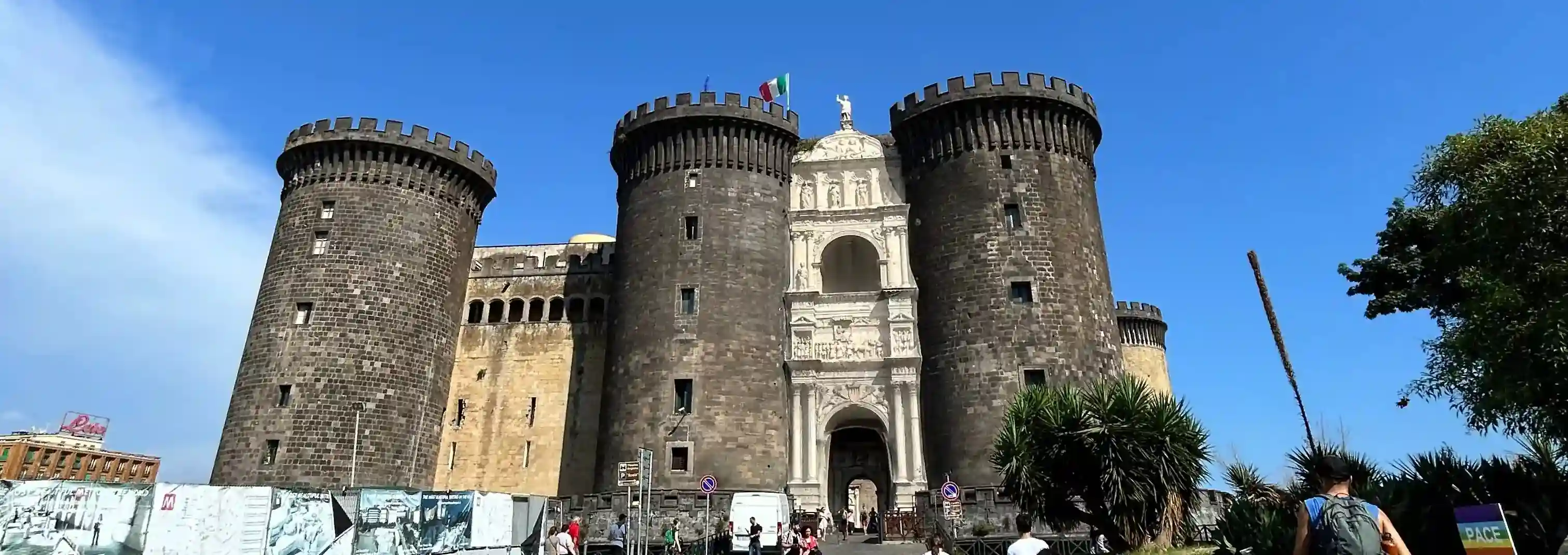
Castel Nuovo, also known as Maschio Angioino, is a medieval fortress in Naples constructed in the late 13th century as the principal royal residence of the Angevin dynasty. Located along the city’s waterfront, it functioned as both a defensive structure and a seat of political authority. The castle was later modified under Aragonese rule in the 15th century, when its defensive towers were reinforced and a triumphal marble arch was added at the main entrance. The structure reflects successive phases of dynastic control in the Kingdom of Naples.
Key Facts
- Materials
- Tuff, Piperno stone, Marble
- Civilization
- Kingdom of Naples (Angevin dynasty)
- Date(s)
- 1279-1282 CE
- Condition
- Preserved fortress housing museum and civic offices
- Original Function
- Royal residence and defensive fortress
- Key Figures
- Charles I of Anjou, Alfonso V of Aragon
Angevin Foundation
13th centuryCharles I of Anjou commissioned the castle after transferring the capital of the Kingdom of Naples from Palermo to Naples. The fortress was designed to consolidate royal authority and defend the harbor.
Aragonese Renovation
15th centuryUnder Alfonso V of Aragon, the castle was extensively rebuilt. Circular towers replaced earlier defensive elements, and a Renaissance triumphal arch commemorating Alfonso’s entry into Naples in 1443 was constructed at the main gate.
Spanish and Bourbon Periods
16th-18th centuriesAs the kingdom came under Spanish and later Bourbon rule, the castle’s role shifted primarily to military and administrative functions. It ceased to serve as a principal royal residence.
Modern Use
19th century - presentThe fortress underwent restoration and now houses the Civic Museum of Naples and municipal offices. Portions of the structure remain accessible to visitors.
Cultural Significance
Castel Nuovo symbolizes the consolidation of royal power in medieval Naples and the transition between Angevin and Aragonese rule. Its architecture illustrates the integration of Gothic defensive planning with Renaissance commemorative elements. The triumphal arch at its entrance is one of the earliest Renaissance monuments in southern Italy, marking a significant moment in the artistic history of the region.
Interpretive Notes
Scholarly debates and areas of uncertainty
Scholars debate the attribution and artistic influences of the Aragonese triumphal arch, particularly the extent of direct Renaissance influence from northern Italy. Archaeologists also examine how successive renovations altered the original Angevin layout, complicating efforts to reconstruct the castle’s earliest form.
Visiting Information
Entry Rules
Paid admission required for museum areas. Portions of the complex may close for municipal functions or restoration work.
Best Times to Visit
Morning visits typically experience lower visitor volume. Summer afternoons may be hot due to exposed stone surfaces.
Photography
Personal photography permitted in most areas without flash. Tripods and commercial filming require authorization.
Preservation Notes
Remain within designated pathways and do not climb defensive structures. Some interior staircases are steep and uneven.
Nearby POIs
11 shown- Palazzo Reale di Napoli0.3 km
- Basilica di San Francesco di Paola0.6 km
- Naples Underground Geothermal Zone0.6 km
- Basilica di Santa Chiara0.9 km
- Galleria Borbonica1 km
- Chiesa di Gesu Nuovo1 km
- Museo Nazionale di San Martino1.1 km
- Cappella Sansevero1.2 km
- Castel Sant'Elmo1.3 km
- Cattedrale di Santa Maria Assunta1.7 km
- Museo Archeologico Nazionale di Napoli1.7 km
Sources & Further Reading
- [1]Castel Nuovo in Naples — Francesco Aceto. Electa Napoli
- [2]The Kingdom of Naples 1266-1713 — David Abulafia. Longman (1997)
- [3]Renaissance Architecture in Southern Italy — Christoph L. Frommel. Yale University Press
Key Facts
- Materials
- Tuff, Piperno stone, Marble
- Civilization
- Kingdom of Naples (Angevin dynasty)
- Date(s)
- 1279-1282 CE
- Condition
- Preserved fortress housing museum and civic offices
- Original Function
- Royal residence and defensive fortress
- Key Figures
- Charles I of Anjou, Alfonso V of Aragon
Nearby POIs
11 shown- Palazzo Reale di Napoli0.3 km
- Basilica di San Francesco di Paola0.6 km
- Naples Underground Geothermal Zone0.6 km
- Basilica di Santa Chiara0.9 km
- Galleria Borbonica1 km
- Chiesa di Gesu Nuovo1 km
- Museo Nazionale di San Martino1.1 km
- Cappella Sansevero1.2 km
- Castel Sant'Elmo1.3 km
- Cattedrale di Santa Maria Assunta1.7 km
- Museo Archeologico Nazionale di Napoli1.7 km