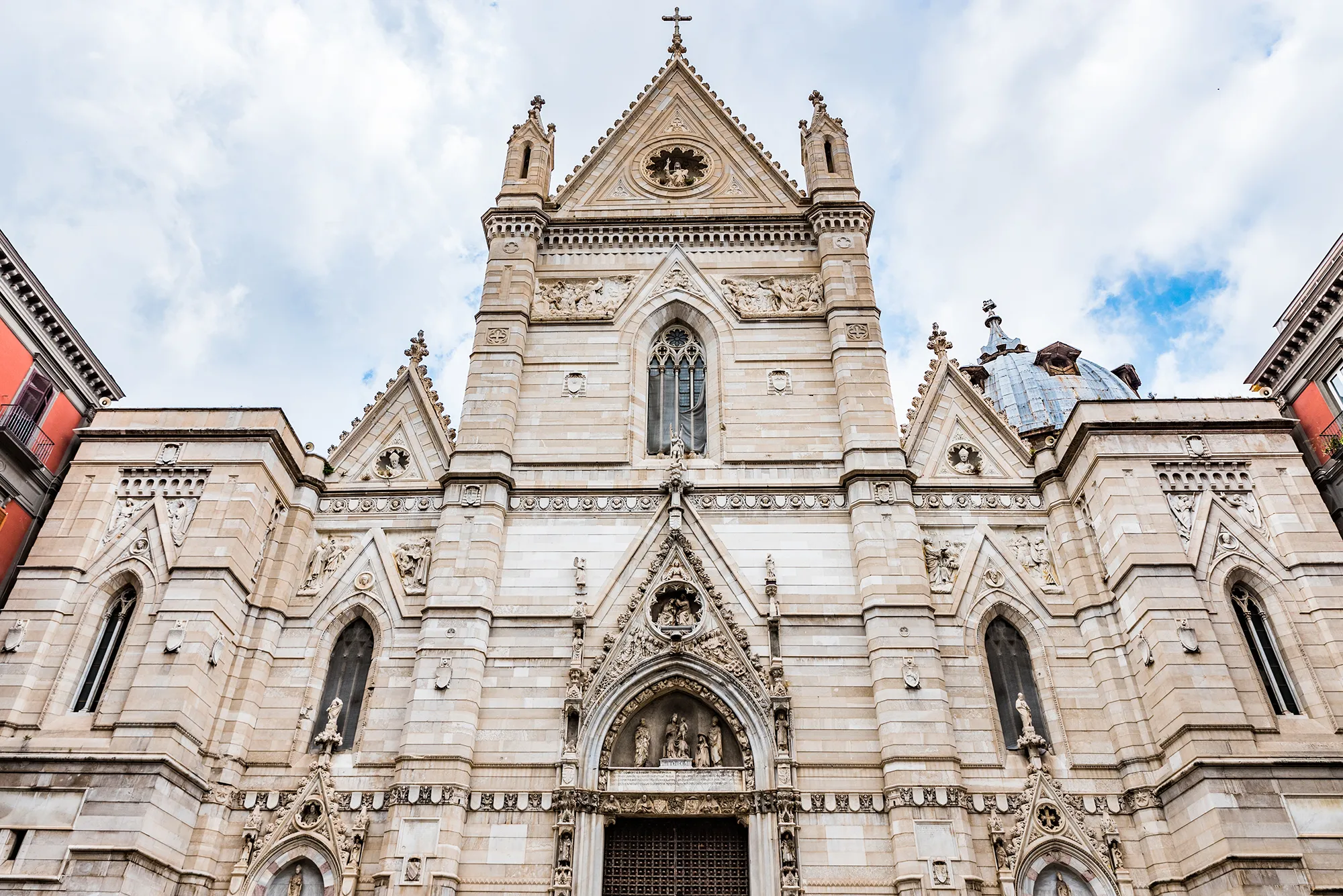
The Cattedrale di Santa Maria Assunta, commonly known as the Naples Cathedral, serves as the primary seat of the Archbishop of Naples. Originally commissioned by King Charles I of Anjou in the late 13th century, the structure was built over the foundations of earlier paleo-Christian basilicas, including the Stefania and Santa Restituta churches.
The cathedral is most famous for housing the Chapel of the Treasure of St. Januarius, which contains the relics of the city's patron saint. The architectural style is a complex layering of periods, featuring a 14th-century Gothic nave, a 17th-century Baroque chapel, and a 19th-century Neo-Gothic facade that replaced the original medieval front.
Key Facts
- Materials
- Tuff, Marble, Stucco
- Civilization
- Kingdom of Naples
- Accessibility
- Ground floor accessible, some chapels have steps
- Date(s)
- 1272-1314 CE
- Condition
- Active religious site and museum
- Original Function
- Cathedral and Royal Mausoleum
- Key Figures
- Charles I of Anjou, Saint Januarius, Cardinal Ascanio Filomarino
Foundations and Early Basilicas
4th-12th centuryThe site originally hosted the Basilica of Santa Restituta, one of the oldest churches in Naples, built in the 4th century. Archaeological excavations beneath the current cathedral reveal layers of Greek and Roman structures, confirming the site's long-standing religious importance.
Angevine Construction
1272-1314King Charles I of Anjou initiated the construction of the new cathedral to replace the aging basilica complex. The work was continued by his successors, Charles II and Robert the Wise, resulting in a grand Gothic structure that served as the spiritual heart of the Angevin kingdom.
Baroque Expansion
17th centuryThe 17th century saw the addition of the Chapel of the Treasure of St. Januarius, a masterpiece of Baroque art and architecture. This period also involved significant interior renovations to align the cathedral with the aesthetic standards of the Counter-Reformation.
Modern Restoration
19th century - presentThe current Neo-Gothic facade was completed in the late 19th century by Enrico Alvino, replacing the original medieval facade which had been damaged by earthquakes and previous modifications. Ongoing conservation efforts focus on preserving the delicate frescoes and the structural integrity of the ancient foundations.
Cultural Significance
The cathedral is the focal point of the 'Miracle of the Blood' of Saint Januarius, a ritual held three times a year where the saint's dried blood is said to liquefy. This event is deeply embedded in Neapolitan identity, serving as a barometer for the city's perceived fortune and divine protection.
Beyond its religious role, the cathedral acts as a repository of Neapolitan art history, housing works by masters such as Luca Giordano and Domenichino. It remains a central site for civic ceremonies and the religious life of the local population.
Interpretive Notes
Scholarly debates and areas of uncertainty
The exact layout and extent of the original 4th-century Stefania Basilica remain a subject of archaeological debate. Scholars continue to analyze the subterranean remains to determine how the early Christian structures were integrated into the later Angevin cathedral footprint.
Visiting Information
Entry Rules
Open daily. Entry to the main cathedral is free. The Baptistery and the Chapel of the Treasure may require a separate ticket for entry. Modest dress is required; shoulders and knees must be covered.
Best Times to Visit
Early morning on weekdays to avoid crowds. The days surrounding the feast of Saint Januarius (September 19th) are historically significant but extremely crowded.
Photography
Photography is permitted without flash. Tripods and professional equipment require prior authorization from the diocesan office.
Preservation Notes
The cathedral is a fragile historic site. Visitors are requested to remain within marked visitor areas and refrain from touching the marble surfaces or historical artifacts.
Nearby POIs
11 shown- Cappella Sansevero0.6 km
- Museo Archeologico Nazionale di Napoli0.8 km
- Chiesa di Gesu Nuovo0.9 km
- Basilica di Santa Chiara0.9 km
- Castel Nuovo1.7 km
- Catacombs of San Gennaro1.7 km
- Museo di Capodimonte1.8 km
- Museo Nazionale di San Martino1.9 km
- Palazzo Reale di Napoli2 km
- Castel Sant'Elmo2 km
- Naples Underground Geothermal Zone2.1 km
Sources & Further Reading
- [1]The Cathedral of Naples: History and Art — Nicola Spinosa. Electa Napoli (2005)
- [2]Naples: A History of the City — John A. Marino. University of Chicago Press (2011)
Key Facts
- Materials
- Tuff, Marble, Stucco
- Civilization
- Kingdom of Naples
- Accessibility
- Ground floor accessible, some chapels have steps
- Date(s)
- 1272-1314 CE
- Condition
- Active religious site and museum
- Original Function
- Cathedral and Royal Mausoleum
- Key Figures
- Charles I of Anjou, Saint Januarius, Cardinal Ascanio Filomarino
Nearby POIs
11 shown- Cappella Sansevero0.6 km
- Museo Archeologico Nazionale di Napoli0.8 km
- Chiesa di Gesu Nuovo0.9 km
- Basilica di Santa Chiara0.9 km
- Castel Nuovo1.7 km
- Catacombs of San Gennaro1.7 km
- Museo di Capodimonte1.8 km
- Museo Nazionale di San Martino1.9 km
- Palazzo Reale di Napoli2 km
- Castel Sant'Elmo2 km
- Naples Underground Geothermal Zone2.1 km