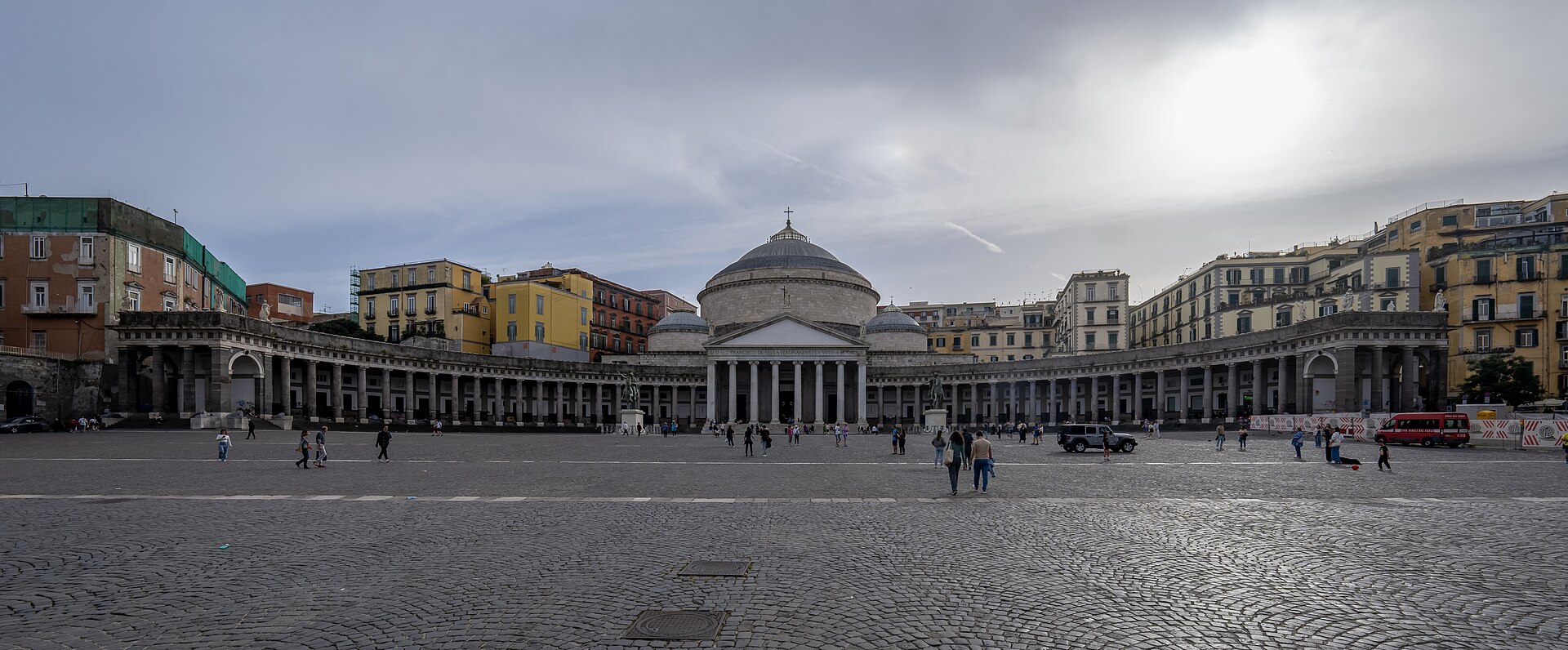
The Basilica di San Francesco di Paola is a prominent church located on the west side of the Piazza del Plebiscito in Naples. Commissioned by King Ferdinand I of the Two Sicilies to commemorate the restoration of the Bourbon monarchy, the structure was designed by architect Pietro Bianchi following a competition held in 1817. Its design is heavily inspired by the Roman Pantheon, featuring a massive circular rotunda fronted by a colonnaded portico.
The interior is characterized by a high dome supported by thirty-four Corinthian columns of Mondragone marble. The basilica serves as a significant example of Neoclassical architecture in Italy, blending religious function with the grand urban planning initiatives of the 19th-century Bourbon court.
Key Facts
- Materials
- Marble, Stucco, Brick
- Civilization
- Kingdom of the Two Sicilies
- Accessibility
- Ground level access from Piazza del Plebiscito
- Date(s)
- 1816-1846
- Condition
- Active basilica
- Original Function
- Royal votive church
- Key Figures
- Ferdinand I of the Two Sicilies, Pietro Bianchi
Commission and Design
1816-1817Following the defeat of Napoleon and the return of the Bourbon monarchy, King Ferdinand I commissioned the church as a votive offering to Saint Francis of Paola. A competition was held to select a design that would complement the royal palace across the square.
Construction Phase
1817-1846Construction was overseen by Pietro Bianchi, who incorporated elements of the Roman Pantheon into the design. The project faced delays due to the complexity of the dome and the logistical challenges of sourcing high-quality marble for the interior columns.
Consecration and Modern Era
1846-PresentThe basilica was consecrated in 1846 by Pope Gregory XVI. It has remained a focal point of Neapolitan religious and civic life, undergoing various restoration efforts to preserve its Neoclassical facade and interior artwork.
Cultural Significance
The basilica is a cornerstone of the Piazza del Plebiscito, representing the Bourbon dynasty's attempt to align Naples with the architectural prestige of Rome. It serves as a symbol of the city's historical transition into the 19th century and remains a primary site for major religious ceremonies in Naples.
Interpretive Notes
Scholarly debates and areas of uncertainty
Debate exists regarding the extent to which the basilica's design was intended to mimic the Pantheon as a political statement of legitimacy versus a purely aesthetic choice by the architect Pietro Bianchi.
Visiting Information
Entry Rules
Open daily to the public. Entry is free. Modest dress is required as it is an active place of worship.
Best Times to Visit
Early morning or late afternoon to avoid the heat of the square and peak tourist crowds.
Photography
Photography is permitted for personal use. Flash and tripods are prohibited inside the basilica.
Preservation Notes
The structure is subject to ongoing maintenance due to its location in a high-traffic urban square. Visitors are requested to remain quiet and respect ongoing religious services.
Nearby POIs
11 shown- Palazzo Reale di Napoli0.3 km
- Naples Underground Geothermal Zone0.3 km
- Galleria Borbonica0.4 km
- Castel Nuovo0.6 km
- Museo Nazionale di San Martino1 km
- Castel Sant'Elmo1.2 km
- Basilica di Santa Chiara1.3 km
- Chiesa di Gesu Nuovo1.4 km
- Cappella Sansevero1.7 km
- Museo Archeologico Nazionale di Napoli2 km
- Cattedrale di Santa Maria Assunta2.2 km
Sources & Further Reading
- [1]The Architecture of the Bourbon Kingdom — Harold Acton. Bourbon Naples Press (1956)
- [2]Neoclassicism in Southern Italy — Pietro Bianchi (Studies). Journal of Architectural History (2012)
Key Facts
- Materials
- Marble, Stucco, Brick
- Civilization
- Kingdom of the Two Sicilies
- Accessibility
- Ground level access from Piazza del Plebiscito
- Date(s)
- 1816-1846
- Condition
- Active basilica
- Original Function
- Royal votive church
- Key Figures
- Ferdinand I of the Two Sicilies, Pietro Bianchi
Nearby POIs
11 shown- Palazzo Reale di Napoli0.3 km
- Naples Underground Geothermal Zone0.3 km
- Galleria Borbonica0.4 km
- Castel Nuovo0.6 km
- Museo Nazionale di San Martino1 km
- Castel Sant'Elmo1.2 km
- Basilica di Santa Chiara1.3 km
- Chiesa di Gesu Nuovo1.4 km
- Cappella Sansevero1.7 km
- Museo Archeologico Nazionale di Napoli2 km
- Cattedrale di Santa Maria Assunta2.2 km