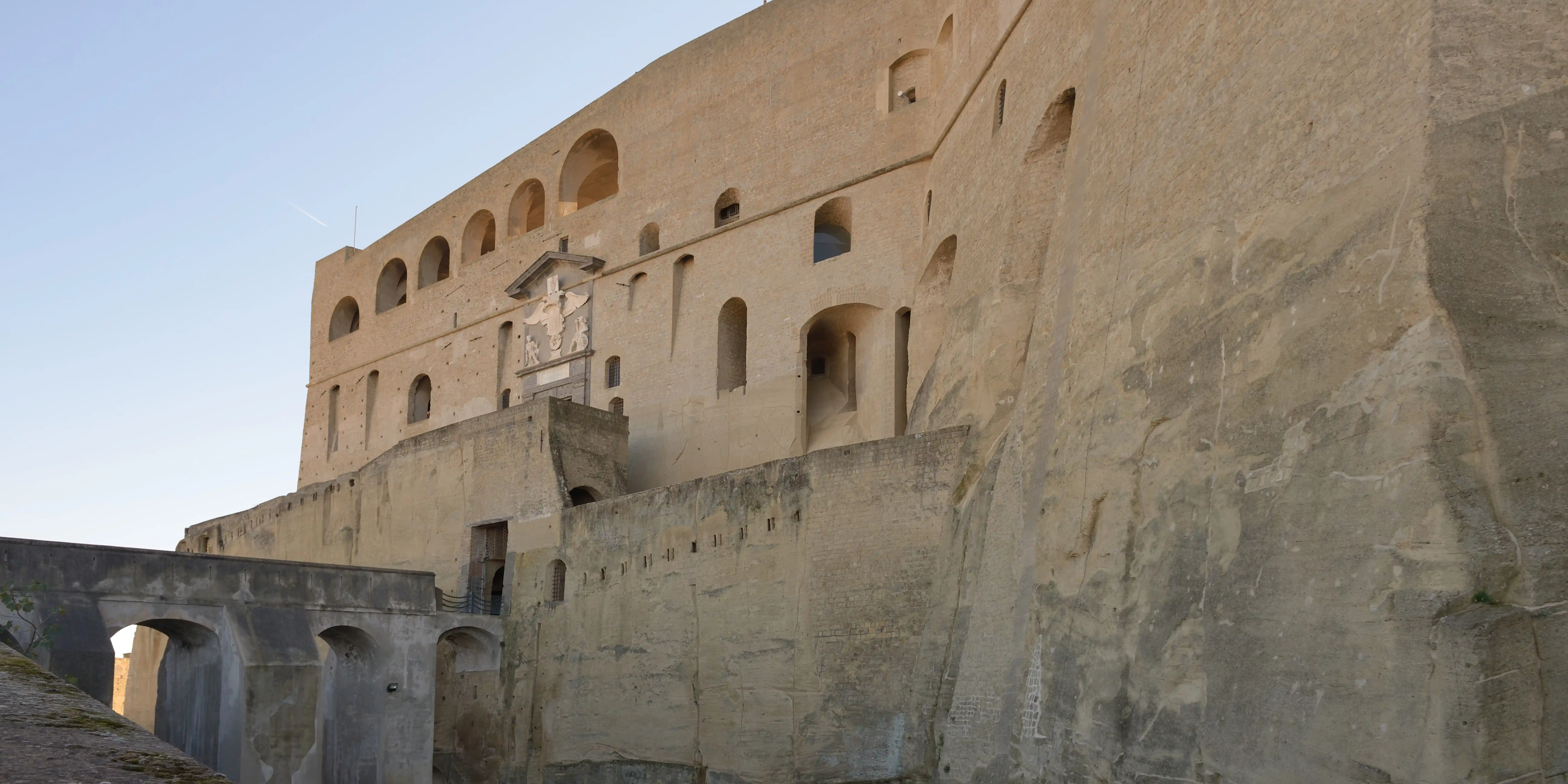
Castel Sant'Elmo is a medieval fortress located on the Vomero hill overlooking Naples, Italy. Originally built as a defensive structure, its current star-shaped layout dates primarily to the 16th-century reconstruction commissioned by the Spanish viceroy Don Pedro de Toledo, which transformed the site into a formidable military bastion.
Today, the castle serves as a cultural hub, housing the Museo del Novecento, which features 20th-century art, as well as serving as a venue for temporary exhibitions and public events. Its strategic position offers panoramic views of the city, the Gulf of Naples, and Mount Vesuvius, making it a significant landmark in the Neapolitan landscape.
Key Facts
- Materials
- Yellow tuff, Stone
- Civilization
- Kingdom of Naples
- Accessibility
- Accessible via funicular and pedestrian paths
- Date(s)
- 1329-1537
- Condition
- Restored and active as a museum
- Original Function
- Military fortress
- Key Figures
- Robert of Anjou, Don Pedro de Toledo, Luigi Scognamiglio
Origins and Anjou Rule
14th centuryThe site was originally home to a church dedicated to Sant'Erasmo. In 1329, Robert of Anjou ordered the construction of a fortified palace known as the Belforte, which served as a defensive stronghold for the Angevin dynasty.
Spanish Reconstruction
16th centuryUnder the Spanish viceroyalty, the castle was completely redesigned by architect Pedro Luis Escrivà. The new star-shaped plan was intended to withstand modern artillery fire, solidifying its role as the primary defensive bastion of the city.
Military and Prison Use
17th-19th centuryFor centuries, the castle functioned as a military garrison and a prison for political dissidents, including notable figures such as Tommaso Campanella and the leaders of the Neapolitan Republic of 1799.
Modern Cultural Transformation
20th century - presentAfter serving as a military prison until 1952, the castle was transferred to the state. Extensive restoration projects in the late 20th century rehabilitated the structure for public use, establishing it as a museum and exhibition space.
Cultural Significance
Castel Sant'Elmo is a symbol of Naples' complex history of foreign rule and military defense. Its transformation from a site of incarceration to a center for contemporary art reflects the city's broader shift toward cultural tourism and heritage preservation. The castle remains a focal point for the city's identity, providing a vantage point that connects the historical urban fabric with the surrounding geography.
Interpretive Notes
Scholarly debates and areas of uncertainty
Debates persist regarding the extent of the original Angevin structure that remains beneath the 16th-century Spanish fortifications. Archaeological investigations continue to uncover subterranean passages and foundations that challenge previous assumptions about the castle's medieval footprint.
Visiting Information
Entry Rules
Open daily. Tickets can be purchased at the entrance or online. The site is accessible via the Montesanto funicular followed by a short walk.
Best Times to Visit
Early morning or late afternoon for the best light and views of the city. Weekdays are generally less crowded than weekends.
Photography
Personal photography is permitted. Commercial photography requires prior authorization from the museum administration.
Preservation Notes
Visitors are requested to stay within marked paths. The structure is historic and contains uneven surfaces; comfortable footwear is recommended.
Nearby POIs
11 shown- Museo Nazionale di San Martino0.2 km
- Naples Underground Geothermal Zone0.9 km
- Chiesa di Gesu Nuovo1.1 km
- Basilica di San Francesco di Paola1.2 km
- Basilica di Santa Chiara1.2 km
- Palazzo Reale di Napoli1.2 km
- Galleria Borbonica1.3 km
- Castel Nuovo1.3 km
- Museo Archeologico Nazionale di Napoli1.5 km
- Cappella Sansevero1.5 km
- Cattedrale di Santa Maria Assunta2 km
Sources & Further Reading
- [1]Castel Sant'Elmo: Storia e Architettura — Gino Doria. Edizioni Scientifiche Italiane (1985)
- [2]The Fortifications of Naples — Cesare De Seta. Laterza (2002)
Key Facts
- Materials
- Yellow tuff, Stone
- Civilization
- Kingdom of Naples
- Accessibility
- Accessible via funicular and pedestrian paths
- Date(s)
- 1329-1537
- Condition
- Restored and active as a museum
- Original Function
- Military fortress
- Key Figures
- Robert of Anjou, Don Pedro de Toledo, Luigi Scognamiglio
Nearby POIs
11 shown- Museo Nazionale di San Martino0.2 km
- Naples Underground Geothermal Zone0.9 km
- Chiesa di Gesu Nuovo1.1 km
- Basilica di San Francesco di Paola1.2 km
- Basilica di Santa Chiara1.2 km
- Palazzo Reale di Napoli1.2 km
- Galleria Borbonica1.3 km
- Castel Nuovo1.3 km
- Museo Archeologico Nazionale di Napoli1.5 km
- Cappella Sansevero1.5 km
- Cattedrale di Santa Maria Assunta2 km