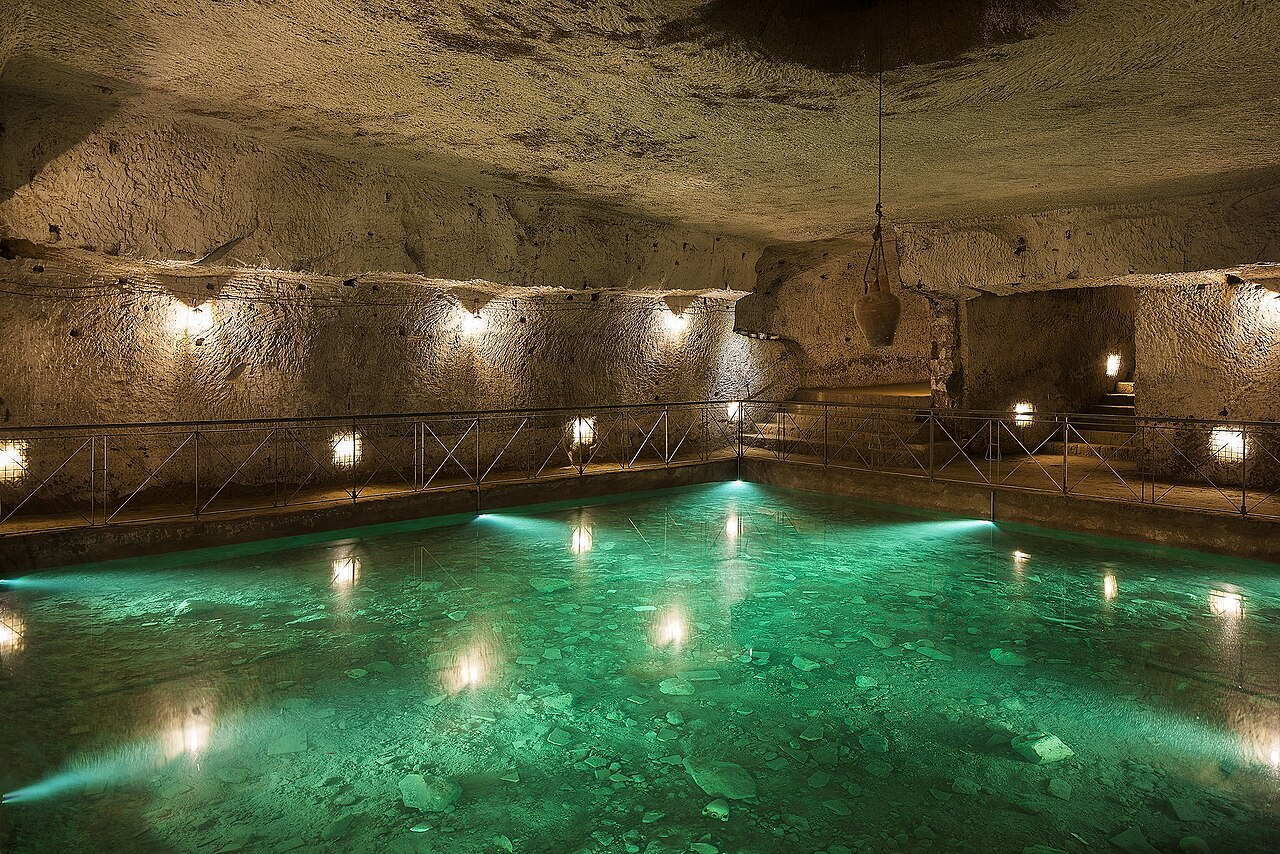
The Galleria Borbonica is a 19th-century underground passage system constructed beneath Naples on the orders of King Ferdinand II of Bourbon. Designed in 1853 as a military escape route and strategic corridor linking the Royal Palace to nearby barracks, the tunnel system was never completed as originally planned. During the Second World War, sections of the tunnels were repurposed as air-raid shelters. In the postwar period, parts of the complex were used for storage before undergoing restoration and opening to the public as a guided underground site.
Key Facts
- Materials
- Tuff
- Civilization
- Kingdom of the Two Sicilies
- Date(s)
- 1853 CE
- Condition
- Restored underground heritage site accessible by guided tour
- Original Function
- Military escape route and subterranean passage
- Key Figures
- Ferdinand II of Bourbon, Errico Alvino
Bourbon Construction
1853-1855Commissioned by Ferdinand II, the project was entrusted to architect Errico Alvino. The tunnel system was intended to provide a secure passage between the Royal Palace and military installations in response to political unrest. Construction halted before completion.
World War II Shelter
1939-1945During the Second World War, portions of the tunnels were adapted as air-raid shelters for Neapolitan civilians. Inscriptions, personal objects, and structural modifications from this period remain visible.
Postwar Use and Rediscovery
Late 20th centuryAfter the war, sections were used for storage and as a vehicle deposit. Rediscovery and clearance efforts in the early 2000s led to systematic restoration and archaeological documentation.
Public Opening
21st centuryThe Galleria Borbonica opened to the public through guided tours, presenting the site as a layered historical environment reflecting Bourbon engineering and wartime civilian experience.
Cultural Significance
The Galleria Borbonica illustrates the political instability of 19th-century Naples and the defensive strategies of the Bourbon monarchy. Its later adaptation as a civilian shelter connects the site to the lived experience of wartime urban populations. The tunnels also demonstrate the reuse of subterranean space in Naples, a city historically characterized by extensive underground infrastructure.
Interpretive Notes
Scholarly debates and areas of uncertainty
Historians examine the extent to which the project reflected genuine security concerns versus symbolic assertions of Bourbon authority. Archaeologists also debate how to interpret and preserve the overlapping material evidence from Bourbon construction and World War II adaptations within a single conservation framework.
Visiting Information
Entry Rules
Access by guided tour only. Paid admission required. Advance booking recommended. Not fully accessible due to uneven surfaces and narrow passages.
Best Times to Visit
Tours operate year-round; reservations advised during weekends and holidays. Underground temperatures remain relatively stable across seasons.
Photography
Personal photography permitted without flash. Tripods and professional equipment require authorization.
Preservation Notes
Wear appropriate footwear due to uneven and damp surfaces. Follow guide instructions at all times. Do not touch historic markings or stored artifacts.
Nearby POIs
11 shown- Basilica di San Francesco di Paola0.4 km
- Naples Underground Geothermal Zone0.5 km
- Palazzo Reale di Napoli0.7 km
- Castel Nuovo1 km
- Museo Nazionale di San Martino1.2 km
- Castel Sant'Elmo1.3 km
- Basilica di Santa Chiara1.7 km
- Chiesa di Gesu Nuovo1.8 km
- Cappella Sansevero2.1 km
- Museo Archeologico Nazionale di Napoli2.4 km
- Cattedrale di Santa Maria Assunta2.6 km
Sources & Further Reading
- [1]Napoli Sotterranea: Storia e Architettura — Vincenzo De Sivo. Electa Napoli
- [2]The Kingdom of the Two Sicilies — John Davis. Oxford University Press (2006)
Key Facts
- Materials
- Tuff
- Civilization
- Kingdom of the Two Sicilies
- Date(s)
- 1853 CE
- Condition
- Restored underground heritage site accessible by guided tour
- Original Function
- Military escape route and subterranean passage
- Key Figures
- Ferdinand II of Bourbon, Errico Alvino
Nearby POIs
11 shown- Basilica di San Francesco di Paola0.4 km
- Naples Underground Geothermal Zone0.5 km
- Palazzo Reale di Napoli0.7 km
- Castel Nuovo1 km
- Museo Nazionale di San Martino1.2 km
- Castel Sant'Elmo1.3 km
- Basilica di Santa Chiara1.7 km
- Chiesa di Gesu Nuovo1.8 km
- Cappella Sansevero2.1 km
- Museo Archeologico Nazionale di Napoli2.4 km
- Cattedrale di Santa Maria Assunta2.6 km