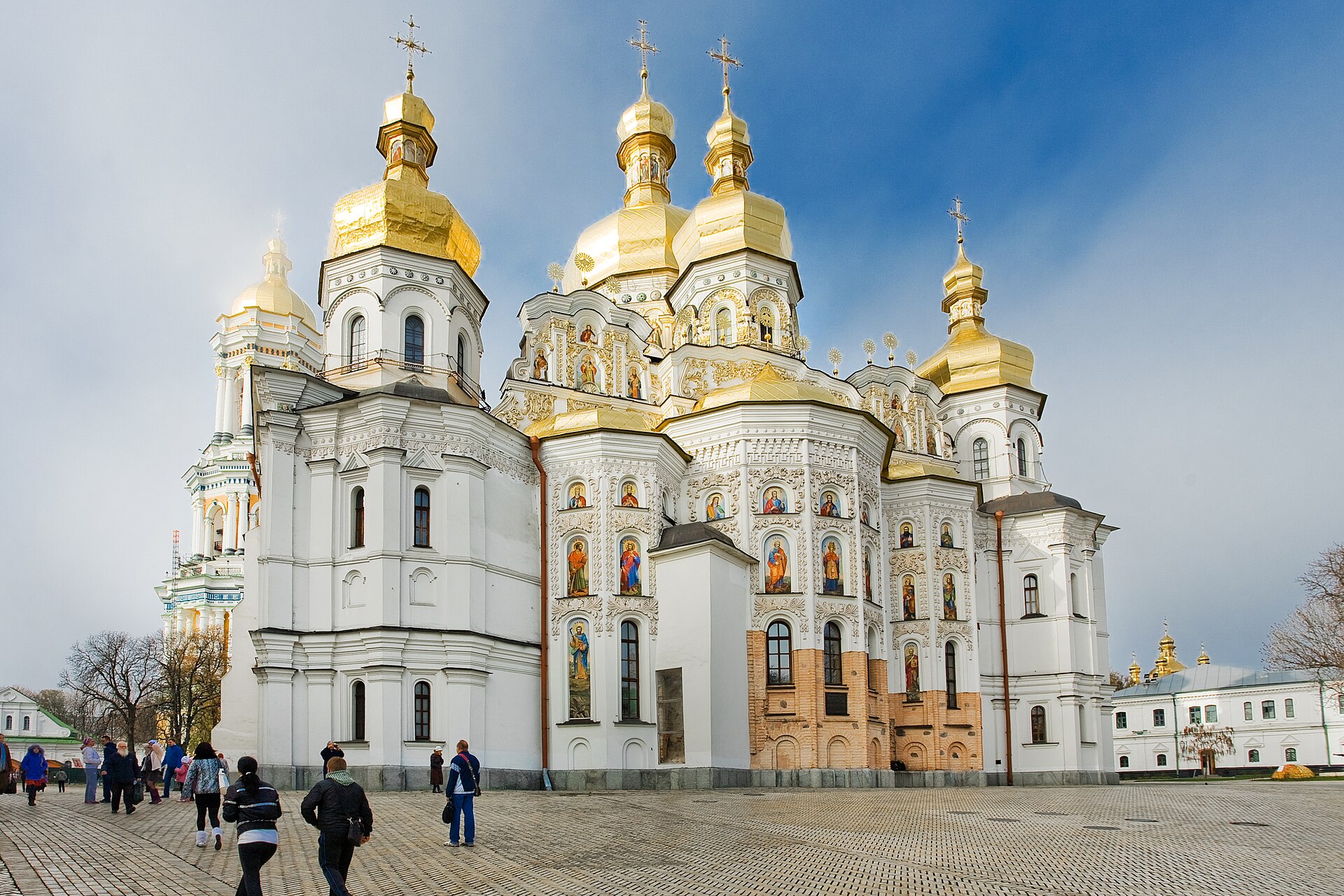
The Dormition Cathedral of the Kiev Pechersk Lavra is the primary church of the historic Pechersk Lavra monastery complex in Kiev. Originally constructed in the 11th century, it served as the burial site for Kievan princes and high-ranking clergy, functioning as a spiritual and political center of the Kievan Rus state.
The current structure is a faithful reconstruction completed in 2000, following the destruction of the original medieval cathedral during the Second World War. The building represents the Ukrainian Baroque style, characterized by its ornate gilded domes and intricate facade, and remains a central site for the Ukrainian Orthodox Church.
Key Facts
- Materials
- Brick, Limestone, Gold leaf, Stucco
- Civilization
- Kievan Rus
- Accessibility
- Ground level accessible, interior may have limited access during services
- Date(s)
- 1073-1078 (original), 1998-2000 (reconstruction)
- Condition
- Fully reconstructed and active
- Original Function
- Monastic cathedral and princely necropolis
- Key Figures
- Theodosius of Kiev, Antony of Kiev, Prince Svyatoslav II
Founding and Kievan Rus Era
11th centuryThe cathedral was founded in 1073 by Theodosius of Kiev and Prince Svyatoslav II. It was built as the main church of the monastery and became the burial place for many prominent figures of the Kievan Rus era, including princes and bishops.
Baroque Transformation
17th-18th centuryFollowing centuries of damage from Mongol invasions and fires, the cathedral underwent significant reconstruction in the Ukrainian Baroque style, adding the characteristic multi-tiered domes and elaborate decorative elements that defined its appearance for centuries.
Destruction and Reconstruction
1941-2000The cathedral was destroyed by an explosion in November 1941 during the German occupation of Kiev. The ruins remained untouched for decades until the Ukrainian government authorized a full reconstruction in the late 1990s, which was consecrated in 2000.
Cultural Significance
The Dormition Cathedral is a cornerstone of Ukrainian national and religious identity. As the heart of the Pechersk Lavra, it symbolizes the historical continuity of the Orthodox faith in the region and serves as a testament to the architectural heritage of the Kievan Rus period and the subsequent Baroque revival.
Interpretive Notes
Scholarly debates and areas of uncertainty
The circumstances surrounding the 1941 explosion remain a subject of historical investigation, with debates focusing on whether the destruction was a deliberate act of sabotage by Soviet forces or a result of German military actions.
Visiting Information
Entry Rules
Open daily. Modest dress is required, including head coverings for women. Photography is generally permitted, but strictly prohibited during religious services.
Best Times to Visit
Early morning on weekdays to avoid large crowds of pilgrims and tourists. The cathedral is particularly significant during major Orthodox holidays.
Photography
No flash photography inside the cathedral. Photography is forbidden during liturgy and other religious ceremonies.
Preservation Notes
Visitors are requested to maintain silence and respect the sanctity of the space. Do not touch the icons or historical wall decorations.
Nearby POIs
11 shown- Mystetskyi Arsenal0.3 km
- Ivan Honchar Museum0.3 km
- National Museum of the Holodomor0.4 km
- National Museum of the History of Ukraine in the Second World War1 km
- Mother Ukraine1 km
- Monument to the Founders of Kiev1.1 km
- Vydubychi Monastery2.2 km
- Gorodetsky House2.3 km
- National Art Museum of Ukraine2.5 km
- PinchukArtCentre2.7 km
- Khanenko Museum3.1 km
Sources & Further Reading
- [1]Kyiv Pechersk Lavra: A History — Serhii Plokhy. Harvard Ukrainian Research Institute (2015)
- [2]The Architecture of the Kievan Rus — Oleg Rappoport. Academic Press of Ukraine (2002)
Key Facts
- Materials
- Brick, Limestone, Gold leaf, Stucco
- Civilization
- Kievan Rus
- Accessibility
- Ground level accessible, interior may have limited access during services
- Date(s)
- 1073-1078 (original), 1998-2000 (reconstruction)
- Condition
- Fully reconstructed and active
- Original Function
- Monastic cathedral and princely necropolis
- Key Figures
- Theodosius of Kiev, Antony of Kiev, Prince Svyatoslav II
Nearby POIs
11 shown- Mystetskyi Arsenal0.3 km
- Ivan Honchar Museum0.3 km
- National Museum of the Holodomor0.4 km
- National Museum of the History of Ukraine in the Second World War1 km
- Mother Ukraine1 km
- Monument to the Founders of Kiev1.1 km
- Vydubychi Monastery2.2 km
- Gorodetsky House2.3 km
- National Art Museum of Ukraine2.5 km
- PinchukArtCentre2.7 km
- Khanenko Museum3.1 km