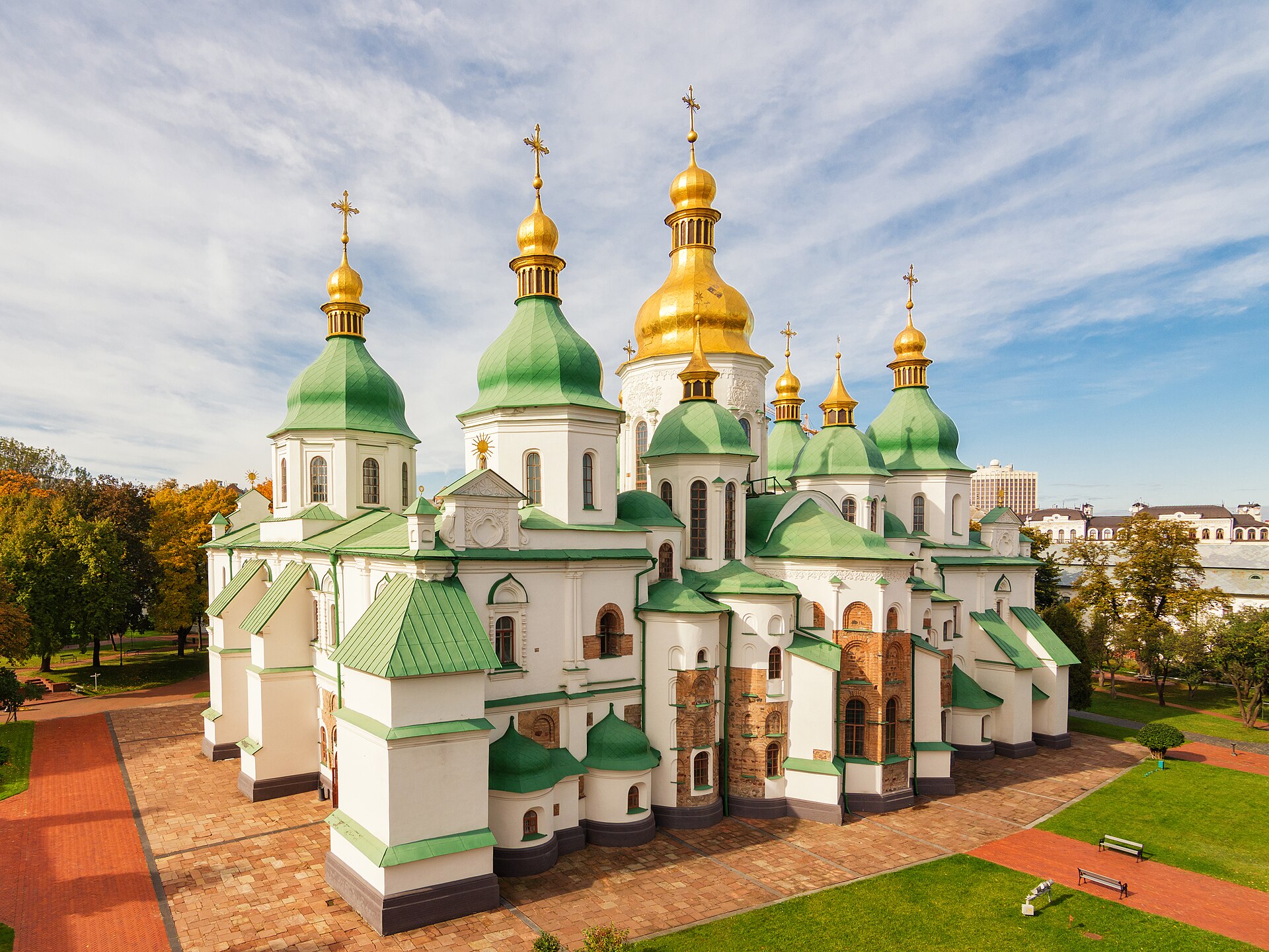
Saint Sophia Cathedral in Kiev is a landmark of Kievan Rus' architecture, founded in the 11th century. It is renowned for its extensive collection of original 11th-century mosaics and frescoes, which represent one of the most significant surviving examples of Byzantine-influenced art in Eastern Europe.
The structure underwent significant reconstruction in the 17th and 18th centuries, adopting the Ukrainian Baroque style for its exterior. Today, the cathedral serves as a museum and is recognized as the first site in Ukraine to be inscribed on the UNESCO World Heritage list, reflecting its enduring role in the cultural and religious history of the region.
Key Facts
- Materials
- Brick, Stone, Mosaic, Fresco
- Civilization
- Kievan Rus'
- Accessibility
- Ground floor accessible, upper levels restricted
- Date(s)
- 1011-1018 CE
- Condition
- Well-preserved museum and architectural monument
- Original Function
- Cathedral and burial place of Kievan princes
- Key Figures
- Yaroslav the Wise, Vladimir the Great
Foundation
11th centuryThe cathedral was founded by Yaroslav the Wise to commemorate his victory over the Pechenegs. It served as the primary religious and political center of the Kievan Rus' state.
Baroque Transformation
17th-18th centuryFollowing a period of neglect, the cathedral was extensively renovated in the Ukrainian Baroque style. This included the addition of new domes and decorative facades that define its current exterior appearance.
Modern Era
20th century - presentThe site was designated a state architectural and historical sanctuary in the 1930s. It was inscribed as a UNESCO World Heritage site in 1990 and currently functions as a museum, preserving its medieval interior art.
Cultural Significance
Saint Sophia Cathedral is a cornerstone of Ukrainian national identity, symbolizing the historical continuity of the Kievan state. It remains a vital site for historical research and a primary destination for understanding the artistic and religious heritage of the medieval East Slavic world.
Interpretive Notes
Scholarly debates and areas of uncertainty
The exact date of the cathedral's foundation remains a subject of academic discussion, with some scholars arguing for a date during the reign of Vladimir the Great, while others maintain the traditional attribution to Yaroslav the Wise based on chronicle evidence.
Visiting Information
Entry Rules
Open daily. Tickets are required for entry to the cathedral and the surrounding bell tower. Modest dress is recommended as a sign of respect for the historical site.
Best Times to Visit
Spring and early autumn offer the best weather for exploring the cathedral grounds. Weekday mornings are generally less crowded than weekends.
Photography
Photography is permitted in the grounds. Flash photography is strictly prohibited inside the cathedral to protect the ancient frescoes and mosaics.
Preservation Notes
The interior environment is strictly climate-controlled to preserve the 11th-century wall paintings. Visitors must follow marked paths and avoid touching any surfaces.
Nearby POIs
11 shown- Golden Gate0.5 km
- National Museum of the History of Ukraine0.6 km
- St. Michael's Golden-Domed Monastery0.7 km
- St Andrew's Church0.7 km
- St Volodymyr's Cathedral1 km
- Monument to Volodymyr The Great1 km
- National Art Museum of Ukraine1.2 km
- Khanenko Museum1.3 km
- PinchukArtCentre1.3 km
- Gorodetsky House1.3 km
- Ukrainian National Chernobyl Museum1.5 km
Sources & Further Reading
- [1]
- [2]The Architecture of Kievan Rus' — Simon Franklin. Cambridge University Press (1991)
Key Facts
- Materials
- Brick, Stone, Mosaic, Fresco
- Civilization
- Kievan Rus'
- Accessibility
- Ground floor accessible, upper levels restricted
- Date(s)
- 1011-1018 CE
- Condition
- Well-preserved museum and architectural monument
- Original Function
- Cathedral and burial place of Kievan princes
- Key Figures
- Yaroslav the Wise, Vladimir the Great
Nearby POIs
11 shown- Golden Gate0.5 km
- National Museum of the History of Ukraine0.6 km
- St. Michael's Golden-Domed Monastery0.7 km
- St Andrew's Church0.7 km
- St Volodymyr's Cathedral1 km
- Monument to Volodymyr The Great1 km
- National Art Museum of Ukraine1.2 km
- Khanenko Museum1.3 km
- PinchukArtCentre1.3 km
- Gorodetsky House1.3 km
- Ukrainian National Chernobyl Museum1.5 km