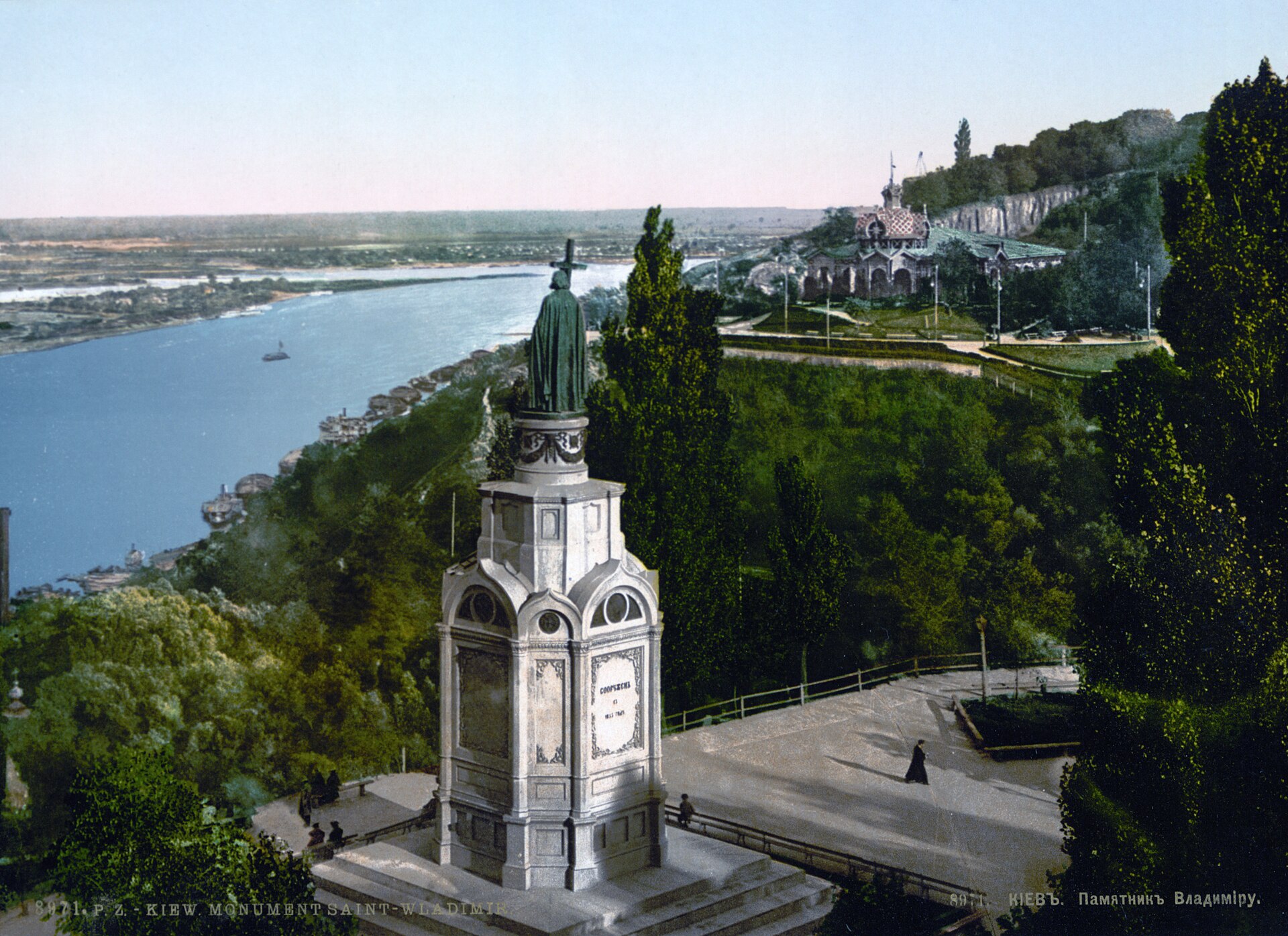
The Monument to Prince Volodymyr the Great is a prominent bronze statue located on Saint Vladimir Hill in Kiev, overlooking the Dnyepr River. Erected in 1853, it is recognized as the oldest sculptural monument in the city and serves as a significant landmark commemorating the Christianization of Kievan Rus' in 988 CE.
The monument features a bronze statue of Prince Volodymyr holding a cross, set upon a high pedestal designed to resemble a chapel. The structure was commissioned by Tsar Nicholas I and designed by sculptor Peter Clodt von Jürgensburg, with architectural contributions from Alexander Thon. It remains a central symbol of Kiev's historical and religious heritage.
Key Facts
- Materials
- Bronze, Cast iron, Brick, Stone
- Civilization
- Russian Empire
- Accessibility
- Accessible via park pathways
- Date(s)
- 1853
- Condition
- Well-preserved
- Original Function
- Commemorative monument
- Key Figures
- Volodymyr the Great, Peter Clodt von Jürgensburg, Tsar Nicholas I
Commission and Design
1850-1853The monument was commissioned by Tsar Nicholas I to honor Prince Volodymyr, the ruler who introduced Christianity to Kievan Rus'. The project was entrusted to sculptor Peter Clodt von Jürgensburg, who created the statue, while the pedestal was designed by architect Alexander Thon.
Inauguration
1853The monument was officially unveiled in 1853 on the steep slopes of Saint Vladimir Hill. It quickly became a focal point for the city and a symbol of the historical connection between the Russian Empire and the legacy of Kievan Rus'.
Modern Era
20th Century - PresentThroughout the Soviet period and following Ukraine's independence, the monument has remained a protected cultural site. It has undergone several restoration efforts to preserve the bronze statue and the masonry of the pedestal, maintaining its status as one of Kiev's most iconic historical monuments.
Cultural Significance
The monument represents the pivotal historical moment of the Christianization of Kievan Rus', a foundational event in the cultural and religious history of Eastern Europe. It serves as a symbol of Kiev's identity and its long-standing historical narrative.
Locally, the site is a popular destination for residents and tourists alike, offering panoramic views of the Dnieper River. It is frequently visited during national holidays and religious commemorations, reinforcing its role as a site of collective memory.
Interpretive Notes
Scholarly debates and areas of uncertainty
Debates surrounding the monument often focus on the historiographical interpretation of the monument's origins, specifically regarding the 19th-century imperial narrative of the 'gathering of Russian lands' versus the modern Ukrainian perspective of the monument as a symbol of Kiev's independent historical trajectory.
Visiting Information
Entry Rules
The monument is located in a public park and is accessible 24 hours a day. There is no entry fee.
Best Times to Visit
Daytime for views of the Dnyepr River; early morning or late afternoon to avoid peak tourist crowds.
Photography
None; personal photography is permitted.
Preservation Notes
The monument is a protected cultural heritage site. Visitors are requested to respect the surrounding park grounds and refrain from climbing on the pedestal.
Nearby POIs
11 shown- St. Michael's Golden-Domed Monastery0.3 km
- St Andrew's Church0.7 km
- National Art Museum of Ukraine0.8 km
- National Museum of the History of Ukraine0.8 km
- Saint Sophia Cathedral1 km
- Gorodetsky House1.2 km
- Golden Gate1.3 km
- Ukrainian National Chernobyl Museum1.3 km
- PinchukArtCentre1.7 km
- St Volodymyr's Cathedral1.8 km
- Khanenko Museum1.9 km
Sources & Further Reading
- [1]Kyiv: A Historical Guide — M. F. Dmitriev. Kyiv University Press (2010)
- [2]The Monuments of Kyiv — O. V. Kudrytskyi. Ukrainian Encyclopedia (1998)
Key Facts
- Materials
- Bronze, Cast iron, Brick, Stone
- Civilization
- Russian Empire
- Accessibility
- Accessible via park pathways
- Date(s)
- 1853
- Condition
- Well-preserved
- Original Function
- Commemorative monument
- Key Figures
- Volodymyr the Great, Peter Clodt von Jürgensburg, Tsar Nicholas I
Nearby POIs
11 shown- St. Michael's Golden-Domed Monastery0.3 km
- St Andrew's Church0.7 km
- National Art Museum of Ukraine0.8 km
- National Museum of the History of Ukraine0.8 km
- Saint Sophia Cathedral1 km
- Gorodetsky House1.2 km
- Golden Gate1.3 km
- Ukrainian National Chernobyl Museum1.3 km
- PinchukArtCentre1.7 km
- St Volodymyr's Cathedral1.8 km
- Khanenko Museum1.9 km