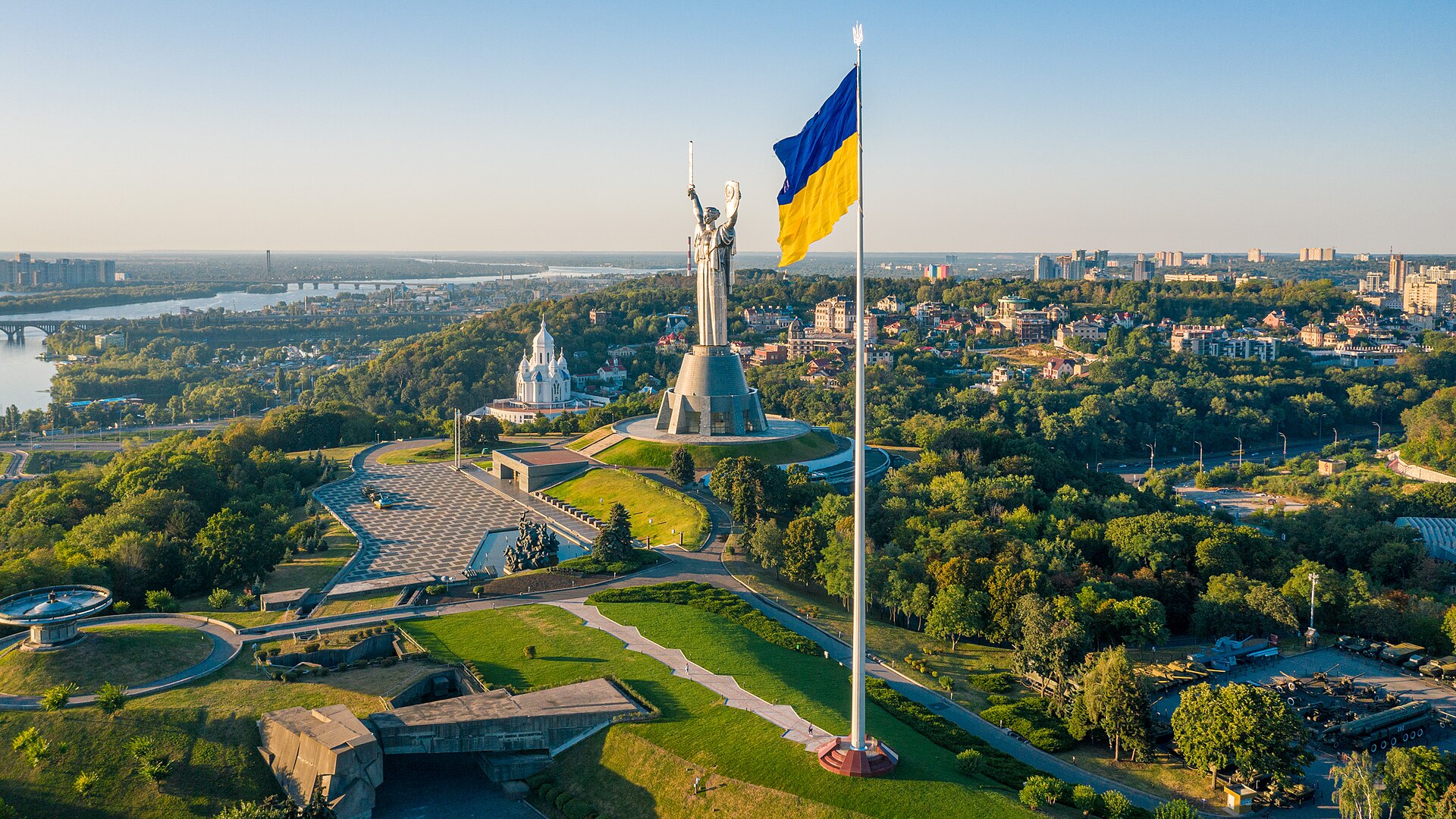
The National Museum of the History of Ukraine in the Second World War is a major memorial complex located on the picturesque slopes of the Pechersk hills in Kiev, overlooking the Dnyepr River. The site is dominated by the Motherland Monument, a 62-meter tall stainless steel statue that serves as a prominent landmark of the city's skyline.
The museum complex serves as a center for historical research and public education regarding the Eastern Front of World War II. It houses extensive collections of artifacts, personal documents, and weaponry, documenting the experiences of the Ukrainian people during the conflict and the subsequent impact of the war on the nation's development.
Key Facts
- Materials
- Stainless steel, Concrete, Granite
- Civilization
- Soviet Union
- Accessibility
- Partially accessible; steep terrain
- Date(s)
- 1974-1981
- Condition
- Active, undergoing thematic updates
- Original Function
- War memorial and museum
- Key Figures
- Yevgeny Vuchetich, Vasyl Borodai
Conception and Construction
1974-1981The memorial complex was initiated to commemorate the Soviet victory in the Great Patriotic War. The construction involved a massive engineering effort to stabilize the Pechersk hills and erect the colossal Motherland Monument, which was inaugurated on May 9, 1981, by Soviet leader Leonid Brezhnev.
Post-Independence Transition
1991-2015Following the dissolution of the Soviet Union, the museum underwent a shift in focus to emphasize the specific role and suffering of the Ukrainian people within the broader context of the war, moving away from purely Soviet-centric narratives.
Modern Recontextualization
2015-presentIn 2015, the museum was officially renamed to reflect its current focus on the history of Ukraine in the Second World War. Recent years have seen the removal of Soviet symbols from the monument, including the replacement of the Soviet coat of arms on the shield with the Ukrainian Tryzub in 2023.
Cultural Significance
The museum is a central site for national memory in Ukraine, representing the complex legacy of the Second World War. It serves as a space for both mourning the millions of lives lost and reflecting on the resilience of the Ukrainian nation.
In the contemporary era, the site has become a focal point for de-Sovietization efforts. The transformation of the monument's iconography reflects Ukraine's ongoing process of reforming its historical narrative and distancing itself from the Soviet ideological framework.
Interpretive Notes
Scholarly debates and areas of uncertainty
There is ongoing academic discussion regarding the balance between the museum's role as a site of Soviet-era monumental architecture and its current mission to provide a modern, independent Ukrainian perspective on the war. The physical preservation of the massive Soviet-era structures while updating the internal exhibits remains a subject of architectural and historical debate.
Visiting Information
Entry Rules
Open daily. Tickets can be purchased at the entrance. Visitors are subject to security checks. Modest behavior is expected given the memorial nature of the site.
Best Times to Visit
Weekdays during the morning hours to avoid weekend crowds. The site is particularly significant on May 8th (Remembrance and Reconciliation Day).
Photography
Personal photography is permitted in outdoor areas. Indoor photography rules may vary by exhibition; check signage at the entrance.
Preservation Notes
The site is a protected cultural landmark. Do not climb on memorial structures or deface the monument. Follow all marked paths as the terrain is uneven.
Nearby POIs
11 shown- Mother Ukraine0.1 km
- Monument to the Founders of Kiev0.4 km
- Ivan Honchar Museum0.7 km
- Dormition Cathedral of the Kiev Pechersk Lavra1 km
- Mystetskyi Arsenal1.1 km
- Vydubychi Monastery1.1 km
- National Museum of the Holodomor1.4 km
- Gorodetsky House3.2 km
- National Art Museum of Ukraine3.4 km
- PinchukArtCentre3.4 km
- Khanenko Museum3.8 km
Key Facts
- Materials
- Stainless steel, Concrete, Granite
- Civilization
- Soviet Union
- Accessibility
- Partially accessible; steep terrain
- Date(s)
- 1974-1981
- Condition
- Active, undergoing thematic updates
- Original Function
- War memorial and museum
- Key Figures
- Yevgeny Vuchetich, Vasyl Borodai
Nearby POIs
11 shown- Mother Ukraine0.1 km
- Monument to the Founders of Kiev0.4 km
- Ivan Honchar Museum0.7 km
- Dormition Cathedral of the Kiev Pechersk Lavra1 km
- Mystetskyi Arsenal1.1 km
- Vydubychi Monastery1.1 km
- National Museum of the Holodomor1.4 km
- Gorodetsky House3.2 km
- National Art Museum of Ukraine3.4 km
- PinchukArtCentre3.4 km
- Khanenko Museum3.8 km