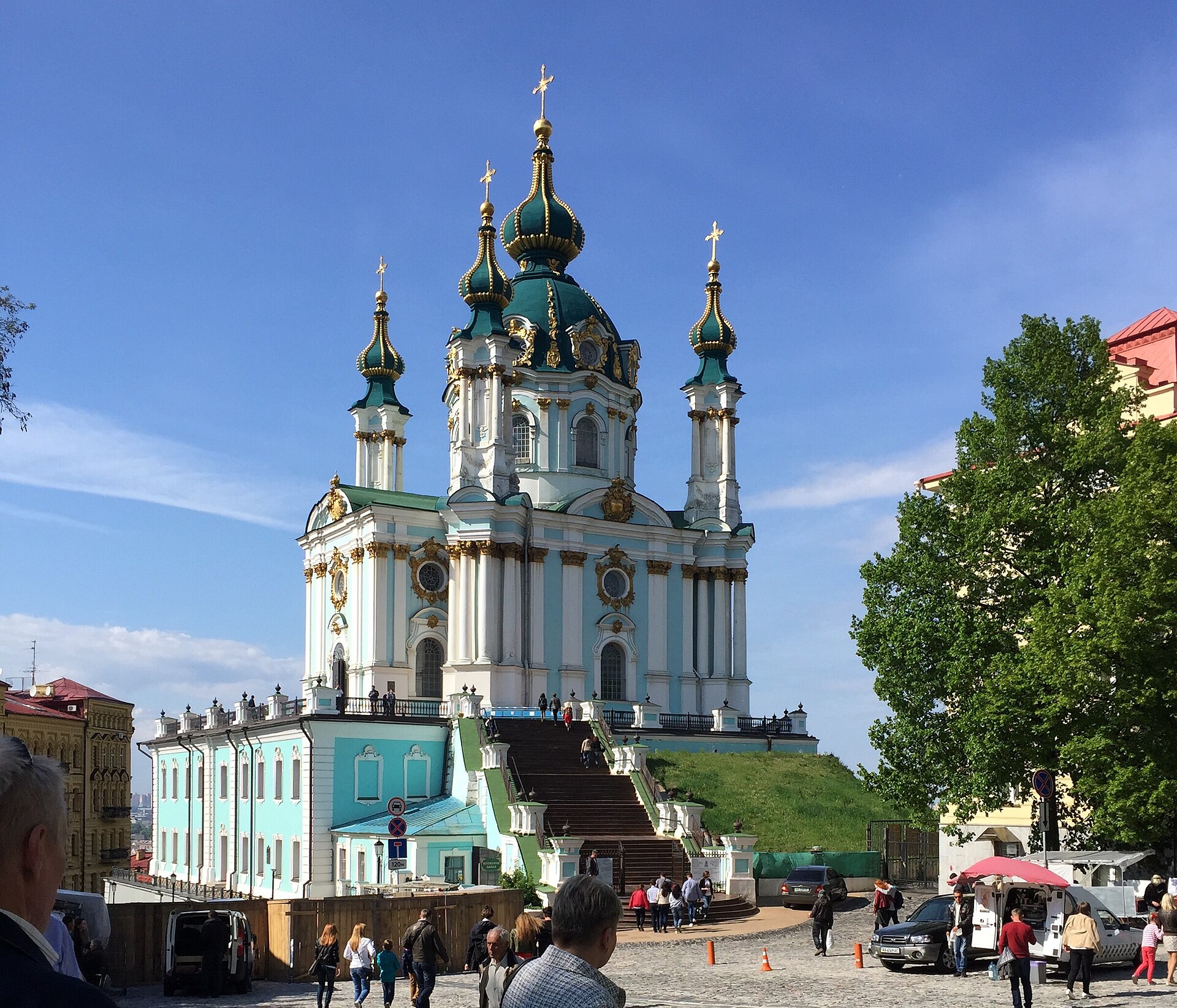
St. Andrew's Church is a prominent Baroque church located in Kyiv, Ukraine, situated on the steep St. Andrew's Hill overlooking the historic Podil neighborhood. Built between 1747 and 1754, the structure was designed by the Italian architect Bartolomeo Rastrelli and stands as a significant example of the Elizabethan Baroque style in Eastern Europe.
The church is traditionally associated with the legend of Andrew the Apostle, who is said to have visited the site and prophesied the rise of a great city. Its elevated position and ornate exterior, characterized by a vibrant turquoise facade and gilded domes, make it a defining landmark of the Kyiv skyline.
Key Facts
- Materials
- Brick, Stucco, Wood, Gold leaf
- Civilization
- Russian Empire
- Accessibility
- Limited due to steep terrain and stairs
- Date(s)
- 1747-1754
- Condition
- Restored and active
- Original Function
- Orthodox Church
- Key Figures
- Bartolomeo Rastrelli, Empress Elizabeth of Russia
Commission and Design
1747The church was commissioned by Empress Elizabeth of Russia during her visit to Kyiv. She laid the foundation stone herself, and the project was entrusted to the imperial architect Bartolomeo Rastrelli.
Construction
1747-1754Construction was managed by the architect Ivan Michurin. Due to the complex topography of the hill, a massive two-story foundation (anastylosis) was required to support the weight of the structure.
Soviet Era and Restoration
20th CenturyThe church was closed for religious services in 1932. It underwent significant restoration in the 1960s and 1970s, eventually becoming a museum branch of the National Sanctuary of St. Sophia of Kyiv.
Cultural Significance
St. Andrew's Church serves as a symbol of Kyiv's religious history and architectural heritage. It is deeply linked to the national identity of Ukraine, representing the intersection of European Baroque influence and local Orthodox traditions. The site remains a focal point for both religious pilgrims and tourists visiting the historic Podil district.
Interpretive Notes
Scholarly debates and areas of uncertainty
There is ongoing discussion regarding the structural stability of the hill upon which the church sits. Due to the high water table and the nature of the soil, the foundation has required extensive engineering interventions throughout the 20th and 21st centuries to prevent subsidence.
Visiting Information
Entry Rules
Open to the public. Modest dress is recommended. Entry may be restricted during specific liturgical services or ongoing restoration work.
Best Times to Visit
Spring and autumn for pleasant weather when walking the steep ascent. Early morning provides the best light for viewing the exterior facade.
Photography
Personal photography is generally permitted, though flash is prohibited inside the sanctuary. Commercial photography requires prior authorization.
Preservation Notes
The site is subject to continuous monitoring due to the geological instability of the hill. Visitors should adhere to all marked pathways and respect ongoing conservation efforts.
Nearby POIs
11 shown- National Museum of the History of Ukraine0.2 km
- St. Michael's Golden-Domed Monastery0.5 km
- Monument to Volodymyr The Great0.7 km
- Saint Sophia Cathedral0.7 km
- Ukrainian National Chernobyl Museum0.8 km
- Golden Gate1.2 km
- National Art Museum of Ukraine1.4 km
- St Volodymyr's Cathedral1.7 km
- Gorodetsky House1.7 km
- PinchukArtCentre1.9 km
- Khanenko Museum2 km
Sources & Further Reading
- [1]St. Andrew's Church in Kyiv — H. Logvin. Mistetstvo Publishers (1984)
- [2]The Architecture of Bartolomeo Rastrelli — Dmitry Shvidkovsky. Yale University Press (2007)
Key Facts
- Materials
- Brick, Stucco, Wood, Gold leaf
- Civilization
- Russian Empire
- Accessibility
- Limited due to steep terrain and stairs
- Date(s)
- 1747-1754
- Condition
- Restored and active
- Original Function
- Orthodox Church
- Key Figures
- Bartolomeo Rastrelli, Empress Elizabeth of Russia
Nearby POIs
11 shown- National Museum of the History of Ukraine0.2 km
- St. Michael's Golden-Domed Monastery0.5 km
- Monument to Volodymyr The Great0.7 km
- Saint Sophia Cathedral0.7 km
- Ukrainian National Chernobyl Museum0.8 km
- Golden Gate1.2 km
- National Art Museum of Ukraine1.4 km
- St Volodymyr's Cathedral1.7 km
- Gorodetsky House1.7 km
- PinchukArtCentre1.9 km
- Khanenko Museum2 km