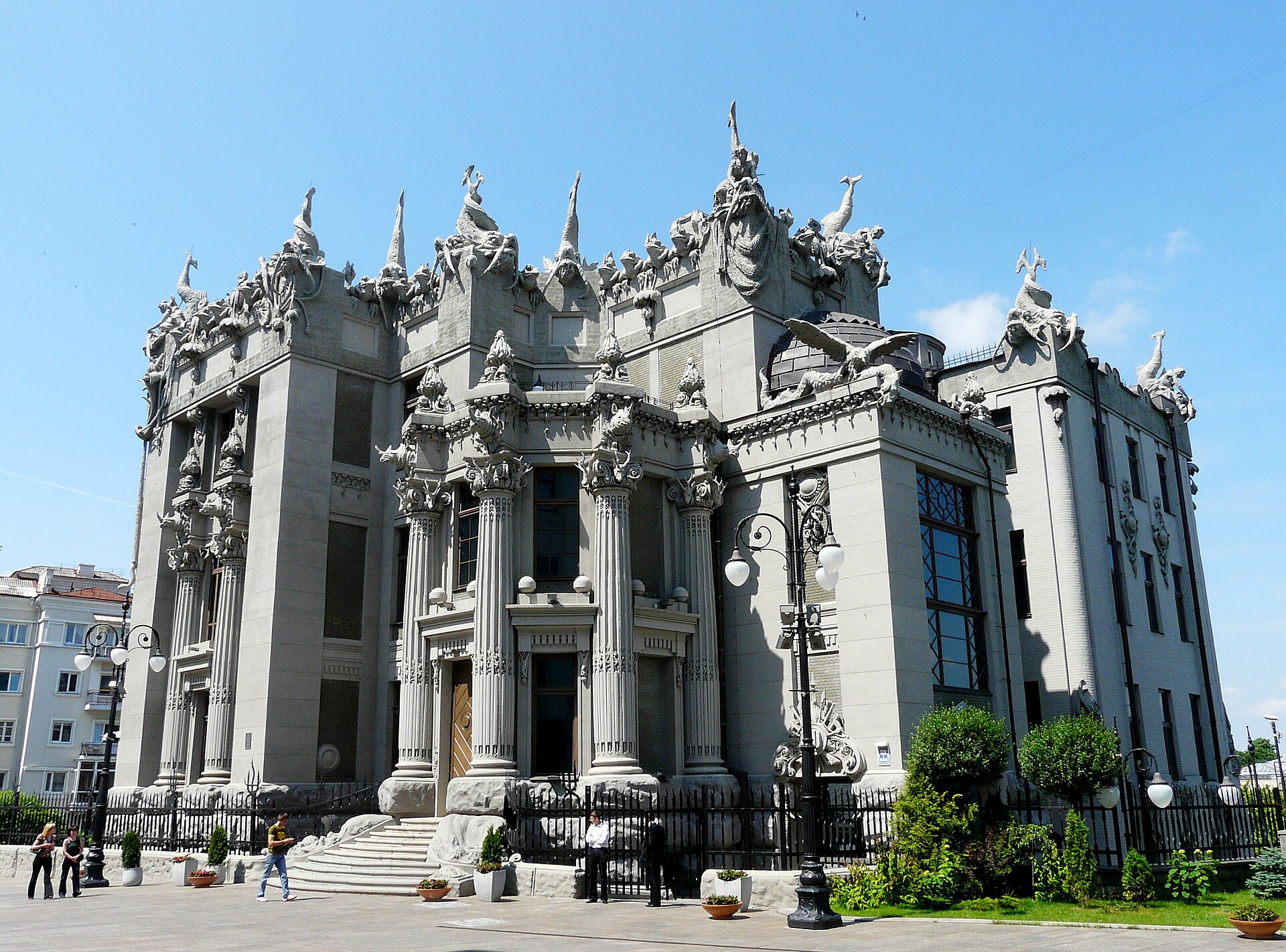
The House with Chimaeras is a prominent Art Nouveau building located in the Pechersk district of Kiev, Ukraine. Designed by the Polish-born architect Władysław Horodecki between 1901 and 1903, the structure is renowned for its elaborate concrete facade, which features sculptural decorations depicting exotic animals and hunting scenes.
Constructed on a steep cliff overlooking the city, the building utilizes an innovative design that accounts for the challenging topography. While originally serving as a high-end apartment building, it has been repurposed over the decades and currently functions as a presidential residence used for diplomatic ceremonies and official state events.
Key Facts
- Materials
- Cement, Concrete, Reinforced concrete
- Civilization
- Russian Empire
- Accessibility
- Restricted access; tours available by appointment only
- Date(s)
- 1901-1903
- Condition
- Restored and maintained as a government residence
- Original Function
- Apartment building
- Key Figures
- Władysław Horodecki, Emilio Sala
Design and Construction
1901-1903Władysław Horodecki, often called the 'Gaudí of Kyiv,' designed the house as a showcase for the capabilities of cement, a relatively new material at the time. The building was constructed on a steep slope, requiring a complex foundation system of concrete piles.
Early Years and Ownership
1903-1920Horodecki lived in one of the apartments while renting out the others. Following the Russian Revolution and the subsequent civil war, the building was nationalized and converted into communal apartments.
Soviet and Modern Era
1920-presentDuring the Soviet period, the building served various functions, including as a clinic for the Central Committee of the Communist Party of Ukraine. In the early 2000s, it underwent a major restoration to return it to its original aesthetic, and it was subsequently designated as a presidential residence.
Cultural Significance
The House with Chimaeras is a landmark of Kiev's architectural heritage, representing the peak of the Art Nouveau movement in the city. Its unique sculptural program, which includes rhinoceroses, elephants, and giant toads, reflects the architect's passion for big-game hunting and his travels in Africa.
Beyond its architectural merit, the building serves as a symbol of the city's eclectic history. It is deeply embedded in local folklore, with numerous legends surrounding the architect's motivations and the building's supposed 'cursed' nature.
Interpretive Notes
Scholarly debates and areas of uncertainty
There is ongoing academic discussion regarding the extent of the influence of Italian sculptor Emilio Sala on the building's decorative program versus Horodecki's own conceptual designs. Additionally, the structural integrity of the building's foundation on the cliffside remains a subject of periodic engineering study.
Visiting Information
Entry Rules
The building is a high-security government facility. Access is strictly limited to official state functions or pre-arranged guided tours organized through the Presidential Administration.
Best Times to Visit
Daytime hours are best for viewing the exterior details. The building is particularly striking in late afternoon light, which highlights the depth of the concrete sculptures.
Photography
Exterior photography is permitted from the street. Interior photography is strictly prohibited due to its status as a government residence.
Preservation Notes
The building is under constant monitoring due to its location on a steep slope. Visitors should respect all security perimeters and refrain from touching the exterior sculptures.
Nearby POIs
11 shown- National Art Museum of Ukraine0.5 km
- PinchukArtCentre0.7 km
- Khanenko Museum1.1 km
- Golden Gate1.2 km
- Monument to Volodymyr The Great1.2 km
- St. Michael's Golden-Domed Monastery1.3 km
- Saint Sophia Cathedral1.3 km
- St Volodymyr's Cathedral1.4 km
- National Museum of the History of Ukraine1.7 km
- St Andrew's Church1.7 km
- National Museum of the Holodomor2 km
Sources & Further Reading
- [1]Władysław Horodecki: The Architect of Kyiv — Dmytro Malakov. Kyiv Publishing House (2005)
- [2]Art Nouveau in Ukraine: The House with Chimaeras — Olena Serhiyenko. Journal of Eastern European Architecture (2018)
Key Facts
- Materials
- Cement, Concrete, Reinforced concrete
- Civilization
- Russian Empire
- Accessibility
- Restricted access; tours available by appointment only
- Date(s)
- 1901-1903
- Condition
- Restored and maintained as a government residence
- Original Function
- Apartment building
- Key Figures
- Władysław Horodecki, Emilio Sala
Nearby POIs
11 shown- National Art Museum of Ukraine0.5 km
- PinchukArtCentre0.7 km
- Khanenko Museum1.1 km
- Golden Gate1.2 km
- Monument to Volodymyr The Great1.2 km
- St. Michael's Golden-Domed Monastery1.3 km
- Saint Sophia Cathedral1.3 km
- St Volodymyr's Cathedral1.4 km
- National Museum of the History of Ukraine1.7 km
- St Andrew's Church1.7 km
- National Museum of the Holodomor2 km