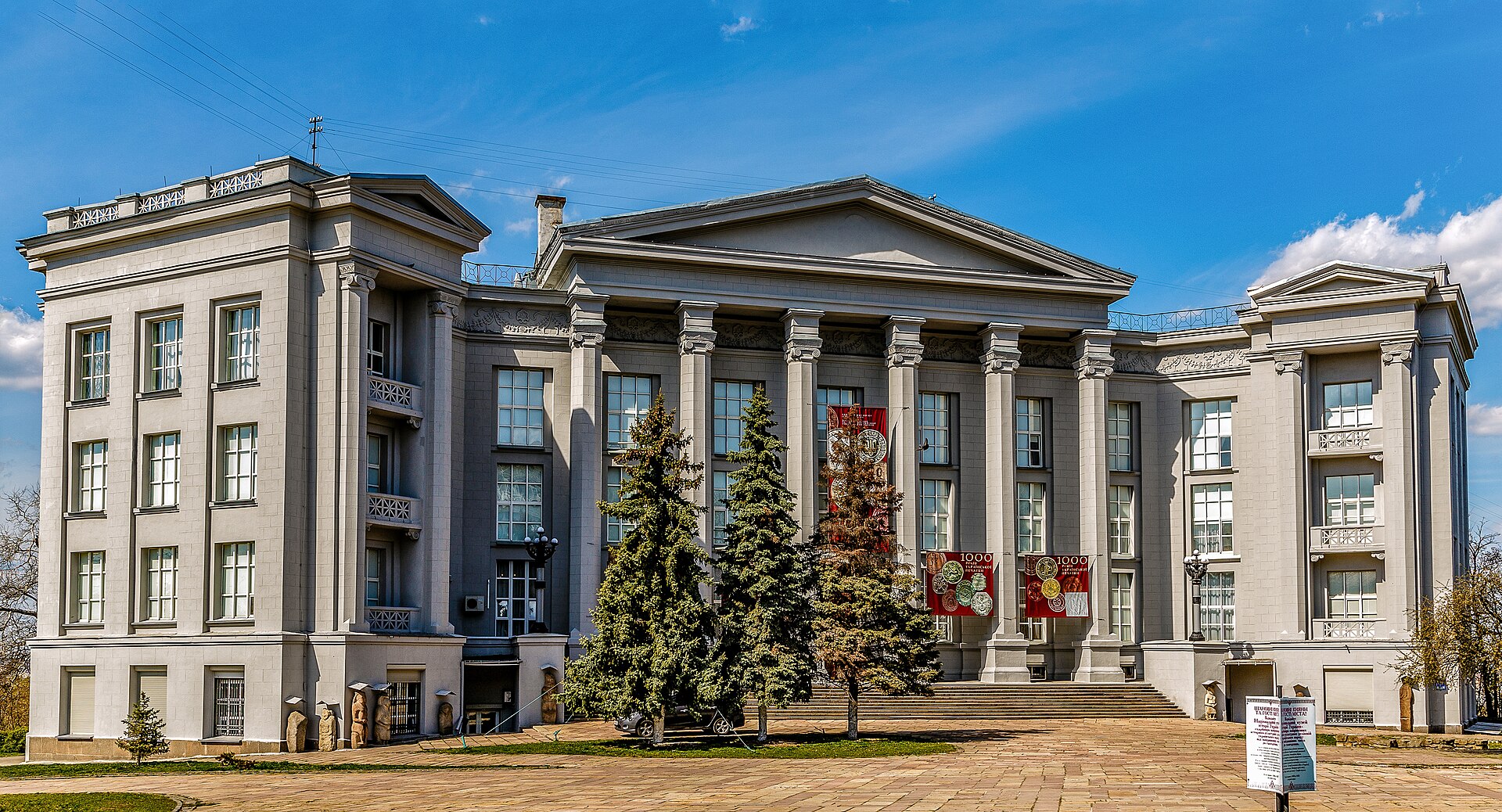
The National Museum of the History of Ukraine is the country's premier historical institution, located in the heart of Kiev near the site of the ancient Desiatynna Church. Established in 1899, the museum houses an extensive collection that chronicles the development of Ukrainian lands from the prehistoric era through the formation of the Kievan Rus state, the Cossack period, and the 20th-century struggle for independence.
The museum's collection comprises over 800,000 artifacts, including significant archaeological finds, medieval weaponry, numismatic treasures, and ethnographic materials. It serves as a central repository for the nation's cultural heritage, providing a comprehensive narrative of the socio-political and cultural evolution of the Ukrainian people.
Key Facts
- Materials
- Stone, Brick, Concrete
- Civilization
- Ukrainian
- Accessibility
- Ground floor accessible
- Date(s)
- 1899
- Condition
- Active
- Original Function
- Historical Museum
- Key Figures
- Vikentiy Khvoyka, Mykola Biliashivsky
Founding and Early Years
1899The museum was founded in 1899 as the City Museum of Antiquities and Art, largely due to the efforts of local intellectuals and archaeologists like Vikentiy Khvoyka. It was officially opened to the public in 1904.
Soviet Era Expansion
1920s-1980sDuring the Soviet period, the museum underwent several reorganizations and relocations. It was moved to its current building, a former art school designed by architect Joseph Karakis, in 1944, where it continued to expand its archaeological and historical holdings.
Independence and Modernization
1991-PresentFollowing Ukraine's independence in 1991, the museum was granted national status. It has since focused on re-evaluating historical narratives, incorporating previously suppressed information regarding the Soviet period and the Holodomor, and digitizing its vast collection.
Cultural Significance
The museum is a cornerstone of Ukrainian national identity, acting as the primary institution for the preservation and interpretation of the country's historical narrative. It plays a vital role in public education and the ongoing process of decolonizing Ukrainian history from imperial Russian and Soviet historiography.
Beyond its role as a repository, the museum is a site of active research and public discourse. It frequently hosts exhibitions that highlight Ukrainian culture, making it a focal point for both domestic and international visitors seeking to understand the region's complex past.
Interpretive Notes
Scholarly debates and areas of uncertainty
Debates within the institution often center on the interpretation of the Kievan Rus period and the extent of its cultural continuity with modern Ukraine, a topic that has historically been contested by neighboring states. Additionally, there is ongoing scholarly work regarding the repatriation of artifacts displaced during the Second World War.
Visiting Information
Entry Rules
Open daily. Tickets can be purchased at the entrance. Visitors are expected to follow standard museum conduct; large bags must be left in the cloakroom.
Best Times to Visit
Weekdays during morning hours are recommended to avoid weekend crowds. The museum is particularly significant during national holidays such as Independence Day (August 24).
Photography
Personal photography is permitted without flash. Professional photography and videography require prior authorization from the museum administration.
Preservation Notes
Do not touch the artifacts or display cases. Flash photography is prohibited to protect light-sensitive materials. Please maintain a quiet demeanor in the galleries.
Nearby POIs
11 shown- St Andrew's Church0.2 km
- St. Michael's Golden-Domed Monastery0.6 km
- Saint Sophia Cathedral0.6 km
- Monument to Volodymyr The Great0.8 km
- Ukrainian National Chernobyl Museum0.9 km
- Golden Gate1.1 km
- National Art Museum of Ukraine1.4 km
- St Volodymyr's Cathedral1.6 km
- Gorodetsky House1.7 km
- PinchukArtCentre1.9 km
- Khanenko Museum1.9 km
Sources & Further Reading
- [1]National Museum of the History of Ukraine: Official Guide — Museum Editorial Board. NMIU Press (2015)View
- [2]The Archaeology of Ukraine — Vikentiy Khvoyka. Kyiv Historical Review (1901)
Key Facts
- Materials
- Stone, Brick, Concrete
- Civilization
- Ukrainian
- Accessibility
- Ground floor accessible
- Date(s)
- 1899
- Condition
- Active
- Original Function
- Historical Museum
- Key Figures
- Vikentiy Khvoyka, Mykola Biliashivsky
Nearby POIs
11 shown- St Andrew's Church0.2 km
- St. Michael's Golden-Domed Monastery0.6 km
- Saint Sophia Cathedral0.6 km
- Monument to Volodymyr The Great0.8 km
- Ukrainian National Chernobyl Museum0.9 km
- Golden Gate1.1 km
- National Art Museum of Ukraine1.4 km
- St Volodymyr's Cathedral1.6 km
- Gorodetsky House1.7 km
- PinchukArtCentre1.9 km
- Khanenko Museum1.9 km