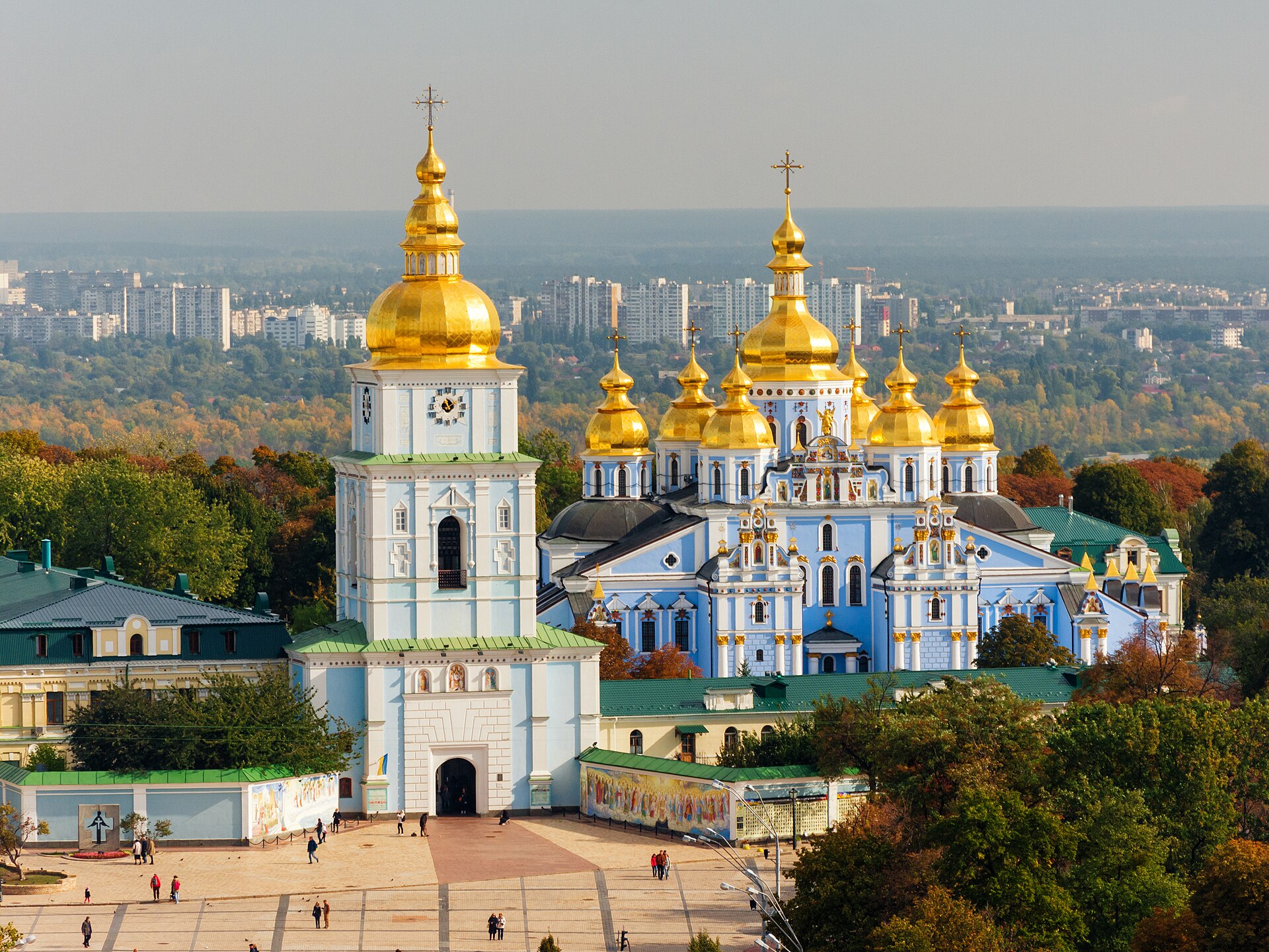
St. Michael's Golden-Domed Monastery is a functioning monastery located in Kiev, Ukraine, serving as the headquarters of the Orthodox Church of Ukraine. The original cathedral was founded in the early 12th century by Sviatopolk II Iziaslavych, notable for its gilded domes and intricate Byzantine-style mosaics and frescoes.
The current structure is a faithful reconstruction completed in 1999. The original medieval cathedral was demolished by Soviet authorities in the 1930s as part of an anti-religious campaign, despite international protests. The site remains a significant symbol of Ukrainian spiritual and cultural resilience.
Key Facts
- Materials
- Brick, Stucco, Gold leaf, Mosaic tiles
- Civilization
- Kievan Rus'
- Accessibility
- Ground level accessible; some stairs to upper levels
- Date(s)
- 1108–1113 (original); 1997–1999 (reconstruction)
- Condition
- Fully restored and active
- Original Function
- Monastery and cathedral
- Key Figures
- Sviatopolk II Iziaslavych, Metropolitan Epiphanius
Founding and Medieval Era
1108–1113The monastery was founded by Prince Sviatopolk II Iziaslavych. It was dedicated to Saint Michael the Archangel, the patron saint of Kyiv, and became a major pilgrimage site due to the presence of the relics of Saint Barbara.
Baroque Expansion
17th–18th centuryDuring the 17th and 18th centuries, the monastery underwent significant renovations in the Ukrainian Baroque style, adding ornate facades and expanding the complex's architectural footprint.
Soviet Destruction
1934–1937In the 1930s, the Soviet government ordered the demolition of the cathedral to make way for a planned administrative center. While many mosaics and frescoes were salvaged and moved to museums, the building itself was razed.
Reconstruction and Modern Era
1997–presentFollowing Ukraine's independence, the government prioritized the reconstruction of the cathedral. Work was completed in 1999, and the monastery was returned to the Ukrainian Orthodox Church, eventually becoming the seat of the Orthodox Church of Ukraine.
Cultural Significance
The monastery is a cornerstone of Ukrainian national identity and religious life. Its destruction and subsequent reconstruction serve as a powerful narrative of the survival of Ukrainian culture against historical erasure. It is a central site for national commemorations and religious ceremonies.
Interpretive Notes
Scholarly debates and areas of uncertainty
Debates persist regarding the extent to which the 1990s reconstruction accurately reflects the original 12th-century Byzantine design versus the later Baroque modifications. Some architectural historians argue that the reconstruction prioritizes symbolic national identity over strict archaeological fidelity.
Visiting Information
Entry Rules
Open daily. Free entry. Visitors are expected to dress modestly; women may be asked to cover their heads, and men should remove hats. Photography is generally permitted, but please respect ongoing religious services.
Best Times to Visit
Early morning for quiet reflection or during Sunday morning liturgy to experience the traditional choral music.
Photography
Personal photography is allowed. Flash and tripods are prohibited inside the cathedral. Professional or commercial photography requires prior permission from the monastery administration.
Preservation Notes
The site is an active religious institution. Please maintain silence, follow posted signage, and avoid areas marked for clergy only.
Nearby POIs
11 shown- Monument to Volodymyr The Great0.3 km
- St Andrew's Church0.5 km
- National Museum of the History of Ukraine0.6 km
- Saint Sophia Cathedral0.7 km
- National Art Museum of Ukraine0.9 km
- Golden Gate1 km
- Gorodetsky House1.3 km
- Ukrainian National Chernobyl Museum1.3 km
- St Volodymyr's Cathedral1.6 km
- PinchukArtCentre1.6 km
- Khanenko Museum1.7 km
Sources & Further Reading
- [1]The Destruction and Reconstruction of St. Michael's Golden-Domed Monastery — Serhii Plokhy. Harvard Ukrainian Research Institute (2005)View
- [2]Ukrainian Baroque Architecture — Titus D. Hewryk. Ukrainian Museum of New York (1982)
Key Facts
- Materials
- Brick, Stucco, Gold leaf, Mosaic tiles
- Civilization
- Kievan Rus'
- Accessibility
- Ground level accessible; some stairs to upper levels
- Date(s)
- 1108–1113 (original); 1997–1999 (reconstruction)
- Condition
- Fully restored and active
- Original Function
- Monastery and cathedral
- Key Figures
- Sviatopolk II Iziaslavych, Metropolitan Epiphanius
Nearby POIs
11 shown- Monument to Volodymyr The Great0.3 km
- St Andrew's Church0.5 km
- National Museum of the History of Ukraine0.6 km
- Saint Sophia Cathedral0.7 km
- National Art Museum of Ukraine0.9 km
- Golden Gate1 km
- Gorodetsky House1.3 km
- Ukrainian National Chernobyl Museum1.3 km
- St Volodymyr's Cathedral1.6 km
- PinchukArtCentre1.6 km
- Khanenko Museum1.7 km