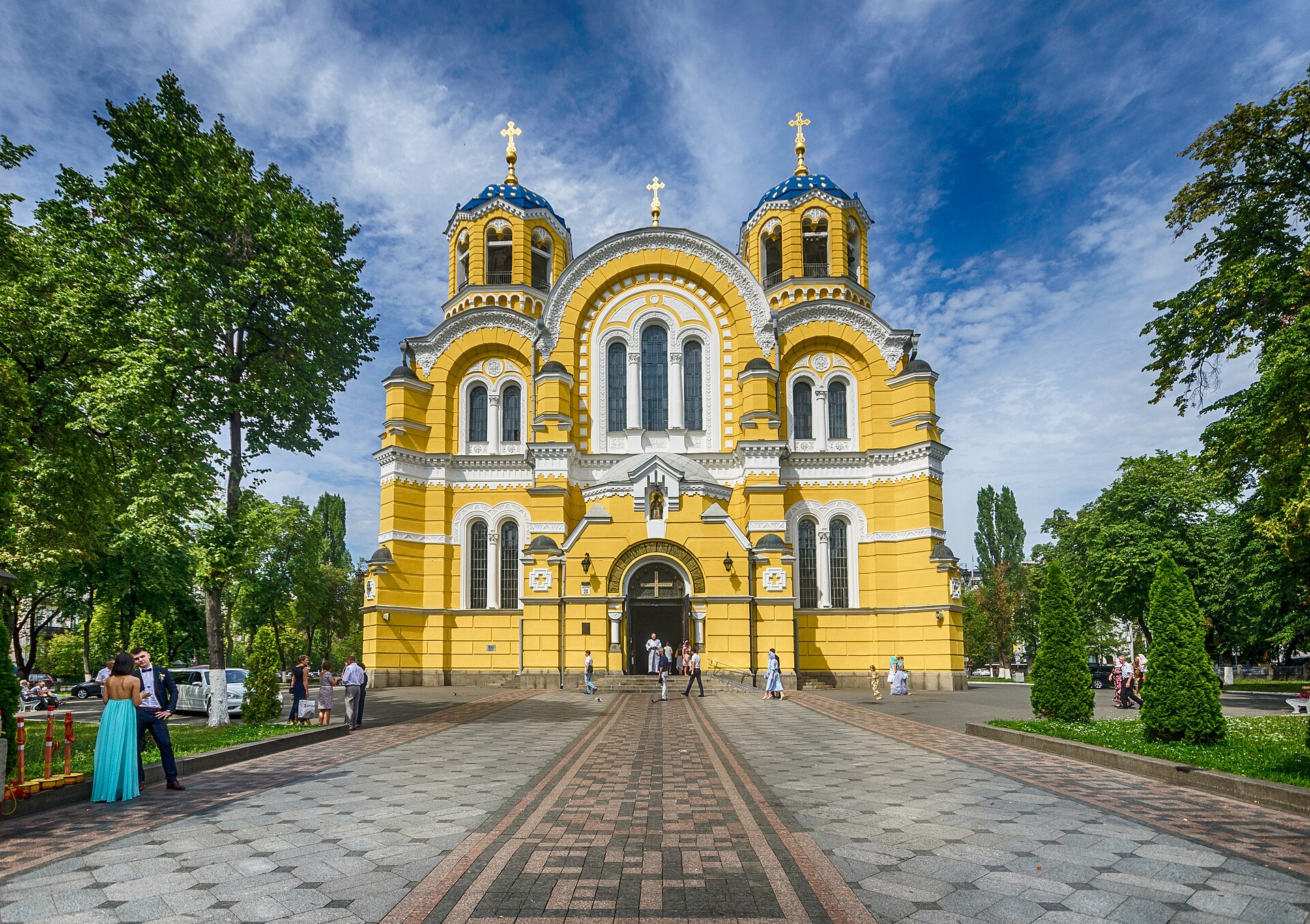
St. Volodymyr's Cathedral is a prominent religious landmark in Kiev, constructed to commemorate the 900th anniversary of the Christianization of Kievan Rus' by Prince Vladimir the Great. The project was initiated in 1852 by Metropolitan Filaret, though construction did not commence until 1862, continuing intermittently until its consecration in 1896.
The cathedral is a masterpiece of the Neo-Byzantine style, featuring seven gilded domes and a complex interior program. Its most significant artistic feature is the extensive cycle of murals painted by renowned artists including Viktor Vasnetsov, Mikhail Nesterov, and Mikhail Vrubel, which blend traditional Orthodox iconography with contemporary 19th-century artistic sensibilities.
Key Facts
- Materials
- Brick, Cement, Marble, Gold leaf
- Civilization
- Russian Empire
- Accessibility
- Ground level access available
- Date(s)
- 1862-1882
- Condition
- Active cathedral of the Orthodox Church of Ukraine
- Original Function
- Cathedral
- Key Figures
- Viktor Vasnetsov, Mikhail Nesterov, Metropolitan Filaret
Conception and Funding
1852-1862The idea for the cathedral was proposed by Metropolitan Filaret in 1852 to honor the 900th anniversary of the baptism of Rus'. Funds were collected through voluntary donations from across the Russian Empire, taking a decade to reach the necessary amount to begin construction.
Construction Phase
1862-1882The initial design was drafted by architects I. Schtrom, P. Sparro, and R. Bernhardt. Construction faced significant delays due to structural issues with the walls and vaults, requiring major reinforcements. The exterior structure was completed by 1882, but the interior remained unfinished for another decade.
Interior Decoration
1885-1896The interior painting was commissioned to a group of famous artists led by Adrian Prakhov. Viktor Vasnetsov's work on the central nave and the iconostasis became iconic, defining the cathedral's aesthetic. The cathedral was finally consecrated in August 1896 in the presence of Tsar Nicholas II.
Soviet Era and Independence
1920s-PresentDuring the Soviet period, the cathedral narrowly escaped destruction, though it was closed for religious services in 1929 and repurposed as an anti-religious museum. It reopened in 1944 and served as the main cathedral of the Ukrainian Exarchate. Since 1992, it has served as the mother cathedral of the Orthodox Church of Ukraine.
Cultural Significance
St. Volodymyr's Cathedral serves as a vital symbol of Ukrainian Orthodox identity and historical continuity. Its architecture and interior murals represent a unique synthesis of Byzantine tradition and the Russian-Ukrainian artistic revival of the late 19th century, making it a landmark of European religious art.
Beyond its religious function, the cathedral is a site of national memory. It houses the relics of Saint Barbara and Saint Macarius, attracting pilgrims from across the region. Its survival through the Soviet era and its role in the establishment of the independent Orthodox Church of Ukraine have cemented its status as a cornerstone of Kiev's cultural landscape.
Interpretive Notes
Scholarly debates and areas of uncertainty
Debates among art historians often center on the 'secularization' of religious art within the cathedral. Some critics at the time of its completion argued that the murals by Vasnetsov and Vrubel were too influenced by Western European romanticism and lacked the strict canonical adherence required by traditional Orthodox iconography.
Visiting Information
Entry Rules
Open daily. Entry is free. Visitors are expected to dress modestly; women are encouraged to cover their heads, and men should remove hats. Photography is generally permitted, but please be respectful during ongoing religious services.
Best Times to Visit
Early morning or late afternoon on weekdays to avoid the heaviest crowds. The cathedral is particularly significant during major Orthodox holidays such as Easter and the feast day of St. Volodymyr (July 28).
Photography
Personal photography is allowed without flash. Professional photography or video equipment requires prior permission from the church administration.
Preservation Notes
The cathedral is an active place of worship; please maintain silence and avoid disturbing congregants. Do not touch the murals or the iconostasis.
Nearby POIs
11 shown- Golden Gate0.6 km
- Khanenko Museum0.6 km
- PinchukArtCentre0.9 km
- Saint Sophia Cathedral1 km
- Gorodetsky House1.4 km
- St. Michael's Golden-Domed Monastery1.6 km
- National Museum of the History of Ukraine1.6 km
- National Art Museum of Ukraine1.6 km
- St Andrew's Church1.7 km
- Monument to Volodymyr The Great1.8 km
- Ukrainian National Chernobyl Museum2.5 km
Sources & Further Reading
- [1]St. Volodymyr's Cathedral: A History of the Murals — Adrian Prakhov. Kyiv Art Press (1905)
- [2]The Neo-Byzantine Architecture of Kyiv — Oksana Yurchyshyn. Ukrainian Heritage Journal (2015)
Key Facts
- Materials
- Brick, Cement, Marble, Gold leaf
- Civilization
- Russian Empire
- Accessibility
- Ground level access available
- Date(s)
- 1862-1882
- Condition
- Active cathedral of the Orthodox Church of Ukraine
- Original Function
- Cathedral
- Key Figures
- Viktor Vasnetsov, Mikhail Nesterov, Metropolitan Filaret
Nearby POIs
11 shown- Golden Gate0.6 km
- Khanenko Museum0.6 km
- PinchukArtCentre0.9 km
- Saint Sophia Cathedral1 km
- Gorodetsky House1.4 km
- St. Michael's Golden-Domed Monastery1.6 km
- National Museum of the History of Ukraine1.6 km
- National Art Museum of Ukraine1.6 km
- St Andrew's Church1.7 km
- Monument to Volodymyr The Great1.8 km
- Ukrainian National Chernobyl Museum2.5 km