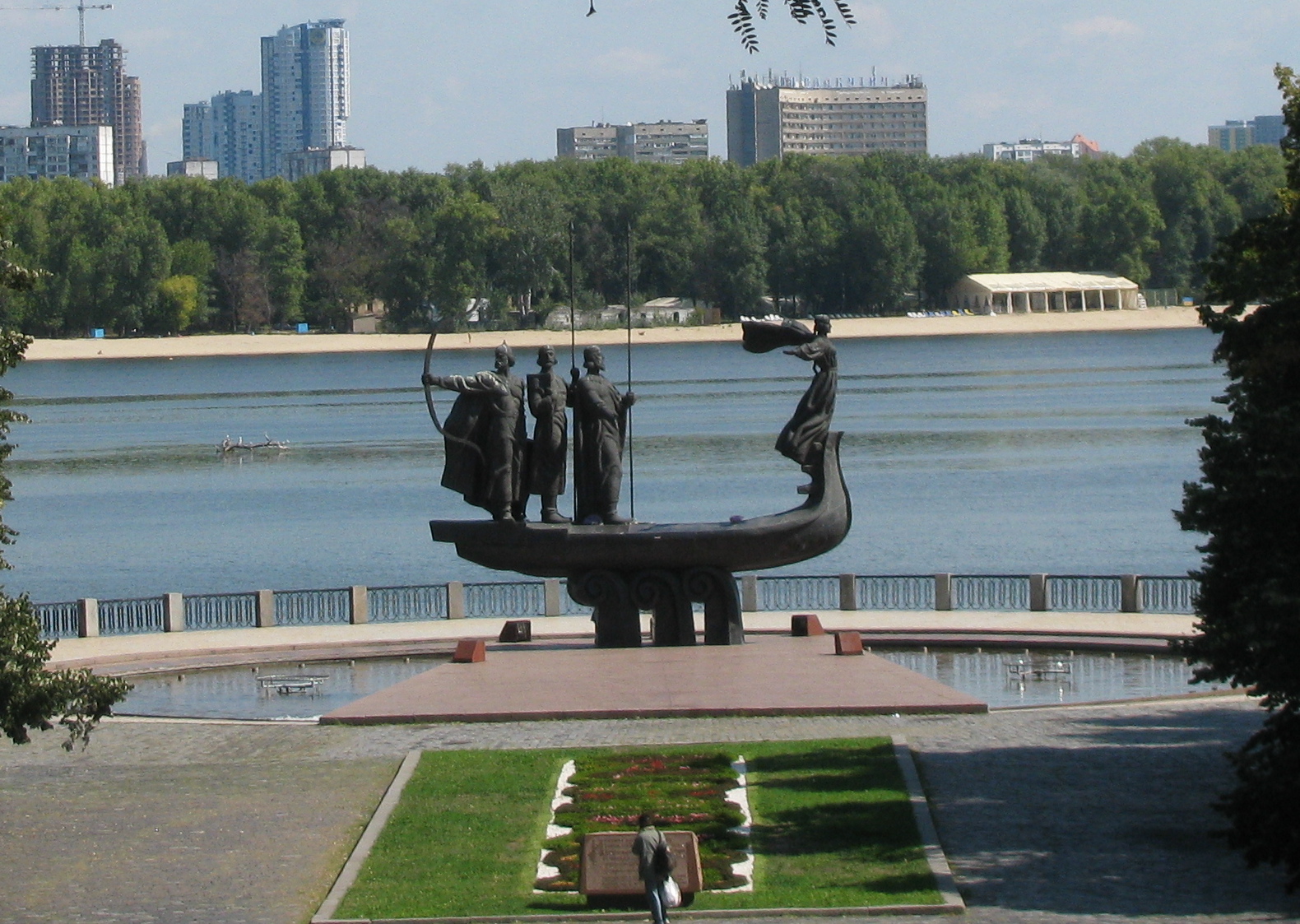
The Monument to the Founders of Kiev is a prominent sculptural ensemble located on the banks of the Dnyepr River in Kiev. Dedicated to the legendary founders of the city—the brothers Kyi, Shchek, and Khoryv, and their sister Lybid—the monument serves as a symbolic representation of the city's origins as described in the Primary Chronicle.
Constructed in 1982 to commemorate the 1500th anniversary of Kyiv, the monument features a boat-shaped structure carrying the four figures. It is crafted from forged copper and mounted on a granite pedestal, becoming a significant landmark and a popular site for wedding ceremonies and public gatherings in the capital.
Key Facts
- Materials
- Forged copper, Granite
- Civilization
- Soviet Union
- Accessibility
- Accessible via park pathways
- Date(s)
- 1982
- Condition
- Well-maintained
- Original Function
- Commemorative monument
- Key Figures
- Vasyl Borodai, Mykola Feshchenko, Mykola Halavkin
Conception and Construction
1982The monument was commissioned as part of the city's 1500th-anniversary celebrations. Sculptor Vasyl Borodai designed the figures, which were intended to embody the legendary founding of the city by the Polianian princes and their sister.
Structural Restoration
2010In 2010, the monument underwent significant restoration after the rear part of the boat structure collapsed due to corrosion and structural fatigue. The monument was dismantled, repaired, and reinstalled to ensure its long-term stability.
Cultural Significance
The monument is a central element of Kiev's civic identity, representing the mythological roots of the city. It is deeply integrated into local traditions, particularly for newlyweds who visit the site to place flowers, symbolizing the continuity of the city's history and the importance of family and origin.
Interpretive Notes
Scholarly debates and areas of uncertainty
The historical accuracy of the figures Kyi, Shchek, Khoryv, and Lybid remains a subject of academic discussion. While the Primary Chronicle presents them as the founders of Kiev, many historians view them as eponymous heroes created to explain the names of local geographical features and tribes.
Visiting Information
Entry Rules
Open to the public at all times. No entry fees or specific dress codes apply.
Best Times to Visit
Daytime, particularly during spring and summer when the surrounding park is active.
Photography
None; personal photography is permitted.
Preservation Notes
The monument is subject to periodic maintenance due to its location near the river, which can accelerate metal oxidation.
Nearby POIs
11 shown- National Museum of the History of Ukraine in the Second World War0.4 km
- Mother Ukraine0.5 km
- Ivan Honchar Museum0.9 km
- Dormition Cathedral of the Kiev Pechersk Lavra1.1 km
- Mystetskyi Arsenal1.2 km
- Vydubychi Monastery1.3 km
- National Museum of the Holodomor1.5 km
- Gorodetsky House3.4 km
- National Art Museum of Ukraine3.5 km
- PinchukArtCentre3.7 km
- Khanenko Museum4.1 km
Sources & Further Reading
- [1]The Primary Chronicle: Laurentian Text — Samuel Hazzard Cross. Medieval Academy of America (1953)
- [2]Kyiv: A History — Serhii Plokhy. Basic Books (2023)
Key Facts
- Materials
- Forged copper, Granite
- Civilization
- Soviet Union
- Accessibility
- Accessible via park pathways
- Date(s)
- 1982
- Condition
- Well-maintained
- Original Function
- Commemorative monument
- Key Figures
- Vasyl Borodai, Mykola Feshchenko, Mykola Halavkin
Nearby POIs
11 shown- National Museum of the History of Ukraine in the Second World War0.4 km
- Mother Ukraine0.5 km
- Ivan Honchar Museum0.9 km
- Dormition Cathedral of the Kiev Pechersk Lavra1.1 km
- Mystetskyi Arsenal1.2 km
- Vydubychi Monastery1.3 km
- National Museum of the Holodomor1.5 km
- Gorodetsky House3.4 km
- National Art Museum of Ukraine3.5 km
- PinchukArtCentre3.7 km
- Khanenko Museum4.1 km