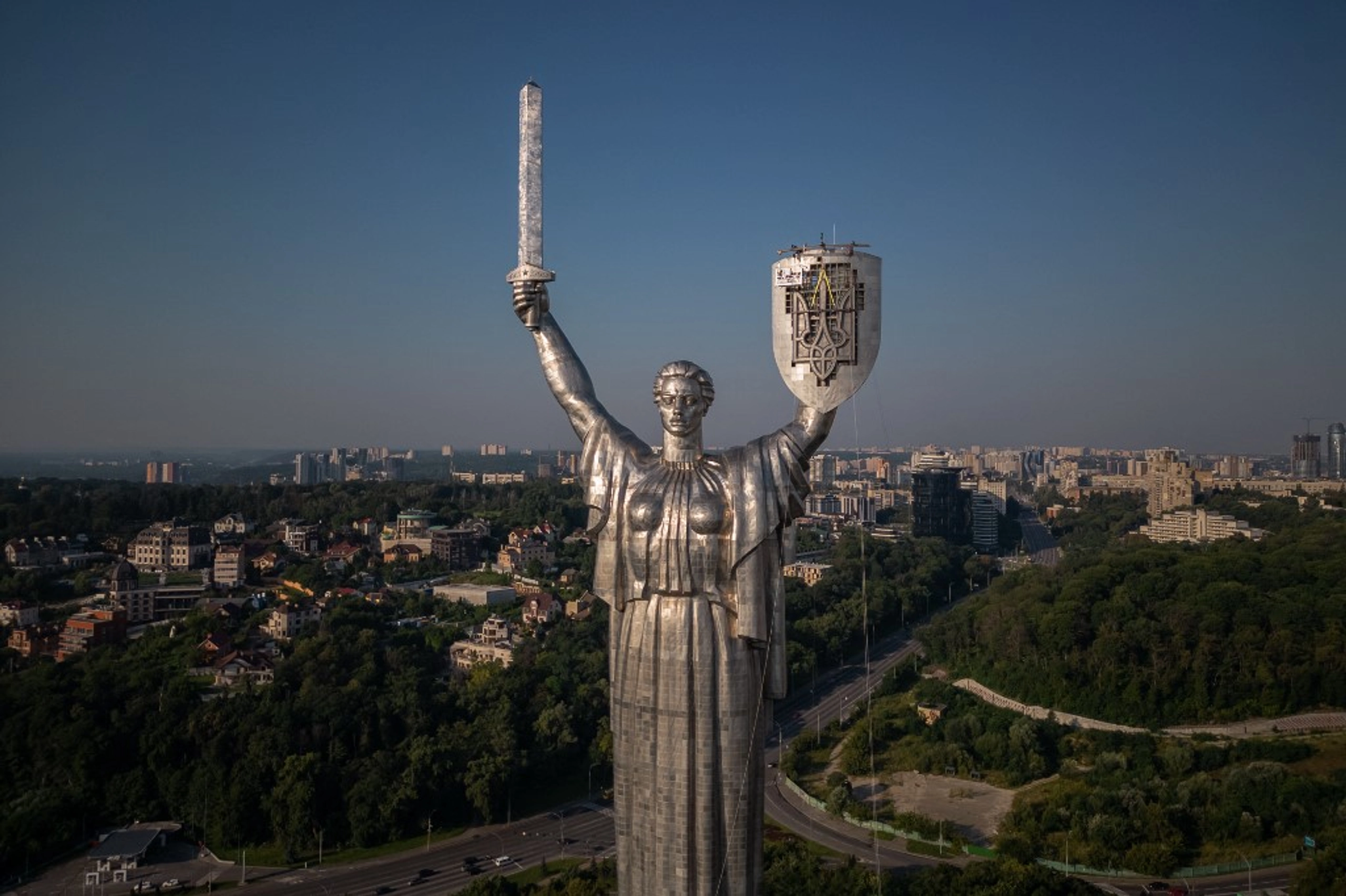
The Mother Ukraine monument, formerly known as the Motherland Monument, is a monumental statue located in Kiev, Ukraine. Standing at 102 meters tall, including its pedestal, it is one of the tallest statues in the world. The structure is part of the National Museum of the History of Ukraine in the Second World War and serves as a prominent landmark overlooking the Dnyepr River.
Originally constructed during the Soviet era to commemorate the victory in the Great Patriotic War, the monument has undergone significant symbolic transformation since the 2022 Russian invasion of Ukraine. In 2023, the Soviet hammer and sickle emblem on the statue's shield was replaced with the Ukrainian trident (tryzub), reflecting the nation's shift toward de-Sovietization and the assertion of Ukrainian national identity.
Key Facts
- Materials
- Stainless steel, Concrete
- Civilization
- Soviet Union
- Accessibility
- Ground level accessible; observation decks require stairs/elevators
- Date(s)
- 1979-1981
- Condition
- Active museum site, recently renovated
- Original Function
- Commemoration of the Soviet victory in World War II
- Key Figures
- Yevgeny Vuchetich, Vasyl Borodai
Conception and Construction
1970sThe monument was designed by sculptor Yevgeny Vuchetich and later completed by Vasyl Borodai. It was intended to be the centerpiece of a massive memorial complex dedicated to the Soviet war effort, officially opening in 1981 in the presence of Soviet leader Leonid Brezhnev.
Post-Independence Era
1991-2021Following the collapse of the Soviet Union in 1991, the monument remained a controversial symbol due to its origins. While it became a popular tourist destination and a symbol of Kiev, debates persisted regarding its aesthetic and ideological alignment with the new Ukrainian state.
Symbolic Transformation
2022-2023In the wake of the war with Russia, the Ukrainian government accelerated de-Sovietization efforts. The removal of the Soviet hammer and sickle from the shield and its replacement with the Ukrainian trident in August 2023 marked a shift in the monument's symbolic purpose.
Cultural Significance
The monument has evolved from a symbol of Soviet collective memory into a potent icon of Ukrainian resilience and sovereignty. Its transformation serves as a physical manifestation of Ukraine's ongoing process of distancing itself from its Soviet past and reforming its historical narrative.
Interpretive Notes
Scholarly debates and areas of uncertainty
Scholars debate the ethics of modifying monumental architecture versus preserving it as a historical artifact. Some argue that the replacement of the Soviet emblem is a necessary act of decolonization, while others discuss the challenges of maintaining the structural integrity of the massive steel statue during such interventions.
Visiting Information
Entry Rules
The museum complex is open to the public. Tickets are required for museum exhibitions and access to the observation decks. Visitors should check official museum hours as they may vary due to security protocols.
Best Times to Visit
Late spring and early autumn offer the best weather for walking the memorial grounds. Sunset provides excellent views of the Kiev skyline from the base of the monument.
Photography
Personal photography is permitted on the grounds. Commercial photography or drone usage requires prior authorization from the museum administration.
Preservation Notes
The monument is subject to ongoing maintenance due to its size and exposure to the elements. Visitors are advised to follow all posted safety signage, especially when accessing the observation platforms.
Nearby POIs
11 shown- National Museum of the History of Ukraine in the Second World War0.1 km
- Monument to the Founders of Kiev0.5 km
- Ivan Honchar Museum0.8 km
- Dormition Cathedral of the Kiev Pechersk Lavra1 km
- Mystetskyi Arsenal1.1 km
- Vydubychi Monastery1.1 km
- National Museum of the Holodomor1.4 km
- Gorodetsky House3.2 km
- National Art Museum of Ukraine3.4 km
- PinchukArtCentre3.4 km
- Khanenko Museum3.8 km
Sources & Further Reading
- [1]The Motherland Monument: A Symbol of Kyiv — National Museum of the History of Ukraine in the Second World War. Official Museum Archives (2023)View
- [2]De-Sovietization and the Transformation of Public Space in Ukraine — Taras Kuzio. Journal of Soviet and Post-Soviet Politics and Society (2023)
Key Facts
- Materials
- Stainless steel, Concrete
- Civilization
- Soviet Union
- Accessibility
- Ground level accessible; observation decks require stairs/elevators
- Date(s)
- 1979-1981
- Condition
- Active museum site, recently renovated
- Original Function
- Commemoration of the Soviet victory in World War II
- Key Figures
- Yevgeny Vuchetich, Vasyl Borodai
Nearby POIs
11 shown- National Museum of the History of Ukraine in the Second World War0.1 km
- Monument to the Founders of Kiev0.5 km
- Ivan Honchar Museum0.8 km
- Dormition Cathedral of the Kiev Pechersk Lavra1 km
- Mystetskyi Arsenal1.1 km
- Vydubychi Monastery1.1 km
- National Museum of the Holodomor1.4 km
- Gorodetsky House3.2 km
- National Art Museum of Ukraine3.4 km
- PinchukArtCentre3.4 km
- Khanenko Museum3.8 km