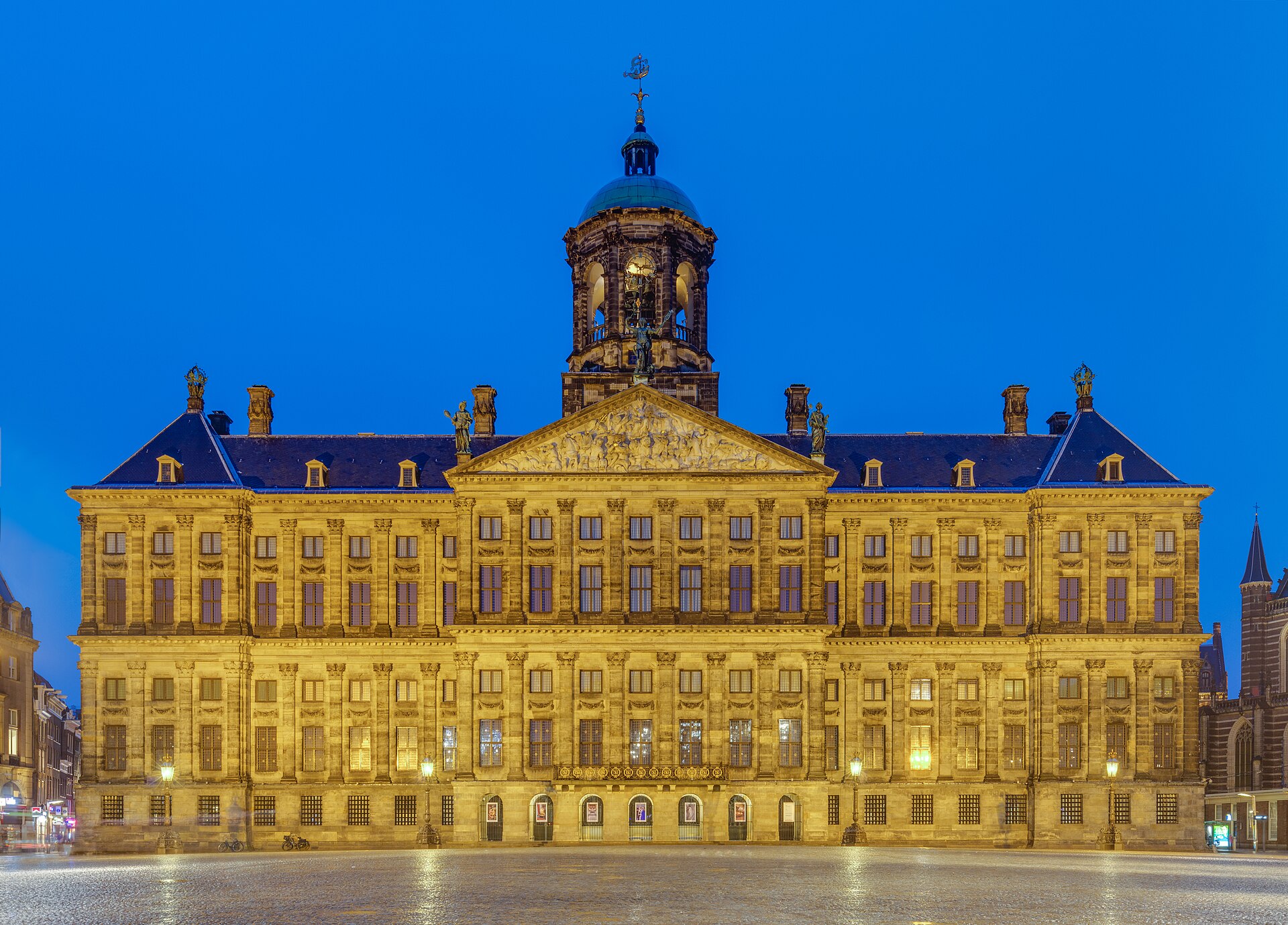
The Royal Palace of Amsterdam, located on Dam Square, was originally constructed as the city's town hall during the Dutch Golden Age. Designed by architect Jacob van Campen, the building was inaugurated in 1655 and served as the administrative and judicial center of Amsterdam for over a century. Its monumental scale and rich ornamentation were intended to reflect the city's status as a global commercial hub.
In 1808, the building was repurposed as a royal residence by Louis Bonaparte, the brother of Napoleon, who reigned as King of Holland. Following the restoration of the Dutch monarchy, it remained one of three palaces at the disposal of the sovereign. Today, it is used for official receptions, state visits, and royal ceremonies, while remaining open to the public as a museum when not in use for state functions.
Key Facts
- Materials
- Yellow sandstone, Marble, Bronze
- Civilization
- Dutch
- Accessibility
- Wheelchair accessible with elevator access to main floors
- Date(s)
- 1648-1665
- Condition
- Well-preserved, active royal palace and museum
- Original Function
- Town Hall
- Key Figures
- Jacob van Campen, Louis Bonaparte, King Willem-Alexander
Construction as Town Hall
1648-1665Commissioned by the city council to replace the medieval town hall, the building was designed by Jacob van Campen in a strict Dutch Classicist style. It was built on 13,659 wooden piles to support its massive weight on the marshy soil of Amsterdam.
Conversion to Royal Palace
1808During the Napoleonic era, the building was confiscated and converted into a royal palace for Louis Bonaparte. The interior was extensively remodeled to suit royal functions, including the installation of Empire-style furniture and decor.
Modern Usage
19th century - presentAfter the return of the House of Orange, the palace continued to serve as a venue for royal events. In 1939, it was transferred to the Dutch state, and since 2009, it has been managed by the Royal Palace Amsterdam Foundation, which oversees its public exhibition program.
Cultural Significance
The palace stands as a symbol of the Dutch Golden Age, representing the wealth and civic pride of the Amsterdam merchant class. Its transition from a republican town hall to a royal residence mirrors the political evolution of the Netherlands from a decentralized republic to a constitutional monarchy.
It remains a focal point for national events, including the annual New Year's reception and the presentation of the Erasmus Prize, cementing its role as a bridge between the Dutch monarchy and the public.
Interpretive Notes
Scholarly debates and areas of uncertainty
Debate persists regarding the extent to which the building's original design was intended to mimic Roman imperial architecture to legitimize the Dutch Republic's global power. Additionally, the conservation of the 19th-century Empire-style interior versus the restoration of the original 17th-century civic aesthetic remains a point of discussion among architectural historians.
Visiting Information
Entry Rules
Open daily to the public, except during state events. Tickets can be purchased online or at the entrance. Security screening is mandatory for all visitors. No large bags are permitted inside.
Best Times to Visit
Weekday mornings are generally less crowded. Check the official website for closure dates due to state visits or royal ceremonies.
Photography
Personal photography is permitted without flash or tripods. Commercial photography requires prior written authorization.
Preservation Notes
The building is subject to ongoing structural monitoring due to its foundation on wooden piles. Visitors are requested to refrain from touching the marble surfaces and historical furniture.
Nearby POIs
11 shownSources & Further Reading
- [1]
- [2]Dutch Classicism in the 17th Century — Koen Ottenheym. Waanders Publishers (2008)
Key Facts
- Materials
- Yellow sandstone, Marble, Bronze
- Civilization
- Dutch
- Accessibility
- Wheelchair accessible with elevator access to main floors
- Date(s)
- 1648-1665
- Condition
- Well-preserved, active royal palace and museum
- Original Function
- Town Hall
- Key Figures
- Jacob van Campen, Louis Bonaparte, King Willem-Alexander