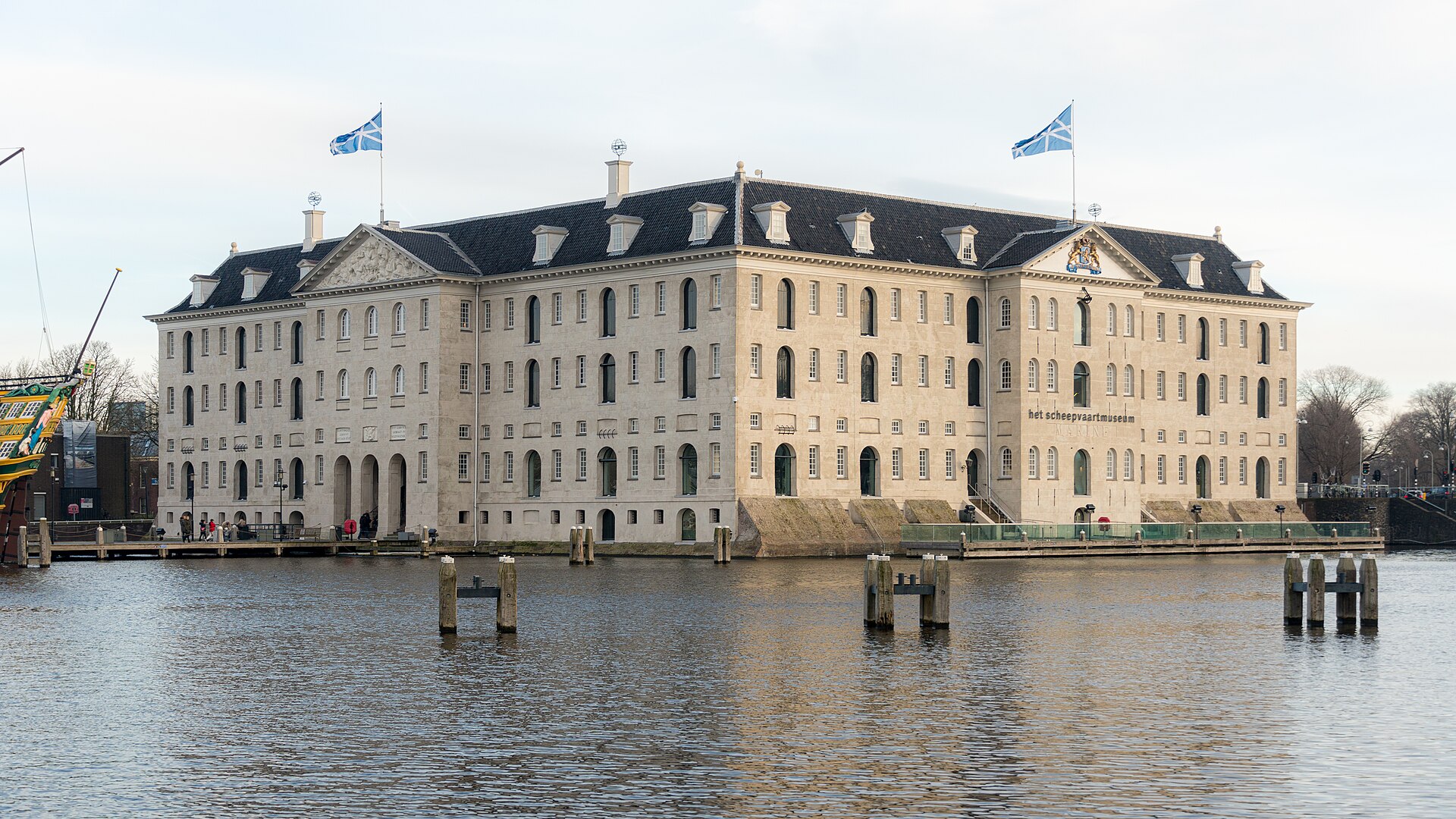
Het Scheepvaartmuseum, or the National Maritime Museum, is housed in 's Lands Zeemagazijn, a monumental storehouse originally constructed in 1656 to serve the Dutch Admiralty. Designed by architect Daniël Stalpaert, the building stands on a foundation of over 10,000 wooden piles driven into the harbor bed, reflecting the engineering prowess of the Dutch Golden Age.
Today, the museum preserves and displays one of the world's most extensive collections of maritime artifacts, including navigational instruments, ship models, and historical maps. The central courtyard, covered by a striking glass roof designed by Laurent Ney, serves as the museum's focal point, while the exterior harbor features a full-scale replica of the 18th-century Dutch East India Company ship, the Amsterdam.
Key Facts
- Materials
- Brick, Stone, Wood, Glass
- Civilization
- Dutch
- Accessibility
- Fully wheelchair accessible
- Date(s)
- 1656
- Condition
- Restored and active museum
- Original Function
- Naval storehouse
- Key Figures
- Daniël Stalpaert
Construction of the Arsenal
1656The building was commissioned by the Admiralty of Amsterdam to serve as a secure warehouse for naval supplies, including sails, ropes, and weaponry, essential for the Dutch Republic's dominance in global trade.
Naval Depot Era
17th-19th centuryFor over two centuries, the structure functioned as a critical logistics hub for the Dutch Navy, housing the vast inventory required to maintain the fleet that protected Dutch merchant interests worldwide.
Transformation into a Museum
1973-presentThe building was repurposed as the National Maritime Museum in 1973. A major renovation completed in 2011 introduced the modern glass roof over the courtyard and updated the exhibition spaces to meet contemporary standards.
Cultural Significance
The museum serves as a primary repository for the maritime history of the Netherlands, documenting the nation's transition from a regional power to a global maritime empire. It provides critical context for the Dutch Golden Age, exploring both the economic prosperity brought by trade and the complex realities of colonial expansion.
Locally, the building is a landmark of Amsterdam's harbor front, symbolizing the city's enduring relationship with the water. It acts as an educational center for maritime heritage, fostering public engagement with the history of navigation and naval engineering.
Interpretive Notes
Scholarly debates and areas of uncertainty
Recent academic discourse has focused on the museum's role in addressing the colonial legacy of the Dutch East India Company (VOC). Scholars and curators are actively debating how to balance the celebration of maritime innovation with a critical examination of the exploitation and human cost associated with the colonial trade networks.
Visiting Information
Entry Rules
Open daily from 10:00 to 17:00. Tickets can be purchased online or at the entrance. No specific dress code is required.
Best Times to Visit
Weekday mornings are generally quieter. The museum is popular with families, so school holidays may see increased attendance.
Photography
Personal photography is permitted throughout the museum. Tripods and professional lighting equipment require prior authorization.
Preservation Notes
The building is a protected national monument. Visitors are requested to refrain from touching historical artifacts and to follow signage regarding restricted areas.
Nearby POIs
11 shownSources & Further Reading
- [1]The Dutch Golden Age: A Maritime History — Jonathan Israel. Oxford University Press (1995)
- [2]Het Scheepvaartmuseum: Building and Collection — National Maritime Museum Staff. Museum Publications (2018)
Key Facts
- Materials
- Brick, Stone, Wood, Glass
- Civilization
- Dutch
- Accessibility
- Fully wheelchair accessible
- Date(s)
- 1656
- Condition
- Restored and active museum
- Original Function
- Naval storehouse
- Key Figures
- Daniël Stalpaert