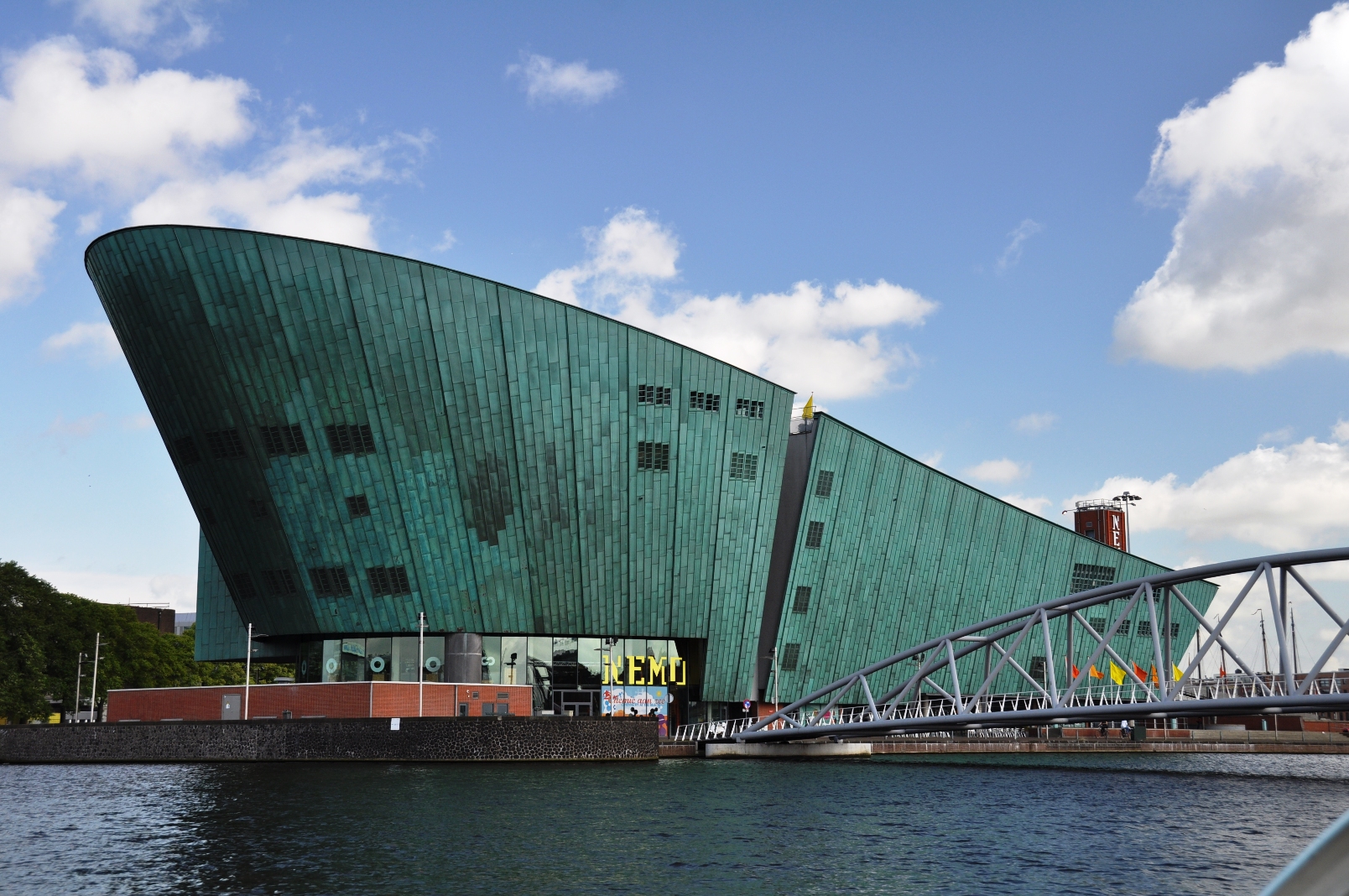
NEMO Science Museum is the largest science center in the Netherlands, located in the Oosterdokseiland neighborhood of Amsterdam. Housed in a distinctive green, copper-clad building designed by Italian architect Renzo Piano, the structure is shaped like a ship's hull and rises above the IJ tunnel, serving as a prominent landmark in the city's harbor area.
The museum features five floors of interactive, hands-on exhibits designed to engage visitors with the principles of physics, chemistry, biology, and technology. The facility aims to make scientific concepts accessible to the general public through experimentation, with a rooftop terrace that provides panoramic views of Amsterdam and serves as a public space.
Key Facts
- Materials
- Copper, Steel, Glass
- Civilization
- Dutch
- Accessibility
- Fully wheelchair accessible with elevators to all floors
- Date(s)
- 1997
- Condition
- Active
- Original Function
- Science Center
- Key Figures
- Renzo Piano
Establishment
1997The museum was opened in 1997 as 'New Metropolis' to replace the former Museum Nint. The building was designed by Renzo Piano to resemble a ship emerging from the water, utilizing a copper facade that was intended to oxidize into a green patina over time.
Rebranding and Evolution
2000-2016In 2000, the institution was rebranded as 'NEMO' to better reflect its focus on interactive science education. Throughout the early 21st century, the museum expanded its permanent collection and educational programming, focusing on STEM outreach for schools and families.
Modern Operations
2016-PresentThe museum continues to operate as a major cultural and educational hub in Amsterdam. Recent updates have focused on integrating digital technology into exhibits and enhancing the rooftop public space, which remains one of the highest accessible points in the city center.
Cultural Significance
NEMO serves as a vital educational resource in the Netherlands, bridging the gap between academic science and public engagement. Its iconic architecture has made it a symbol of modern Amsterdam, representing the city's commitment to innovation and sustainable urban development.
Interpretive Notes
Scholarly debates and areas of uncertainty
Discussions regarding the museum often center on the balance between entertainment and rigorous scientific education in interactive museum design, as well as the long-term maintenance of the building's unique copper exterior.
Visiting Information
Entry Rules
Open Tuesday through Sunday. Tickets should be booked online in advance to ensure entry. Visitors are encouraged to allow at least three hours for a full visit.
Best Times to Visit
Weekday mornings during the school term are the quietest times to visit. The rooftop terrace is best enjoyed during late spring and summer months.
Photography
Personal photography is permitted throughout the museum. Professional or commercial photography requires prior authorization from the museum management.
Preservation Notes
The building's copper facade is subject to natural weathering; visitors are requested to respect all exhibit barriers and follow staff instructions to ensure the longevity of interactive displays.
Nearby POIs
11 shownSources & Further Reading
- [1]
- [2]Science Centers in Europe: A History — Perin, A.. European Journal of Science Education (2012)
Key Facts
- Materials
- Copper, Steel, Glass
- Civilization
- Dutch
- Accessibility
- Fully wheelchair accessible with elevators to all floors
- Date(s)
- 1997
- Condition
- Active
- Original Function
- Science Center
- Key Figures
- Renzo Piano