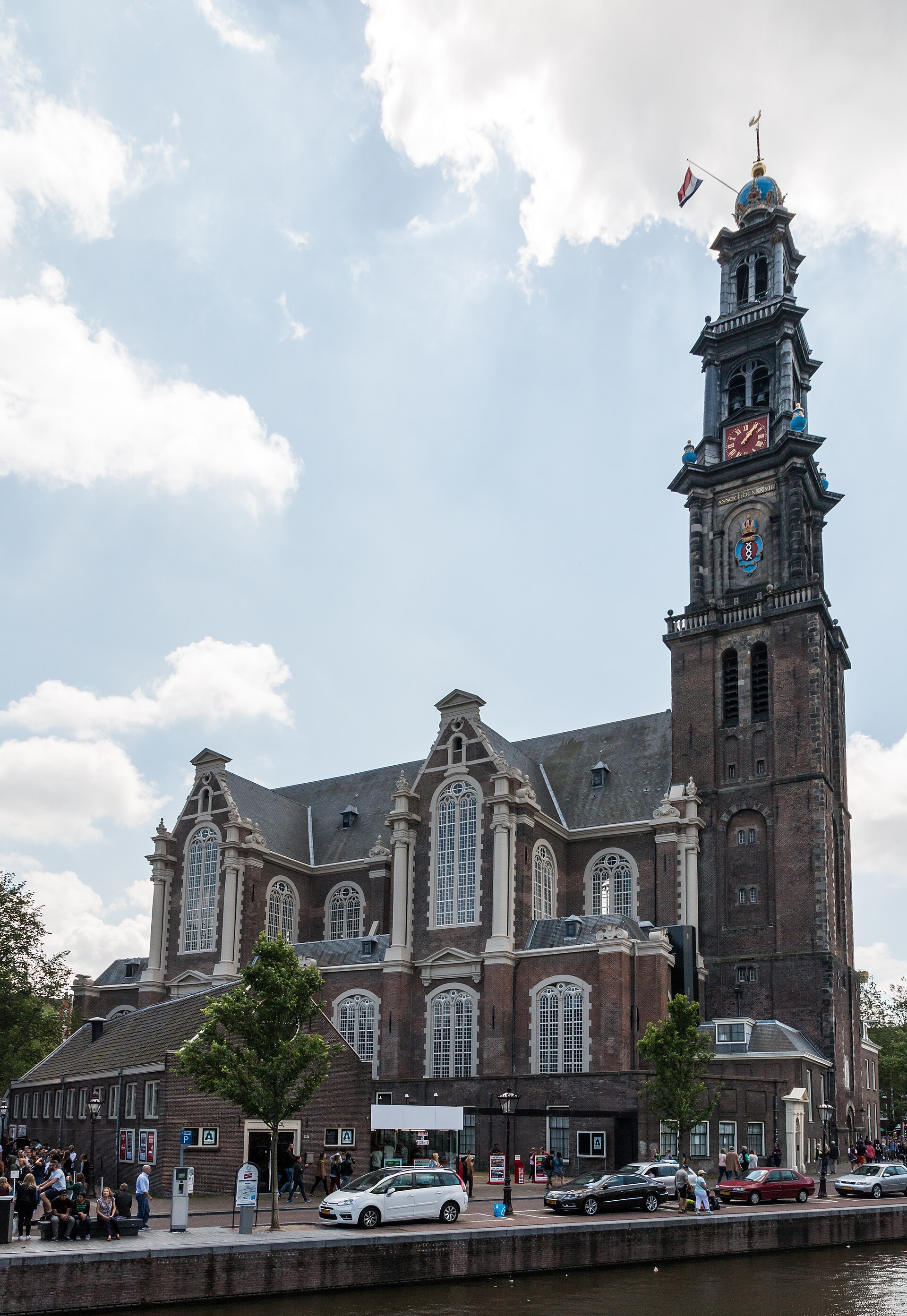
The Westerkerk is a prominent 17th-century Protestant church located in the Jordaan district of Amsterdam. Designed by architect Hendrick de Keyser and constructed between 1620 and 1631, it is a hallmark of Dutch Renaissance architecture. The building is best known for its iconic 85-meter-high tower, which is topped by the imperial crown of Maximilian I, a symbol granted to the city by the Holy Roman Emperor.
The interior of the church is characterized by its spacious, light-filled nave and a large 17th-century organ. Beyond its architectural significance, the Westerkerk holds deep historical importance as the final resting place of the painter Rembrandt van Rijn, who was buried in an unmarked grave within the church in 1669. The site is also closely associated with Anne Frank, whose diary frequently mentions the sound of the church's bells, which she could hear from her hiding place in the nearby Prinsengracht.
Key Facts
- Materials
- Brick, Sandstone, Wood
- Civilization
- Dutch
- Accessibility
- Wheelchair accessible via side entrance
- Date(s)
- 1620-1631
- Condition
- Active church and cultural venue
- Original Function
- Protestant Church
- Key Figures
- Hendrick de Keyser, Rembrandt van Rijn, Anne Frank
Design and Construction
1620-1631Following the Reformation, the city of Amsterdam required larger spaces for Protestant worship. Hendrick de Keyser was commissioned to design the Westerkerk, though he died before its completion; the project was finished by his son, Pieter de Keyser, and Cornelis Danckerts.
The Dutch Golden Age
17th CenturyThe church became a focal point for the wealthy merchant class of the Jordaan district. Its prominent location and the addition of the imperial crown to the spire served as a testament to Amsterdam's growing status as a global trade hub.
Rembrandt's Burial
1669Rembrandt van Rijn, who lived nearby on the Rozengracht, was interred in the Westerkerk on October 8, 1669. While the exact location of his grave remains unknown, a plaque commemorates his burial within the church.
Modern Era
20th Century - PresentThe church gained international recognition through the diary of Anne Frank, who lived in the nearby Secret Annex. Today, the church remains an active place of worship while serving as a major cultural landmark and tourist destination.
Cultural Significance
The Westerkerk is a central element of Amsterdam's skyline and a symbol of the city's religious and cultural history. Its association with Rembrandt and Anne Frank links the building to both the artistic peak of the Dutch Golden Age and the somber history of the Second World War, making it a site of dual remembrance.
Interpretive Notes
Scholarly debates and areas of uncertainty
There is ongoing discussion regarding the exact location of Rembrandt's remains within the church, as records from the 17th century are incomplete and the church floor has undergone multiple renovations over the centuries.
Visiting Information
Entry Rules
Open to the public for visits and tower climbs. Check official website for seasonal opening hours and service schedules. Modest attire is requested.
Best Times to Visit
Weekday mornings to avoid large tour groups. The tower climb offers the best views of the city center.
Photography
Photography is permitted for personal use. Tripods and flash are prohibited during services.
Preservation Notes
The structure is subject to ongoing maintenance due to its age and the soft soil conditions of Amsterdam. Visitors are asked to respect the quiet nature of the space.
Nearby POIs
11 shownSources & Further Reading
- [1]Hendrick de Keyser: Architect of Amsterdam — Gary Schwartz. Amsterdam University Press (2017)
- [2]Rembrandt: The Painter at Work — Ernst van de Wetering. Amsterdam University Press (2009)
Key Facts
- Materials
- Brick, Sandstone, Wood
- Civilization
- Dutch
- Accessibility
- Wheelchair accessible via side entrance
- Date(s)
- 1620-1631
- Condition
- Active church and cultural venue
- Original Function
- Protestant Church
- Key Figures
- Hendrick de Keyser, Rembrandt van Rijn, Anne Frank